Breaking
Latest health news from South Africa and around the world•Wellness, nutrition, and fitness updates daily•Medical breakthroughs and healthcare updates•Science-backed health explainers and guides•Health tech, reviews, and upcoming events•
 SA Health News Desk
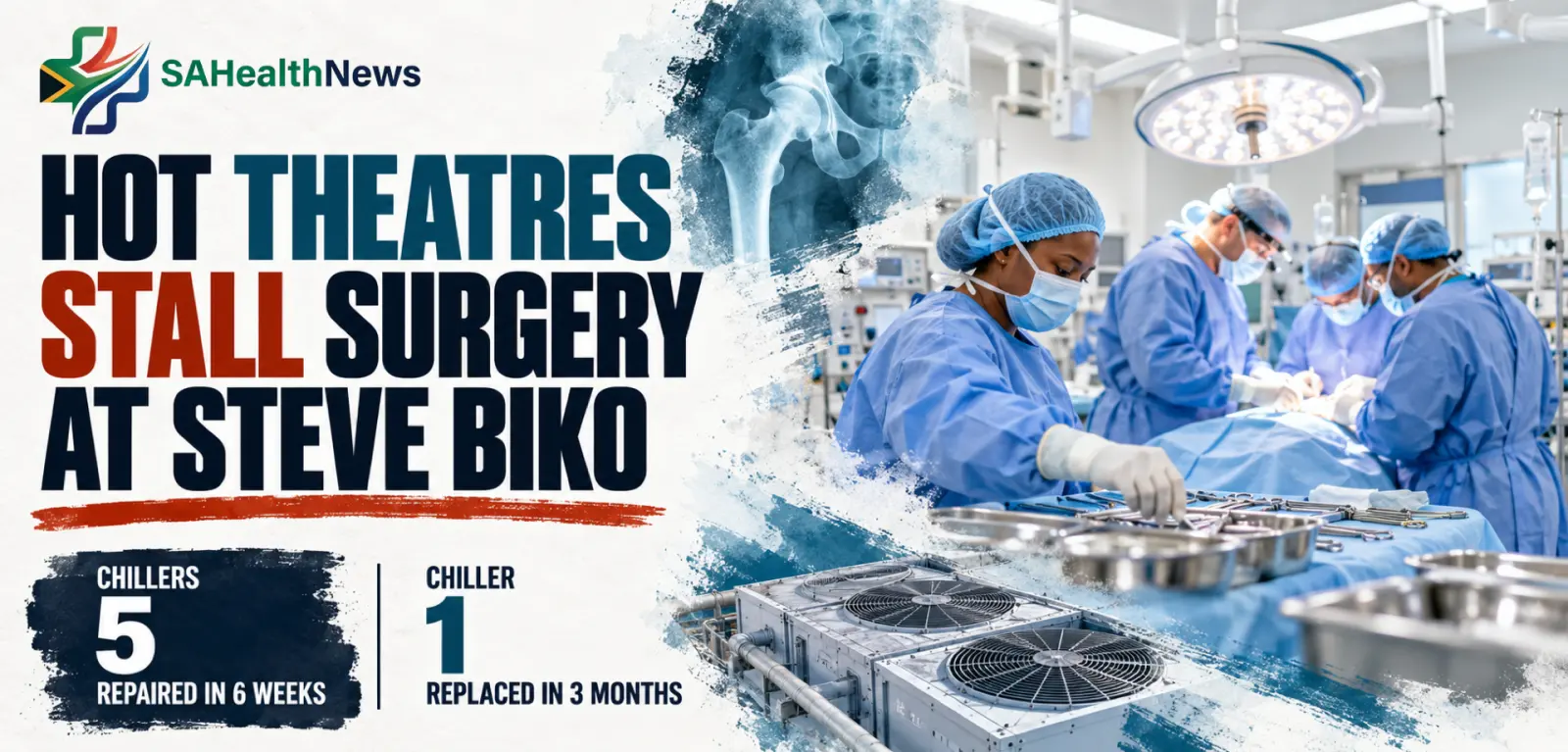
Steve Biko Academic Hospital has delayed long orthopaedic operations as its theatres overheat; Gauteng says chiller repairs will take up to three months.
Patients waiting for hip, knee and fracture operations at Steve Biko Academic Hospital in Pretoria have had their surgery put off because the hospital's operating theatres are too warm for long procedures. The Gauteng Department of Health says it will repair five of the hospital's air-conditioning chillers over the next six weeks and replace a sixth within three months.
Department spokesperson Steve Mabona said the hospital has kept doing emergency operations and selected elective procedures. "However, the higher-than-normal temperatures experienced during the current summer period have resulted in theatre temperatures that are not suitable for some long and complex surgical procedures," he said.
The patients on the waiting list include people who need reconstructive and trauma surgery, joint replacements and upper-limb operations. The department says patients are prioritised by medical need and that some are being sent to other public hospitals where appropriate. It has not said how many people are waiting or when full theatre lists will resume. "Selected elective procedures" is the department's phrase for the work that continues. It has not published which operations still go ahead and which are the ones the heat has stopped.
"The department acknowledges the concerns and impact that these infrastructure challenges have had on patients," Mabona said, adding that it would give updates as the repair work reaches milestones. The milestones he named are the six-week repair of five chillers and the three-month replacement of the sixth. He did not give a date on which the longest operations would be booked again.
The same repair timetable was reported by IOL on 28 October, The Star on 29 October and The Citizen on 30 October. The plan has not changed across those three days: five chillers repaired over six weeks, one replaced within three months.
The DA's Gauteng health spokesperson, Madeleine Hicklin, says theatre temperatures have risen well above 20°C, against the roughly 18°C the party says is needed to limit infection and keep long operations safe. The risk of airborne infection matters most in bone surgery, where an infected implant can mean further operations. Those temperatures are the party's account, not a reading the department has published. Mabona's statement talks about temperatures that are "not suitable" for long and complex procedures. It does not give a degree figure.
According to the DA, orthopaedic patients have been told their operations are on hold until the fault is fixed. Shorter procedures continue, but complex fracture repairs and hip and knee replacements have been suspended. The party says it has received many complaints from patients admitted with broken hips over the past six weeks. A broken hip that waits is the case the complaints are about. The department's answer is the chiller timetable, plus the offer to move some patients to other public hospitals. It has not named those hospitals.
The Star spoke to two families, using pseudonyms. One man said his mother, admitted in April with a broken hip, waited five weeks for surgery and developed bedsores and other complications during that time. She later died. Another family said a 76-year-old diabetic relative had her operation scheduled and cancelled about eight times over three weeks, going without food each time before surgery that did not happen. Cancellations were blamed on theatre temperatures and a shortage of intensive care beds.
The department did not respond to the specific claims about the patients' care. The two accounts are what the families told The Star. They are not figures from the hospital's waiting list, which the department has not released. The April admission and the five-week wait, and the eight cancellations over three weeks, sit in that reporting. The department's public comment stays at the level of the chillers and the acknowledgement that patients have been affected.
A shortage of intensive care beds is the second reason the second family was given. The chiller plan does not add ICU beds. Even after the theatres cool, a case that needs intensive care still depends on a bed the department has not said is free.
The theatres' cooling has failed before. Pretoria News reported in October 2022 that non-urgent surgery had resumed after faulty chillers forced postponements. In February this year, the DA's Jack Bloom, then the party's Gauteng health spokesperson, said scores of operations had been cancelled or deferred after another failure, and The Star reports that the department linked delays at the time to a ventilation system installed in 2006.
Hicklin called the repeated breakdowns "unacceptable" and said they "expose the department's failure to learn from past crises". The 2022 postponements, the February cancellations and this summer's heat are three dated reports of the same theatres losing cooling. The department's current plan is a repair, not a statement that the 2006 ventilation system is being replaced as a whole. Five chillers are to be repaired. One is to be replaced.
The department's plan puts the last chiller replacement around the end of January. Until then, the hospital's longest orthopaedic operations depend on how hot Pretoria's summer gets. Emergency operations continue, Mabona said, and so do selected elective procedures. Hip and knee replacements and complex fracture repairs are the work the DA says has been suspended. The department has not contradicted that list, and it has not confirmed it with its own numbers.
What is still missing is the size of the list. No outlet in this reporting has a figure for how many people are waiting, how many have been moved to another hospital, or which day the long lists start again. The next public mark the department has offered is an update when a repair milestone is reached. The first of those, on the timetable it gave, falls inside six weeks of the late-October statements.
Source: SA Health News