Breaking
Latest health news from South Africa and around the world•Wellness, nutrition, and fitness updates daily•Medical breakthroughs and healthcare updates•Science-backed health explainers and guides•Health tech, reviews, and upcoming events•
 SA Health News Desk
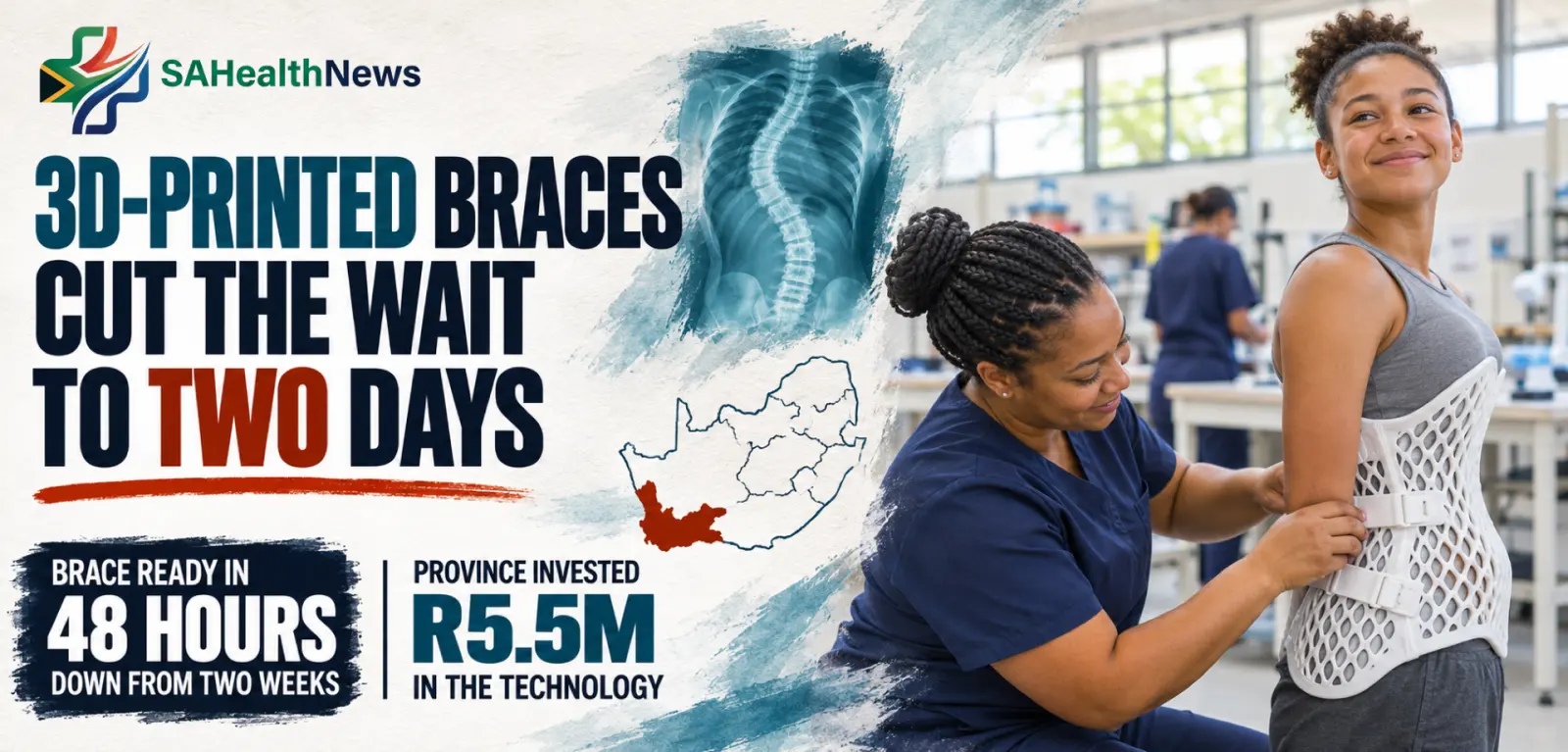
The Western Cape's only public orthotic centre now scans and 3D-prints spinal braces in 48 hours, at under half the cost of plaster. Six patients so far.
Public patients in the Western Cape who need a spinal brace can now have one scanned, printed and fitted within 48 hours. The provincial Department of Health and Wellness launched a 3D scanning and printing service at its Orthotic and Prosthetic Centre (OPC) in Pinelands, Cape Town, on 5 November, International Prosthetics and Orthotics Day.
Until now the centre made spinal braces from plaster of Paris casts, and a new brace took about two weeks. The department says the printed version takes two days and costs less than half as much to make.
Six patients have been fitted so far. The department spent about R5.5 million on the scanners, printers and related machinery in April.
Patients are referred by a specialist or medical officer and seen by appointment. They stand in light clothing while a 3D scanner captures the shape of the torso, which takes a few minutes. A clinician then adjusts the digital model, and the brace is printed from that file.
The department says the printed braces are lighter and fit more precisely than plaster ones. The service is meant for people with scoliosis, spinal injuries, pectus carinatum (pigeon chest), tuberculosis of the spine, compression fractures and spondylosis.
One of the first recipients is a 14-year-old girl with scoliosis who has worn braces for four years. Because she is still growing, the centre will keep adjusting and replacing her brace until she turns 18. Quoted by The Citizen, she said her earlier braces "were always the heavier plaster of Paris braces. This is much lighter."
The OPC is the only orthotic and prosthetic centre in the Western Cape's public health system. It serves patients from every district except the Garden Route, formerly Eden, where the department uses a private facility. Its staff also run 112 outreach services at satellite sites around the province.
So the turnaround matters. A child whose spine is still curving, or an adult recovering from a spinal fracture, goes without support for as long as the brace is being made.
"These braces help to reduce pain, support recovery, and prevent further complications," said Mireille Wenger, the provincial minister of health and wellness. She said the department was "using innovation to help patients get the care they need, sooner."
Bongani Mlambo, the OPC's facility manager, said: "We are not just launching a printer, we are launching a new way of working." He described the service as a first on the African continent. SA Health News could not independently confirm that claim.
The department has not said how many braces the centre expects to print in a year, how long patients currently wait for an appointment, or whether the scanners will travel to the outreach sites. Six patients is a small start, and the two-day figure is the department's own. No independent data on fit, comfort or clinical results has been published yet.
It has also not said whether the same equipment will be used for the centre's other devices.
Patients cannot book directly. Anyone who thinks they or their child may need a spinal brace should ask their clinic or hospital doctor for a referral to the Orthotic and Prosthetic Centre.
Until 5 November the Orthotic and Prosthetic Centre in Pinelands made spinal braces from plaster of Paris casts, and a new brace took about two weeks. The Western Cape Department of Health and Wellness says the printed brace takes two days and costs less than half as much to make. The launch date was International Prosthetics and Orthotics Day. The department spent about R5.5 million on the scanners, printers and related machinery in April. Six patients have been fitted so far.
A patient does not book the printer. Referral comes from a specialist or a medical officer, and the visit is by appointment. The person stands in light clothing. A 3D scanner captures the shape of the torso in a few minutes. A clinician adjusts the digital model. The brace is printed from that file. The department says the printed braces are lighter and fit more precisely than the plaster ones.
The conditions the service is meant for are scoliosis, spinal injuries, pectus carinatum (pigeon chest), tuberculosis of the spine, compression fractures and spondylosis. One of the first recipients is a 14-year-old girl with scoliosis who has worn braces for four years. She is still growing, so the centre will keep adjusting and replacing her brace until she turns 18. Quoted by The Citizen, she said her earlier braces "were always the heavier plaster of Paris braces. This is much lighter."
The OPC is the only orthotic and prosthetic centre in the Western Cape's public health system. It serves patients from every district except the Garden Route, formerly Eden, where the department uses a private facility. Staff also run 112 outreach services at satellite sites around the province. A child whose spine is still curving, or an adult recovering from a spinal fracture, is without that support for as long as the brace is being made. That is the wait the two-day claim is aimed at.
"These braces help to reduce pain, support recovery, and prevent further complications," said Mireille Wenger, the provincial minister of health and wellness. She said the department was "using innovation to help patients get the care they need, sooner." Bongani Mlambo, the OPC's facility manager, said: "We are not just launching a printer, we are launching a new way of working." He described the service as a first on the African continent. That claim is his. It has not been independently confirmed.
The department has not said how many braces the centre expects to print in a year, how long patients currently wait for an appointment, or whether the scanners will travel to the 112 outreach sites. Six patients is a small start. The two-day figure is the department's own. No independent data on fit, comfort or clinical results has been published. The department has also not said whether the same equipment will be used for the centre's other devices.
Anyone who thinks they or their child may need a spinal brace still has to ask a clinic or hospital doctor for a referral to the Orthotic and Prosthetic Centre. There is no direct booking.
Source: SA Health News