
Breaking
Latest health news from South Africa and around the world•Wellness, nutrition, and fitness updates daily•Medical breakthroughs and healthcare updates•Science-backed health explainers and guides•Health tech, reviews, and upcoming events•
 SA Health News Desk
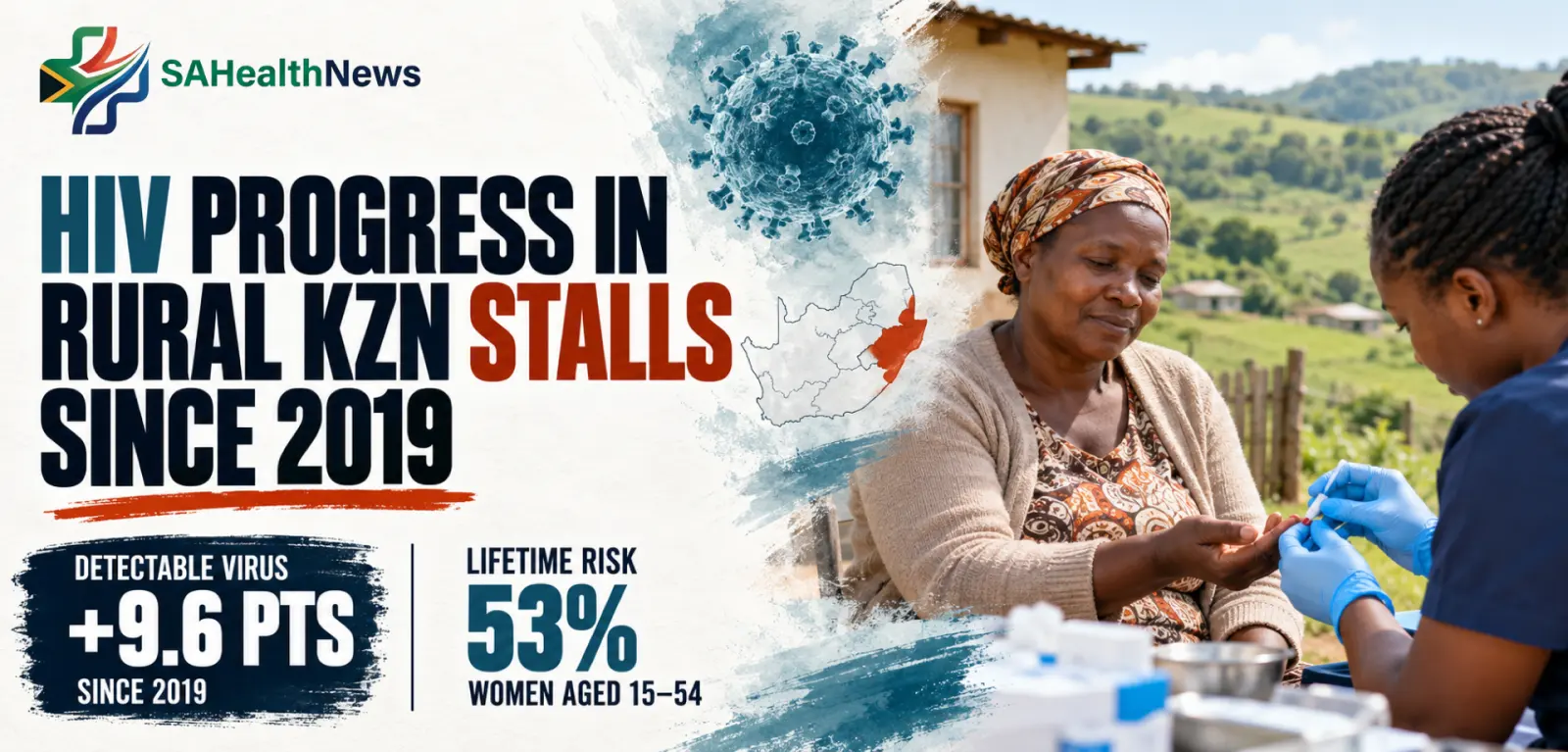
New HIV infections in rural KwaZulu-Natal stopped falling after 2019 and unsuppressed virus rose, a two-decade AHRI study in The Lancet HIV finds.
After years of steep falls in new HIV infections, progress in rural KwaZulu-Natal has stopped since 2019 and on one measure has gone backwards, according to a study that has followed the same community for more than two decades.
The study, published in The Lancet HIV on 7 October, was led by researchers at the Africa Health Research Institute (AHRI) in Durban and Stellenbosch University's South African Centre for Epidemiological Modelling and Analysis (SACEMA) and Centre for Epidemic Response and Innovation (CERI). It uses data from AHRI's health and demographic surveillance system in rural KwaZulu-Natal, which has tested residents for HIV since 2003. The Lancet page itself blocked a direct fetch, so the figures below come from AHRI's release of 9 October and from MedicalBrief's summary of the paper.
New infections fell sharply for years. Overall incidence dropped from 3.32 new infections per 100 person-years in 2010 to 1.49 in 2024–25, a fall of 55%. The steepest decline came between 2013 and 2018, when annual incidence fell by 52.2% in men and 36.9% in women.
Over the same years more people were on effective treatment. Between 2011 and 2018 the share of people with a detectable viral load, meaning the virus was not suppressed, fell by 44.5% in men and 50.5% in women.
From 2019 that changed. Between 2019 and 2025 the researchers found no evidence that incidence kept falling in either women or men, and the share of people with detectable virus rose by 9.6 percentage points. MedicalBrief reported the confidence interval on that rise as 5.4 to 13.8 percentage points. Viral suppression remains 30.7 percentage points short of the UNAIDS 95–95–95 target, with a reported interval of 27.2 to 34.3 points. The gap is not a rounding error around the target. On the authors' numbers, suppression is still about 30 points short, and the share of people with detectable virus has risen since 2019.
Of 91,367 people aged 15 to 54 who were contacted, 59,806 agreed to take part at least once. MedicalBrief put that consent rate at 65.4%. Of 42,662 people who first tested HIV-negative and were later contacted again, 29,702 were retested. Across more than 182,000 person-years of follow-up the team recorded 4,852 new infections, and it ran 11 rounds of population viral load testing between 2011 and 2025.
The authors stress that the cohort is not nationally representative. It covers one rural population, so the findings show a trend worth watching rather than a national rate. A stall in this community is not, on the paper's own terms, a stall for South Africa. It is evidence from the place the researchers have actually measured, continuously, since the early years of the treatment scale-up.
The ratio of new infections to people already living with HIV, a measure of whether an epidemic is under control, fell from 0.132 in 2006 to 0.034 in 2022, a drop of 74.2%. Since 2022 it has stayed above the 0.03 benchmark for epidemic control. The long decline is real on these figures. So is the fact that the ratio did not cross, and stay under, the line the authors treat as control.
The picture differs by age. Incidence is still falling among people under 35, but it has stalled or risen among adults aged 35 to 54. Programmes built around younger adults will not, on this split, describe what is happening to people in middle age in the same community.
On 2019–2025 patterns, the researchers estimate that a woman in the area has a 53% lifetime risk of acquiring HIV between the ages of 15 and 54, and a man a 32% risk. The estimate does not account for deaths from other causes. It is a projection from recent patterns in this cohort, not a count of infections that have already happened to those women and men.
The authors suggest three explanations: the early gains from mass antiretroviral treatment may have run their course, COVID-19 disruptions may have widened gaps in treatment and viral suppression, and an ageing epidemic leaves older adults less likely to see themselves at risk and less well served by prevention programmes. These are possible reasons, not findings the study tested. The data show the stall. They do not show which of the three accounts, if any, produced it.
"South Africa has made extraordinary progress against HIV over the past two decades."
"These data show what sustained investment in treatment and prevention can achieve."
Prof Frank Tanser, the study's senior author, said both of those lines. Lead author Dr Elphas Okango said the results "should be a call to action". AHRI's director of science and study co-author, Dr Kobus Herbst, said following the same population for more than 20 years shows "where we are making progress, where we are losing momentum". The progress is the 55% fall in incidence and the 74% fall in the incidence-to-prevalence ratio. The loss of momentum is everything the paper dates to 2019 and after.
The researchers call for prevention tailored to different risk groups and reaching older ages, stronger support for starting and staying on treatment, more flexible patient-centred services, and wider use of long-acting medicines for HIV prevention and treatment. They also say planning should look beyond the UNAIDS 2030 targets. The age split is the part a provincial programme can read without waiting for a national rate: incidence still falling under 35, stalled or rising from 35 to 54, in the one rural population this study measured.
The study was funded by the US National Institute of Mental Health.
Sources: AHRI release, 9 October 2026; MedicalBrief, 21 October 2026; The Lancet HIV, 7 October 2026 (Okango and colleagues). Figures are from the release and MedicalBrief's summary. The Lancet page returned a 403 to the desk's fetcher.
Source: SA Health News