Breaking
Latest health news from South Africa and around the world•Wellness, nutrition, and fitness updates daily•Medical breakthroughs and healthcare updates•Science-backed health explainers and guides•Health tech, reviews, and upcoming events•
 SA Health News Desk
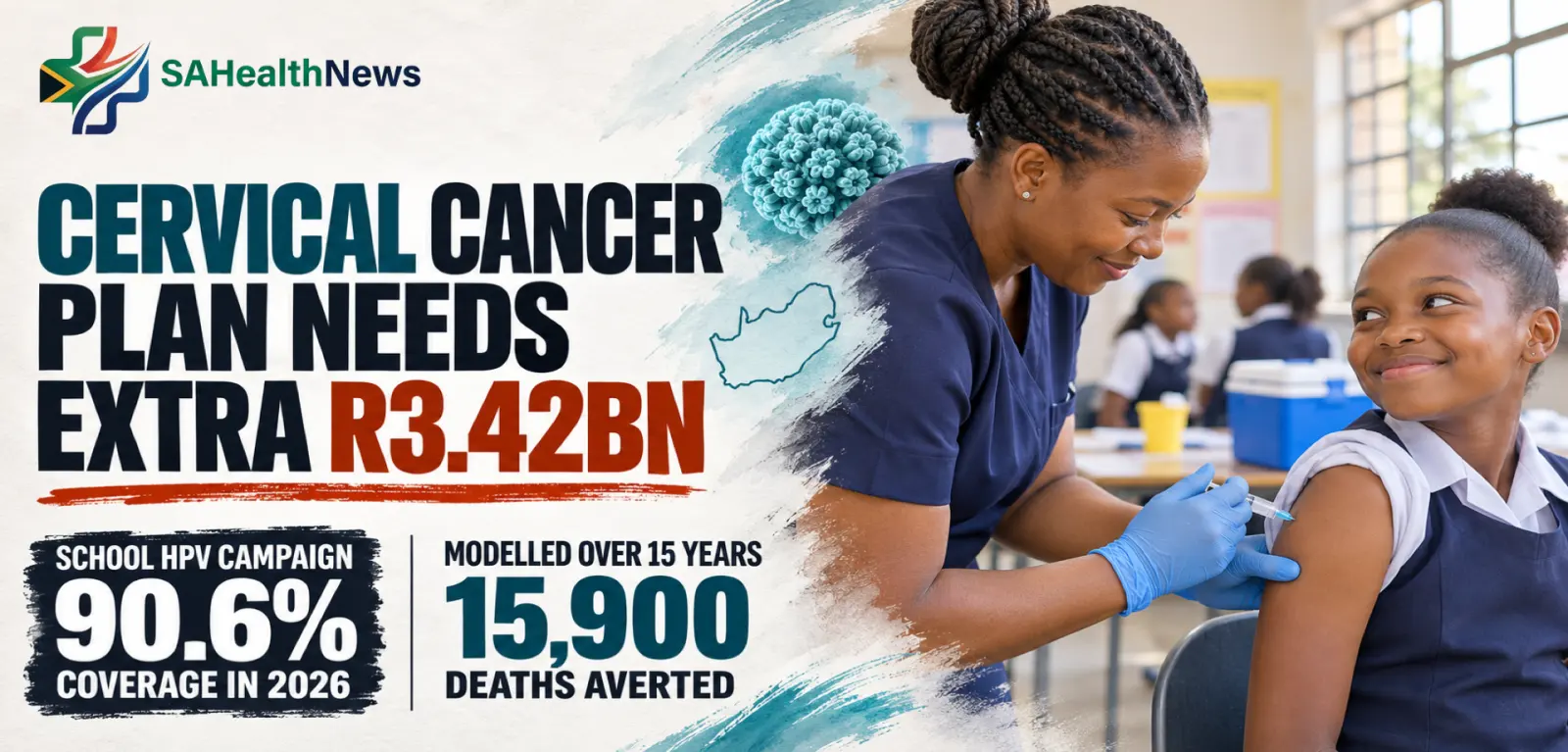
South Africa has moved to one HPV vaccine dose and says reaching its 2030 cervical cancer targets will need an extra R3.42bn over three years.
South Africa has moved schoolgirls onto a single dose of the HPV vaccine, and the Department of Health has put a price on reaching its 2030 cervical cancer targets: an extra R3.42 billion over the three financial years from 2027/28 to 2029/30.
The department gave the figures on Tuesday, 17 November, World Cervical Cancer Elimination Day, in a statement on its Cervical Cancer Elimination Strategy 2026–2030. The strategy is the national plan for the World Health Organization's 90-70-90 targets, the route the WHO has set for ending cervical cancer as a public health problem. The statement is a plan and a bill. It is not a budget vote, and it does not say the extra money has been set aside.
The three targets are plain, and each one fails if the next one is missing. Ninety percent of girls should be vaccinated against HPV by the age of 15. Seventy percent of women should be screened with a high-performance test at 35 and again at 45. Ninety percent of women found to have cervical disease should get the right treatment.
A vaccination figure on its own does not meet the strategy. A woman who was missed at school, or who was vaccinated and never screened, or who was screened and then lost between a positive result and treatment, is still inside the problem the 2030 date is meant to close. The department's own cost split says where the system spends today: about R3.1 billion a year for the full package of prevention and care, and about 77 percent of that on treating invasive cancer, the stage prevention is supposed to avoid.
The school HPV vaccination programme began in 2014. In line with updated WHO recommendations, South Africa has switched from a two-dose schedule to a single dose. The department expects that to make the programme more efficient and to lift coverage. The statement does not say when the change took effect. A parent asking whether a girl vaccinated last year is on the old schedule or the new one will not find the date in this announcement.
This year's school campaign reached about 428,395 girls in Grades 5 to 7, a coverage of 90.6 percent. Six provinces vaccinated more than 90 percent of eligible girls. The statement does not name the three that did not. National coverage can clear 90 percent while a province, or a set of schools inside a province, sits under it. The 90.6 percent is a campaign result for girls who are in those grades and were reached. It is not yet the WHO target, which is 90 percent of girls vaccinated by 15, across the years, not one campaign.
The department has also opened the programme to nine-year-old girls at private schools. It says it is working to reach girls missed in earlier campaigns, and it plans to take the vaccine to girls who are not in school. Those two groups are the ones a school campaign cannot count. The statement names the intention. It does not give a number for girls outside school, or a date for the private-school extension beyond the announcement itself.
Women living with HIV face a higher risk of cervical cancer. The department said it would keep assessing prevention and care for higher-risk groups. It did not, in this statement, set out a separate schedule for them.
HPV DNA testing is being extended to all provinces. With the Clinton Health Access Initiative and Unitaid, the department is scaling up thermal ablation, which destroys precancerous cells with heat, and it is joining screening more closely to treatment so that fewer women drop out between a positive result and care.
In September the department secured 201 thermal ablation devices and 24 machines for LLETZ, large loop excision of the transformation zone, the procedure that removes abnormal tissue from the cervix. It said the machines are aimed particularly at underserved areas. Online training for health officials started in October. Equipment in September and training in October is a supply line, not yet a count of women treated with the new machines.
Two pilot sites that screen and treat women in one service are screening more women than a year ago. From April to September 2026, Ceza Hospital in KwaZulu-Natal screened 1,086 women, up from 869 in the same months of 2025. Mofolo Community Health Centre in Gauteng screened 1,266, up from 431. Those are two sites, and they are screening counts, not treatment counts. The jump at Mofolo, from 431 to 1,266, shows what a single-visit service can do to the number of women seen. It does not yet show how many of those women needed treatment, or how many received it.
Reaching 90-70-90 on an accelerated timeline would need an additional R3.42 billion between 2027/28 and 2029/30. Compared with keeping coverage where it is, the department's modelling suggests that about 19,500 cases and 15,900 deaths could be averted over 15 years. These are projections from a model, not results, and not a promise about any one woman.
The statement does not say whether the extra R3.42 billion has been budgeted. An unfunded acceleration is a different plan from a funded one. The R3.1 billion a year already described, with most of it on invasive cancer, is the cost of the disease the strategy is trying to prevent. The R3.42 billion is the extra cost of trying. Until a budget says the extra is there, the strategy is a case for the money, not the money.
The department called for a whole-of-society response. It asked South Africans to support HPV vaccination, to go for regular screening, and to help women get timely care. That ask sits next to the gaps the statement itself leaves open: no date for the single-dose switch, no names for the provinces under 90 percent, no figure for girls who are not in school, and no confirmation that the three-year top-up is in the budget.
None of this replaces advice from the clinic, a pharmacist or a doctor. Whether a girl is due a dose, and whether a woman is due a screen, depends on a record this announcement does not have.
Source: SA Health News