Breaking
Latest health news from South Africa and around the world•Wellness, nutrition, and fitness updates daily•Medical breakthroughs and healthcare updates•Science-backed health explainers and guides•Health tech, reviews, and upcoming events•
 SA Health News Desk
The list of medicines at risk of running out has doubled since May. Thirty shipments sit at Durban port, and suppliers have cut off three provinces.
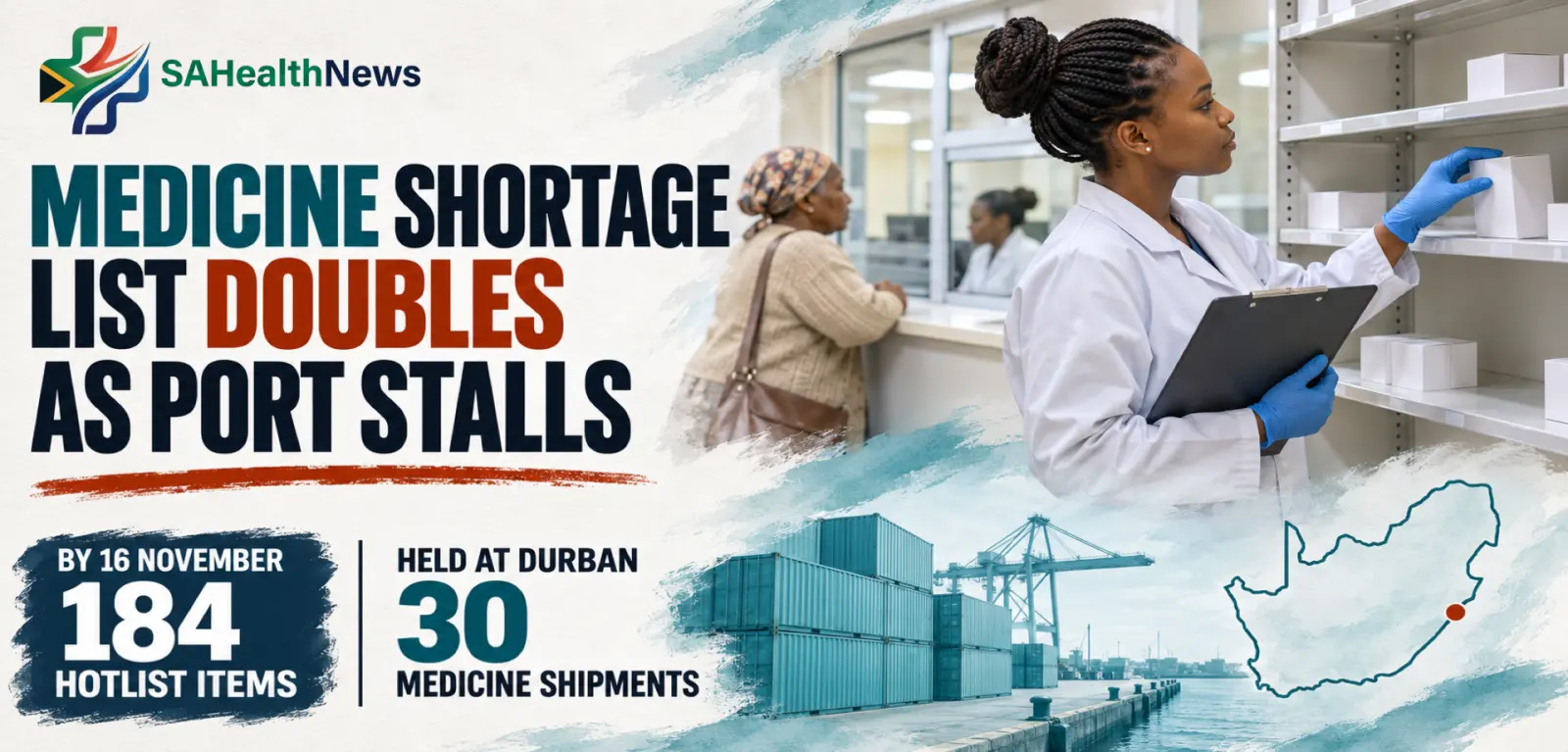
The health department's list of medicines at risk of running out has more than doubled since May, reaching 184 items by 16 November. Director-General Dr Thembisile Xulu put the figure to the Portfolio Committee on Health on Wednesday 18 November. The public account of that briefing was published the next day. The committee's own record of the meeting is not public. About a third of the items, 67, have been on the list for more than three months.
The meeting was about the antiretroviral tender, a court ruling against parts of it, and medicine stock-outs. The shortage is getting worse, not easing. The department's October list ran to 165 items.
One account dated the 184 items to October. That does not fit the October list of 165. The 16 November date, from the director-general's briefing, is the one that lines up with the count already on record.
Health Minister Dr Aaron Motsoaledi has asked Transport Minister Barbara Creecy to speed up the release of 30 shipments of medicines held at Durban's congested container terminal. Officials gave Transnet a list of the most critical shipments on Monday. Xulu told MPs that Transnet could not release all 30 at once.
Transnet announced urgent measures on Wednesday evening to cut backlogs at the Durban terminal, putting urgent cargo, pharmaceuticals among it, at the front of the queue. Motsoaledi has also blamed a new computer system at the port for part of the delay.
The held stock includes antibiotics and medicines for high cholesterol, high blood pressure and stomach ulcers, according to the department's own list. A person waiting on a blood-pressure tablet, or a parent sent home without an antibiotic, is not a footnote to a port statistic. South Africa relies on imported active ingredients, mainly from India and China, for the medicines it makes locally. A queue of containers in Durban is, for those medicines, the supply line.
Suppliers have stopped delivering to the Eastern Cape, Northern Cape and North West health departments over unpaid invoices. Speaking to Newzroom Afrika, Motsoaledi said the national department had given the three provinces until the end of the week to pay. If they do not, he said, "I will then have to come at the political level, write letters to their premiers."
He also said that paying was not the whole answer, because provinces that had settled their bills were still short of some medicines. A receipt does not put a tablet on a clinic shelf if the shipment is still in a stack at the port, or if the plant that makes it has been told to stop.
The department has 96 contracted medicine suppliers, 11 of them for antiretrovirals. About 6.1 million people take antiretroviral treatment, and Motsoaledi said provinces must keep three months of stock in reserve. If a clinic runs short of antiretrovirals, he said, it would be a logistical problem rather than a lack of stock in the country. That distinction matters, and it is his claim. It does not tell a person at the dispensary window what to do this week.
Xulu told the committee that the South African Health Products Regulatory Authority (SAHPRA) inspected two pharmaceutical manufacturers in 2024, nine in 2025 and 16 so far this year. Sites that fail are closed in full or in part. Enforcement action at one contract manufacturer, Wrapsa, accounts for 42 items on the hotlist, and the company needs about three more months to ramp production back up, she said.
Forty-two of 184 is close to a quarter of the list, tied to a single plant. Xulu said that kind of enforcement could have unintended consequences where there are few other suppliers. Stavros Nicolaou, who chairs the industry's Pharmaceutical Task Group, said SAHPRA's updated requirements had moved faster than manufacturers could keep up, and called for a risk-based transition rather than an immediate halt to production.
Last week SAHPRA said compliance action was not necessarily the only cause of shortages. The department's own figures now put a large share of this particular list on one manufacturer's stoppage. Both statements can be true. Enforcement is not the only cause, and it is still the cause the department has numbered.
The department has said that a medicine on the hotlist "does not necessarily mean that all the listed medicines are already unavailable". The list is an early warning of stock falling below target, not a count of empty shelves. It put national availability at 83.4%, with hospitals at 79.9% and clinics at 85.7%.
An average can hide the one medicine a person needs. A clinic at 85.7% can still be out of a blood-pressure tablet, a cholesterol medicine or an antibiotic that is sitting in one of those 30 containers. The national figure is not a promise that your script will be filled.
The department listed the causes as provinces not paying suppliers, congestion at Durban, disruption to shipping through the Strait of Hormuz, interruptions at manufacturers and SAHPRA enforcement. It did not rank them, and it did not say which cause sits behind which of the 184 lines.
The department has sent circulars to provinces and facilities setting out which medicines can be swapped for alternatives. Motsoaledi gave the diuretic furosemide as an example, where smaller tablet strengths can be combined to make up a dose. Provinces may also buy from other suppliers when a contracted company cannot deliver. "When a company cannot supply, we are allowed by law to look elsewhere. And that's what the provinces have been allowed to do," he said.
A swap is not something to guess at the pharmacy counter. Anyone given a different medicine, a different strength or a different number of tablets should ask the pharmacist or nurse to explain the change before taking it. Do not stop a prescribed medicine, or start one bought elsewhere, because a clinic is out of stock. If the clinic has none, ask whether there is a suitable alternative, whether stock can be fetched from another facility, and when to come back.
None of this replaces advice from the clinic, a pharmacist or a doctor.
Source: SA Health News