Breaking
Latest health news from South Africa and around the world•Wellness, nutrition, and fitness updates daily•Medical breakthroughs and healthcare updates•Science-backed health explainers and guides•Health tech, reviews, and upcoming events•
 SA Health News Desk
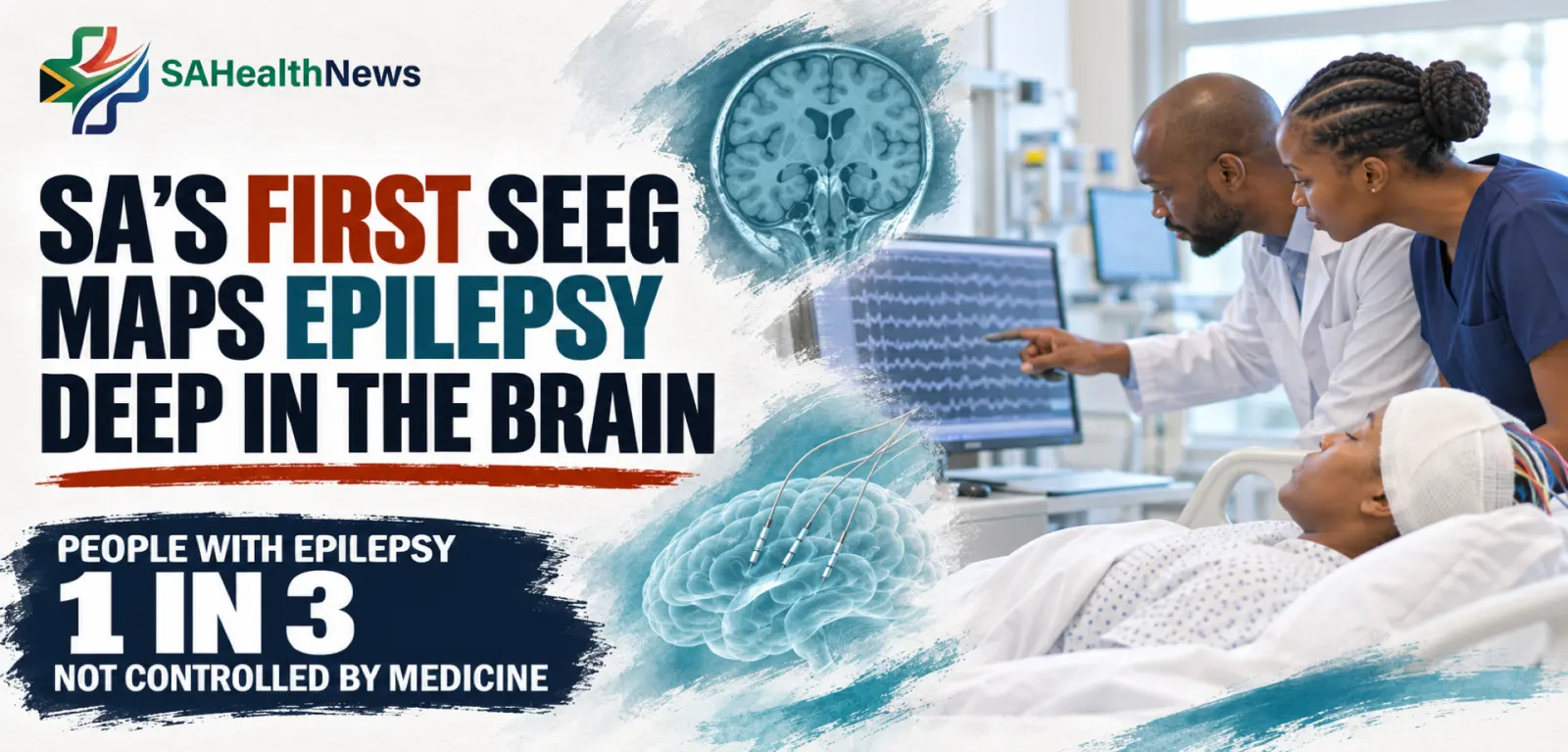
A Cape Town team has set up SA's first SEEG service, placing fine electrodes deep in the brain to find where seizures start in people medicine cannot help.
A team at Mediclinic Constantiaberg in Cape Town has set up South Africa's first stereo-electroencephalography service, a way of mapping where seizures start by placing fine recording electrodes deep inside the brain. It is also the first such service in sub-Saharan Africa.
The first procedure was scheduled for Monday, 16 November. MedicalBrief reported on 18 November that it had gone ahead. The hospital itself has not, in what has been published, confirmed that the procedure took place. Until now, South Africans who needed this mapping had to travel abroad for it, which put it out of reach for almost everyone who might have been a candidate.
That gap is the story. The technique is not new in countries that already do epilepsy surgery. What is new is that a South African team says it can now do the mapping here, in one private hospital in Cape Town, after more than a year of setting the service up.
About one in three people with epilepsy do not get their seizures under control with medicine. For some of them, surgery to remove or disconnect the small area of brain where seizures begin can stop the attacks. Surgeons first have to find that area precisely. Standard scalp EEG and brain scans do not always show it.
The first patient is a 43-year-old man whose seizures began a little over a year ago, according to reports in the Cape Times and The Post. Several anti-seizure medicines have failed to control them. The seizures have disrupted his work and family life, and he can no longer drive.
"This is exactly the kind of patient SEEG was designed for," said Dr Aayesha Soni, the epileptologist who leads the programme.
Failed medicines and a life that has narrowed are the reason a team looks past the scalp. They are not, by themselves, a reason to operate. The mapping has to show a place that can be treated, and a place that can be treated without taking something the person cannot afford to lose. Nothing published so far says what this patient's recordings showed, because the first procedure, if it has happened, is the start of the recording, not the end of it.
Electrode paths are planned in advance on detailed brain scans so that they avoid blood vessels and vital structures. A stereotactic frame fixed to the head guides each electrode through a small hole in the skull, so the skull is not opened. The electrodes then record brain activity while the patient has seizures. Soni described that recording as giving a three-dimensional picture of a person's epilepsy.
The electrodes are removed afterwards without a second operation. If the recordings pinpoint where the seizures start, the team can decide whether surgery is an option. If they do not, the mapping has still been an operation of a kind, and the person goes back to medicines that have already failed.
The older alternative, placing electrodes on the brain's surface, needs an open operation on the skull. Mediclinic said earlier this year that stereo-electroencephalography can reach deeper parts of the brain than that approach. Deeper is not automatically better. It is the reason this method exists for seizures that start somewhere a surface grid cannot see.
Setting up the service took more than a year. Soni works with neurosurgeon Dr James Butler and neurophysiologist Dr Sean Tromp, alongside neuropsychologists, radiologists, anaesthetists, nurses and technical staff. The team secured funding approval from medical schemes for the procedure.
"Nobody does this alone," Soni said.
Soni completed a clinical epilepsy and EEG fellowship focused on epilepsy surgery at Western University in Canada, because South Africa has no epilepsy-specific fellowships. Apart from a recent procedure in Egypt, this form of mapping is not done anywhere else on the continent, MedicalBrief reported. A fellowship abroad is how the skill arrived. It is also a reminder that the next epileptologist who wants the same training still has to leave the country to get it.
The service is in a private hospital, and its first patient was funded through medical scheme approval. Nothing published so far says how a public-sector patient would be referred, who would pay, or whether a provincial hospital can send someone to Constantiaberg for the mapping and then take them back for the surgery, if surgery is even the result.
Soni said the next step is making sure the care is not limited to a few people. "People with epilepsy deserve the best care, wherever they live and whatever their means," she said.
That sentence is the open question, not a description of the service as it stands. One funded patient in a private hospital is a first. It is not a pathway. Epilepsy affects about 50 million people worldwide, and nearly 80% of them live in low- and middle-income countries. It is more common in sub-Saharan Africa than in Europe, Asia or North America. The team has not said how many South Africans it expects to map in a year, or what happens to someone whose scheme says no.
None of this replaces advice from the clinic, a pharmacist or a doctor. Someone whose seizures are not controlled should be talking to the clinician who already knows their medicine, not deciding from a news report that they are a candidate for electrodes. The hospital has not published who it will see, how a referral works, or what the first patient's recordings found.
Source: SA Health News