Breaking
Latest health news from South Africa and around the world•Wellness, nutrition, and fitness updates daily•Medical breakthroughs and healthcare updates•Science-backed health explainers and guides•Health tech, reviews, and upcoming events•
 SA Health News Desk
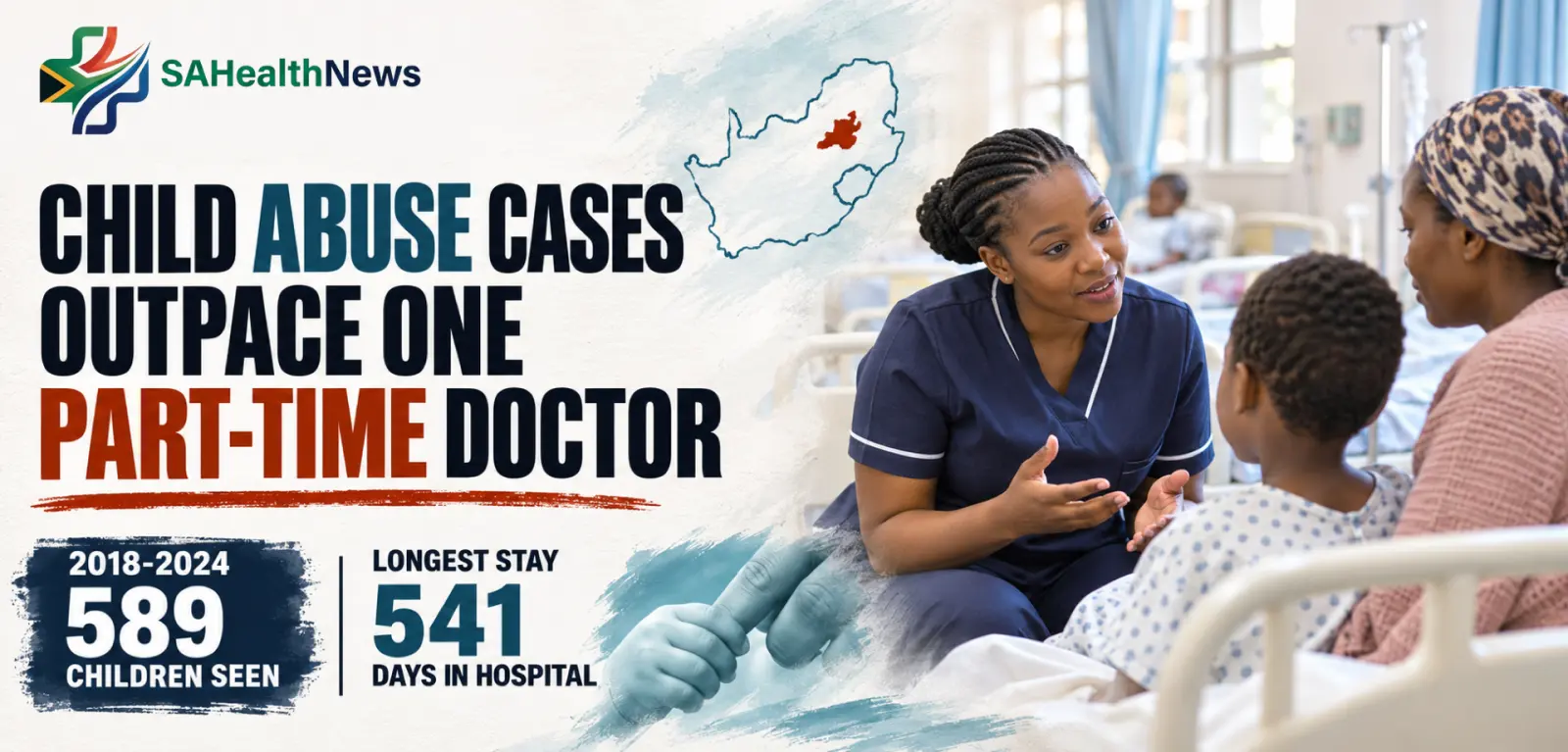
Chris Hani Baragwanath's child-abuse programme saw 589 children in seven years with one part-time doctor; one child stayed in hospital for 541 days.
A programme that identifies and follows up abused and neglected children at Chris Hani Baragwanath Academic Hospital managed 589 children between 2018 and 2024, and its caseload more than doubled while its staff stayed the same, according to a study in the November issue of the South African Medical Journal (SAMJ).
The Suspected Child Abuse and Neglect (SCAN) Programme saw 48 children in 2018 and 125 in 2024. Its staff is a part-time medical officer and a data capturer. It runs in the hospital's paediatrics department with the non-profit Surgeons for Little Lives, offers an inpatient consultation service and holds a dedicated clinic once a week at the 2,680-bed Soweto hospital.
The authors, from Wits University's departments of paediatrics and paediatric surgery and from the hospital, reviewed every child aged 14 or younger referred to the programme over seven years. They say there "remains a critical need" to turn it into a full-time, multidisciplinary service, because many children are still not being reached.
Forty-eight to 125 is the caseload on the same two-person staffing: one part-time doctor and one data capturer. The 589 is the seven-year total, not a single year's work. The clinic is one day a week inside a 2,680-bed hospital. The authors' point is that the numbers grew and the posts did not.
Just over half (53.65%) were girls, and the average age was 4.6 years. Physical abuse was the reason for 338 referrals (57.39%), deliberate neglect for 184 (31.24%), sexual abuse for 129 (21.91%) and emotional abuse for 20 (3.40%). Sixty-six children (11.21%) had more than one type.
The percentages can add up past 100 because 66 children were counted under more than one kind of abuse. The 338, 184, 129 and 20 are referrals by reason, not four separate groups of children that sum to 589.
Most of the children did not come to hospital because anyone suspected abuse. In 82.02% of cases the reason for the visit was something else, which the authors say shows how much depends on clinicians spotting the signs. The paediatric department made the largest share of referrals, 234 (39.73%).
The Children's Act requires health workers to report suspected abuse or deliberate neglect of a child, using Form 22. The programme reported 356 children (60.44%) to statutory social services. Of those who were not reported, 76 were already known to those services.
Police opened a case docket for 170 children (28.86%). Thirty-five (5.94%) were enrolled in court.
A report to social services, a police docket and a court enrolment are three different steps. Three hundred and fifty-six were reported. One hundred and seventy had a docket. Thirty-five reached court. The paper does not say that the 35 are a failure of the 356. It records how far each step got.
The median hospital stay was 23.5 days. Eighteen children (3.06%) stayed longer than 100 days, and one admission lasted 541 days.
Some long stays were for medical or surgical treatment. But the main cause, the authors write, was waiting for statutory social services to give feedback on discharge plans. They describe their working relationship with those services as generally positive, and say the efficiency of the child protection system "needs to be strengthened".
The 541 days is one admission, not a typical stay. The typical stay in the paper is the median, 23.5 days. Eighteen children were in hospital for more than 100 days. The authors' explanation for the long stays, in the main, is the wait for a discharge plan, not a claim that every one of those 18 was waiting on paperwork alone. Some stays were for treatment.
Of the 407 children booked for the programme's clinic after discharge, 198 (48.65%) attended.
Another 182 (30.90%) left hospital without a clinic date. Of these, 40 were discharged from the programme because no abuse or neglect was found and 33 were sent back to the facility that had referred them. Social services removed and placed 56 children without telling the programme. Sixteen were discharged from their ward without the programme being told, and what happened to them is unknown. Thirty-seven of the 182 died; the paper does not give the causes.
The 37 deaths are among the 182 who left without a clinic date. The paper does not say the deaths were caused by the missing appointment, and it does not give causes. The 16 whose ward discharged them without telling the programme are a separate line: the programme does not know what happened to them. The 56 placed by social services were placed. The programme was not told.
The team tries to reach caregivers by telephone, but this is not always successful. The authors want ward staff to understand what it means to discharge these children before the programme has finished its work, and propose a standard operating procedure for departments.
Their recommendations are to expand SCAN into a full-time, multidisciplinary programme; to keep up awareness lectures and working relationships with hospital departments, especially those that refer few children; to screen high-risk wards so more cases are identified and reported; and to adopt that standard operating procedure.
They would also like to reach community health workers, social workers, teachers and police outside the hospital, which they say is hard with one day a week allocated to the service.
The study covers a single hospital, so its findings may not apply elsewhere, and its retrospective design may mean some abuse and neglect went unrecorded by treating doctors. Data of this kind is not routinely collected at local, regional or provincial health facilities, the authors note.
Source: SA Health News