Breaking
Latest health news from South Africa and around the world•Wellness, nutrition, and fitness updates daily•Medical breakthroughs and healthcare updates•Science-backed health explainers and guides•Health tech, reviews, and upcoming events•
 SA Health News Desk
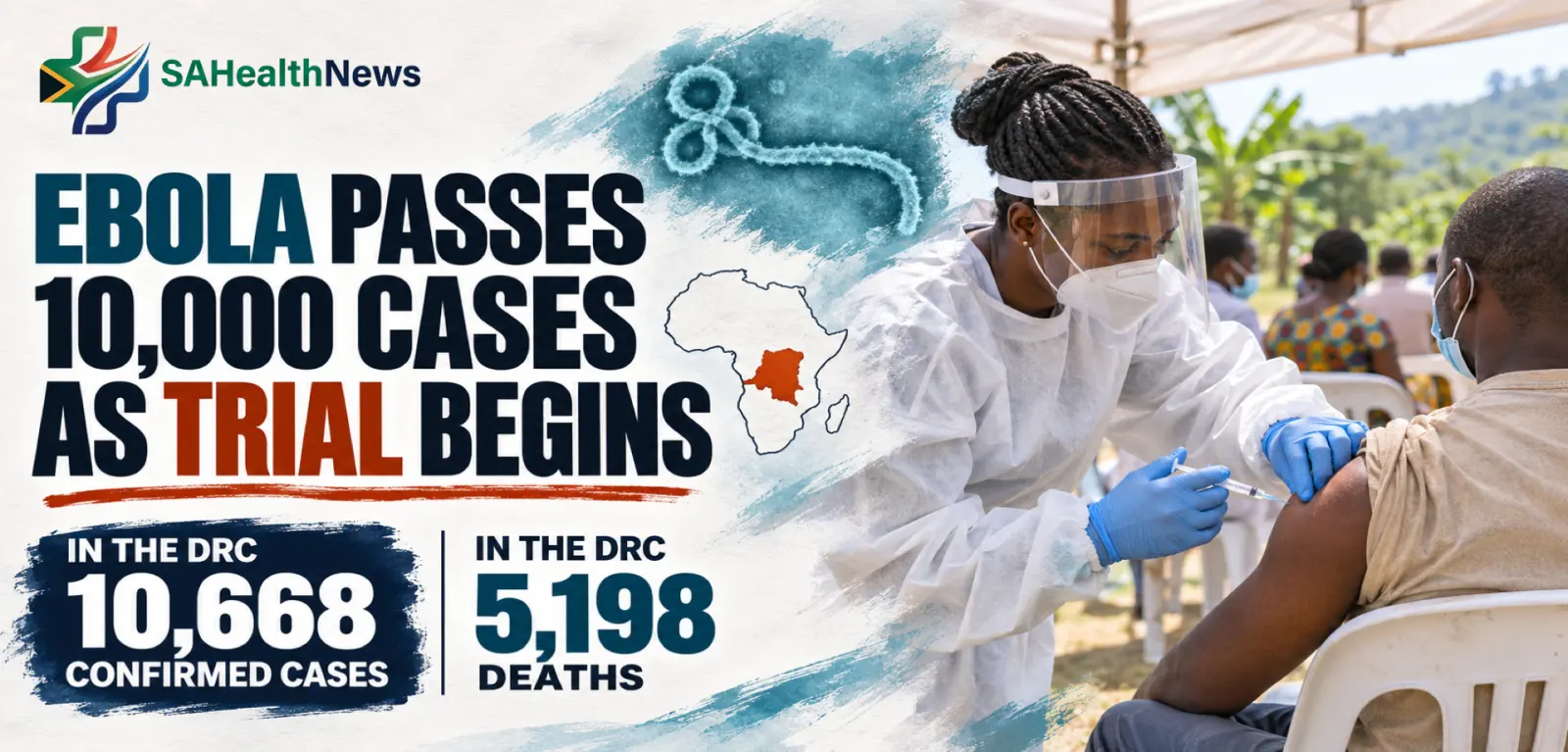
WHO counts 10,668 confirmed Ebola cases and 5,198 deaths in the DRC as the first vaccine trial against the Bundibugyo strain gets under way in Bunia.
The Ebola outbreak in the Democratic Republic of the Congo has passed 10,000 laboratory-confirmed cases. The World Health Organization's latest outbreak notice, published on 6 November, counts 10,668 confirmed cases and 5,198 deaths in the DRC up to 3 November.
The outbreak is caused by Bundibugyo virus, an Ebola species for which there is no approved vaccine or specific treatment. The first trial of vaccines against it began in the eastern DRC city of Bunia on 23 October.
When SA Health News last reported on the outbreak, on 24 October, the US Centers for Disease Control and Prevention counted 9,704 confirmed cases and 4,687 deaths in the DRC.
WHO says the outbreak has spread to more parts of the DRC, with confirmed cases in 67 health zones across eight provinces. In the 21 days to 3 November, 1,463 new confirmed cases were reported, and transmission was active in 51 of those health zones. Ituri remains the worst-affected province, while Nord-Kivu reported the most cases in the latest week, 232.
Almost half of confirmed patients in the DRC have died: WHO puts the crude case fatality rate at 48.7%. It reports 2,881 recoveries.
Outside the DRC, the count has held. Kenya still has nine confirmed cases and two deaths, all in a single cluster made up of the first patient, four of his family members and four health and care workers. WHO says there is no evidence of transmission beyond that cluster. Nigeria's only case, an imported infection confirmed in Abuja on 20 October, was medically evacuated to Geneva. Of the 62 contacts identified in Nigeria, six had completed follow-up by 3 November. Neither country has reported a new case since WHO's previous notice.
Switzerland and the United Kingdom have each received a medically evacuated patient. The patient taken to the UK is a health and care worker. Uganda, which recorded 20 cases and two deaths earlier in the outbreak, had its outbreak declared over by WHO on 27 August, according to the European Centre for Disease Prevention and Control.
The trial, named Tumaini, is a Phase 2/3 study co-led by the DRC's Institut National de Recherche Biomédicale and the University of Antwerp, with the DRC health ministry overseeing it. It is built as a platform that can test several vaccines side by side. Vaccines are given to people at high risk, such as contacts of confirmed patients, and the trial measures safety, immune response and whether they prevent disease.
The first vaccine in the trial is Ervebo, which is licensed against a different species, Zaire ebolavirus. It has not been shown to protect against Bundibugyo virus, and the trial is meant to find out. Two vaccines designed specifically against Bundibugyo, one from the University of Oxford and the Serum Institute of India and one from Moderna, will join once national approvals are granted, WHO says.
The trial is funded through the Coalition for Epidemic Preparedness Innovations (CEPI). Gavi, the vaccine alliance, has committed up to US$40 million to prepare for manufacturing.
In Kenya, patients are receiving experimental treatments under approved study protocols.
WHO's last rapid risk assessment, made on 14 August, rated the risk very high in the DRC, high for countries that share a land border with it, and low for the rest of the African region and globally. WHO says the assessment is now being revised. It continues to advise against restricting travel to, or trade with, affected countries.
South Africa is not among the countries WHO lists as affected, and it does not border the DRC, which places it in WHO's low-risk group for the rest of the region.
Health Minister Aaron Motsoaledi set out the country's plans in July: 24 public and 12 private hospitals are designated to receive suspected or confirmed patients, and travellers arriving from affected countries are screened at ports of entry. The National Institute for Communicable Diseases rated the risk of spread to South Africa as low in May. SA Health News could not find a revised public rating.
Screening at airports picks up travellers who are already ill or who report an exposure. It cannot catch someone who is still in the incubation period, which can last up to 21 days, and feels well. Nigeria's patient fell ill four days after landing in Abuja.
Anyone who has been in the DRC, Kenya or Nigeria in the past 21 days and develops fever, headache, muscle pain, sore throat, diarrhoea, abdominal pain, a rash, or unexplained bleeding or bruising should phone a doctor or clinic before arriving, and give their travel history.
Ebola spreads through direct contact with the blood or body fluids of a person who is sick with the disease or has died from it. It does not spread through the air.
The 24 October report used the CDC count to that point: 9,704 confirmed cases and 4,687 deaths in the DRC. WHO's 6 November notice, with data to 3 November, counts 10,668 confirmed cases and 5,198 deaths. The difference between those two published counts is 964 confirmed cases and 511 deaths. Over the 21 days to 3 November, WHO reported 1,463 new confirmed cases, with transmission still active in 51 of the 67 health zones that have recorded cases. Ituri is still the worst-affected province. Nord-Kivu reported the most cases in the latest week, 232. WHO also records 2,881 recoveries. Recoveries do not mean the outbreak has stopped in the zones that are still reporting transmission.
Outside the DRC the published picture is unchanged since the previous notice. Kenya remains at nine confirmed cases and two deaths, all inside one cluster: the first patient, four family members, and four health and care workers. Nigeria's single imported case, confirmed in Abuja on 20 October, was medically evacuated to Geneva, and six of 62 identified contacts had completed follow-up by 3 November. Uganda's earlier outbreak, 20 cases and two deaths, was declared over on 27 August.
The Tumaini trial in Bunia, which began on 23 October, is testing whether vaccines protect against Bundibugyo virus. Ervebo, the first vaccine in the trial, is licensed against Zaire ebolavirus and has not been shown to protect against this species. The Oxford and Serum Institute vaccine and the Moderna vaccine join only once national approvals are granted. CEPI funds the trial. Gavi has committed up to US$40 million for manufacturing preparation. None of that is a licensed Bundibugyo vaccine.
This is outbreak reporting for readers in South Africa. It is not a diagnosis, and it is not personal medical advice. Anyone who has been in the DRC, Kenya or Nigeria in the past 21 days and develops the symptoms listed above should phone a doctor or clinic before going in, and should say where they have been.
Source: SA Health News