Breaking
Latest health news from South Africa and around the world•Wellness, nutrition, and fitness updates daily•Medical breakthroughs and healthcare updates•Science-backed health explainers and guides•Health tech, reviews, and upcoming events•
 SA Health News Desk
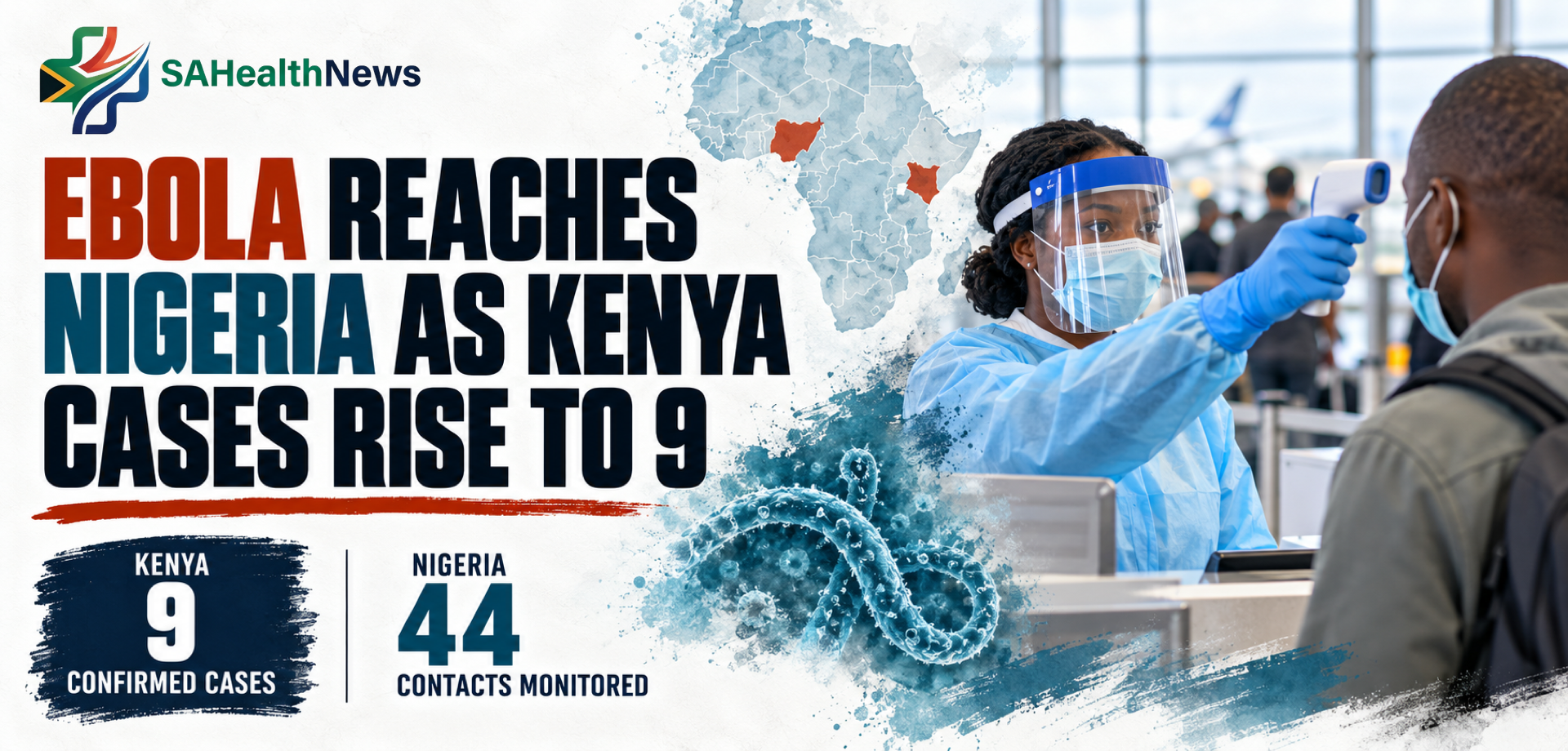
Nigeria has confirmed its first Bundibugyo Ebola case and Kenya's cluster has reached nine, two of them fatal. What it means for South Africa's preparedness.
Nigeria has confirmed its first case of Bundibugyo virus disease, the Ebola species behind the outbreak in the Democratic Republic of the Congo, making it the first country in West Africa to detect the virus since the outbreak was declared in May.
In Kenya, a cluster that began with a single imported case on 5 October has grown to nine confirmed cases, two of them fatal.
The outbreak has now been recorded in four African countries, along with a single case in France. South Africa does not appear on the list of affected countries in the US Centers for Disease Control and Prevention (CDC) situation summary, last updated on 22 October.
According to the World Health Organization's Africa office, the patient is a woman with recent travel to Uganda. She arrived in Abuja on 3 October and fell ill four days later, on 7 October. She sought care at a private health facility in Abuja on 11 October, and laboratory tests confirmed Bundibugyo virus on 20 October.
She is in isolation and receiving treatment. Health officials have identified 44 contacts who are under monitoring, and the Nigeria Centre for Disease Control and Prevention has activated its incident management system. WHO says investigators are still working to establish where she was infected.
Nigeria's health minister, Muhammad Ali Pate, said on Friday that genetic analysis showed the virus was closely related to the one found in Kenya's first patient, Al Jazeera reported.
Kenya's first patient, a man who travelled from the DRC, died in a Nairobi isolation unit on 5 October. Kenya's health ministry announced a second death on Friday, 23 October: a 65-year-old woman, a close relative of the first patient, who developed symptoms while in quarantine.
Seven patients are being treated at two isolation facilities. The ministry says 135 contacts have been traced and quarantined, and that all nine cases belong to "one cluster, with no evidence of community spread".
The DRC declared the outbreak on 15 May, and WHO declared it a public health emergency of international concern two days later. By 21 October the CDC counted 9,704 confirmed cases and 4,687 deaths in the DRC. Uganda recorded 20 cases and two deaths but has no active cases.
There is no licensed vaccine or approved treatment for Bundibugyo virus. The Ebola vaccine and antibody treatments used in recent outbreaks were developed against a different species, Zaire ebolavirus. Care for Bundibugyo patients relies on early isolation and supportive treatment such as fluids.
WHO has urged countries in the region to stay on high alert through surveillance, laboratory testing, response teams, infection control in health facilities and monitoring at points of entry. It advises against restricting travel to, or trade with, affected countries.
South Africa's plans, set out by Health Minister Aaron Motsoaledi in July, designate 24 public and 12 private hospitals to receive suspected or confirmed Ebola patients. Travellers arriving from affected countries are screened, and the health department's traveller questionnaire asks about symptoms and provides for monitoring for up to 21 days after a possible exposure.
The National Institute for Communicable Diseases (NICD) rated the risk of the outbreak spreading to South Africa as low in May. SA Health News could not find a revised public rating since the Kenyan and Nigerian cases.
Both new countries' first cases arrived by air from the outbreak region, and Nigeria's patient had no symptoms until four days after landing. Airport screening picks up people who are already ill or who report an exposure. It cannot catch someone who is still in the incubation period and feels well.
Anyone who has been in the DRC, Uganda, Kenya or Nigeria in the past 21 days and develops fever, headache, muscle pain, sore throat, diarrhoea, abdominal pain, a rash, jaundice, or unexplained bleeding or bruising should phone a doctor or clinic before arriving, and give their travel history.
Ebola spreads through direct contact with the blood or body fluids of a person who is sick or has died from the disease, not through the air.
Source: SA Health News