Breaking
Latest health news from South Africa and around the world•Wellness, nutrition, and fitness updates daily•Medical breakthroughs and healthcare updates•Science-backed health explainers and guides•Health tech, reviews, and upcoming events•
 SA Health News Desk
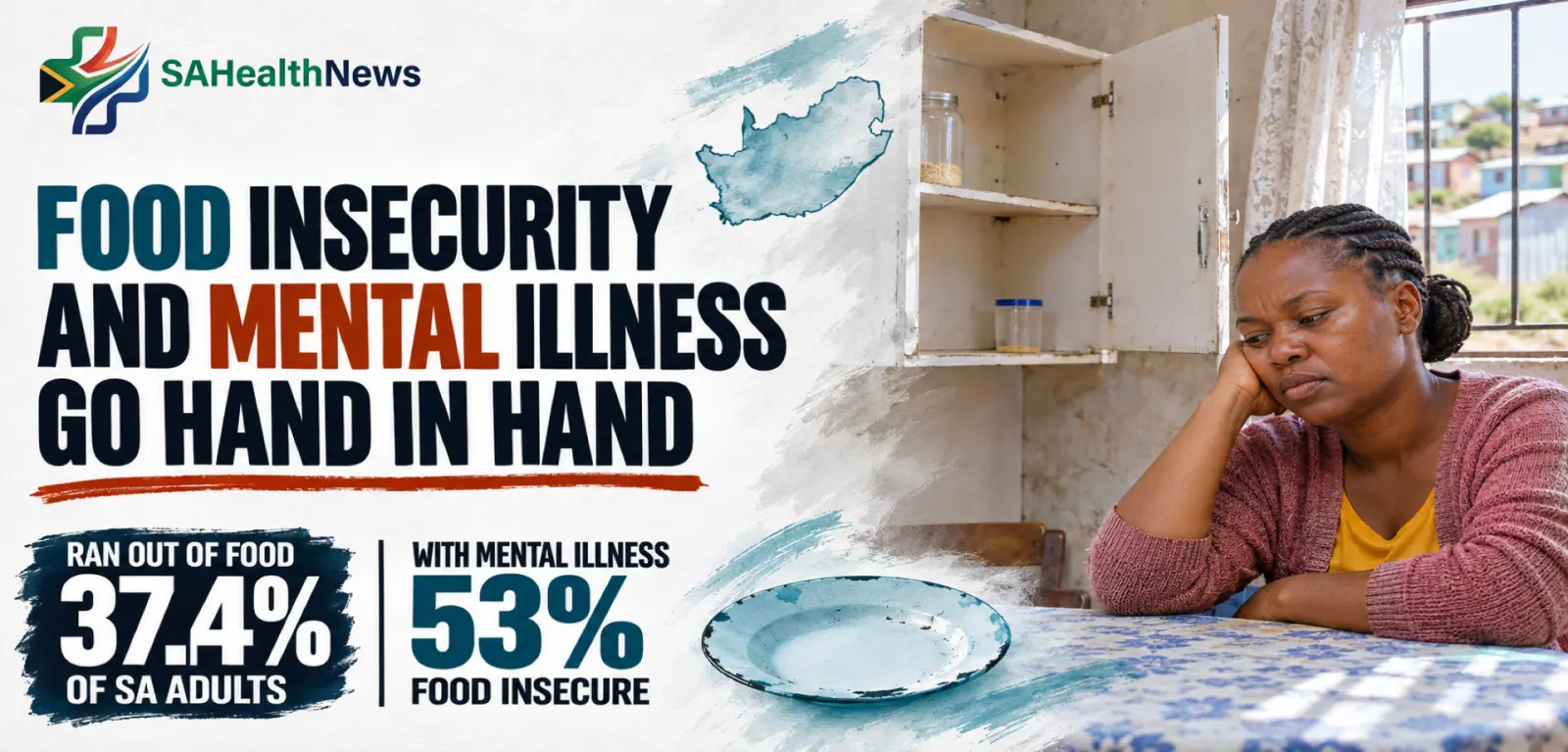
A national survey found 37.4% of adults ran out of food in a year. Among those diagnosed with a mental illness it was 53%, a Pretoria study shows.
Running out of food is common enough in South Africa that a national survey can put a number on it, and that number is not small. More than a third of adults ran out of food at some point in a year and could not afford to buy more. Among adults who had been diagnosed with a mental illness, the share was more than half.
The analysis, by three researchers at the University of Pretoria, is published in the journal Preventive Medicine Reports. It uses the South African Social Attitudes Survey, a face-to-face household survey of people aged 16 and older that was in the field from January to March 2025. Interviewers asked the questions in people's homes. This is not a clinic sample and it is not an online poll.
Of the 3,095 people interviewed, 37.4% answered yes when asked whether, in the past 12 months, "there was any time you have run out of food and not been able to purchase more". The researchers counted them as food insecure. The question is blunt. It asks about a moment when the money and the food both ran out. It does not ask how often, or for how long.
Hunger was unevenly spread. Half of unemployed adults (50.3%) were food insecure, against 23.2% of those with jobs. Among people who had not finished high school the figure was 46.9%; among those with education beyond high school it was 15%. Work and schooling track the same hardship. A person without a wage, or without a matric, was far more likely to have faced an empty cupboard they could not refill.
Women were more affected than men, at 42.1% against 32.3%. By population group, 42.8% of Black African adults were food insecure, 23.8% of Coloured adults, 11% of Indian or Asian adults and 8.3% of white adults. The authors say these gaps reflect structural inequality left by apartheid-era policy, not anything intrinsic to the groups. The figures describe who still carries that history in the grocery budget. They are not a comment on character, culture or appetite.
Rural adults reported more food insecurity than urban adults (51.6% against 30.8%), but that difference fell just short of statistical significance. The gap is large on the page. The study does not treat it as a settled difference once chance is allowed for. A rural household reading the raw percentages should not be told the survey has proved a rural penalty it itself would not call significant.
Of adults who said a health professional had diagnosed them with a mental illness, a category that covered stress, depression and emotional problems, 53% were food insecure. Among those with no such diagnosis it was 36.3%. The diagnosis had to come from a health professional. Someone who is struggling and has never been able to see a clinician is not in the 53%. They may sit in the larger group, counted as if there were no mental illness, because the survey could only record a diagnosis that had been given.
When the researchers modelled several factors together, a mental illness diagnosis was associated with 2.82 times the odds of food insecurity (95% confidence interval 1.54 to 5.18). The interval starts above 1, which is the researchers' way of saying the link is unlikely to be a fluke of this sample. It is still an association. Higher socioeconomic status was strongly protective, cutting the odds by more than 80%. Nicotine use was associated with 1.64 times the odds.
The relationship ran in both directions: the statistical path from food insecurity to mental illness was also significant. In a separate check, food-insecure adults scored lower on a short measure of emotional well-being, averaging 8.0 against 9.1. The scale is short. The difference is modest. It points the same way as the diagnosis finding, and it does not explain a life.
High blood pressure and diabetes told a different story. Once income, education and behaviour were accounted for, having both conditions was not significantly linked to food insecurity, which the authors read as a sign that these problems share underlying social causes. The survey is not saying blood pressure or diabetes is unrelated to hardship. It is saying that, in this model, those two conditions did not add a separate link to food insecurity beyond the social factors already counted.
This is a snapshot, so it cannot say whether running out of food leads to mental illness, whether mental illness makes it harder to keep food on the table, or both. The authors say so plainly. A person who is depressed may lose work and then lose meals. A person who cannot buy food may become depressed. Both can be true in the same household, and a survey taken once cannot put them in order.
Food insecurity was measured with one question, which cannot separate a single bad week from chronic hunger. Mental illness was self-reported and depended on having been diagnosed, so people without access to care would be missed. The models used the 2,979 participants with complete answers. A little over a hundred interviews dropped out because an answer was missing. That is ordinary in a long household questionnaire. It is another reason not to treat 2.82 as a law.
The researchers, Lungile Nkosi, Teshager Nigussie and Olalekan Ayo-Yusuf of the university's Africa Centre for Tobacco Industry Monitoring and Policy Research, argue for stronger household income and food security policies. They also want mental health and behavioural risk screening built into social support programmes, so that hunger, mental health, and tobacco and alcohol use are dealt with together. The paper's centre studies tobacco policy. Nicotine appears in the model because that is part of the work, not because smoking is offered as the cause of an empty kitchen.
The study was funded by the Africa Capacity Building Foundation with support from the Gates Foundation. The funding covered acquiring the data. It was published online on 21 September 2026, in Preventive Medicine Reports, volume 71, article 103642.
None of this is a diagnosis, and it is not a reason to stop treatment or to decide alone that hunger and a mental illness must be linked in one household. Anyone who is running out of food, or who is living with depression, stress or any other mental illness, needs a person who can help in real life: a clinic, a counsellor, or a social support office. This survey describes the country. It does not prescribe for one reader.
Source: SA Health News