Breaking
Latest health news from South Africa and around the world•Wellness, nutrition, and fitness updates daily•Medical breakthroughs and healthcare updates•Science-backed health explainers and guides•Health tech, reviews, and upcoming events•
 Staff Writer
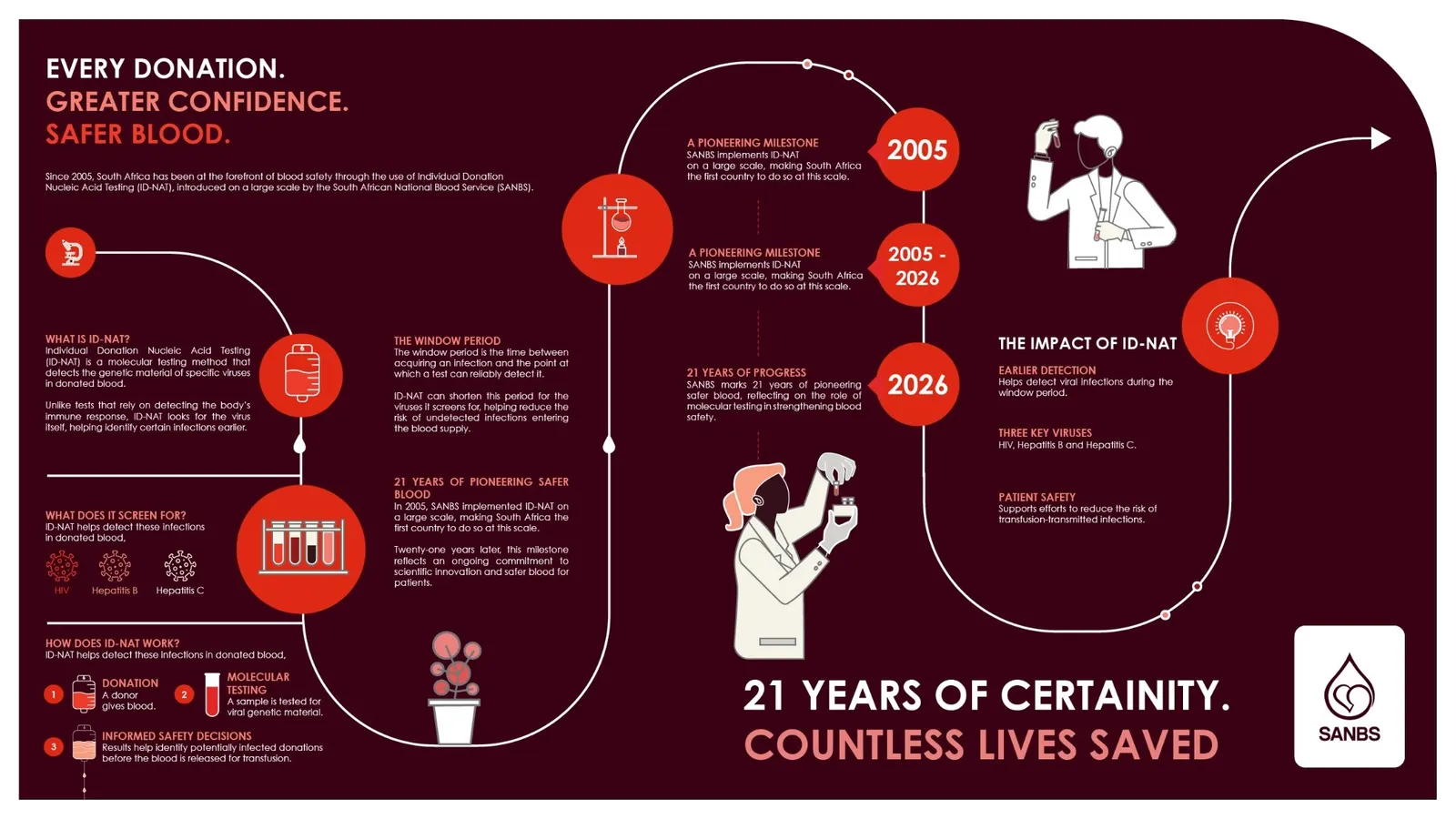
Two decades after a pivotal chapter in South Africa's blood-service history, SANBS reflects on the evolution of blood safety, from the people whose lives are connected by donation to the science that helps protect patients.
The story of safer blood in South Africa is not only one of scientific progress, but also of difficult questions, changing policies and a continued commitment to protecting patients.
SANBS faced difficult challenges between 1996 and 2004 as the HIV pandemic posed a significant risk to the safety of the blood supply. SANBS implemented risk management strategies to mitigate against the transmission of HIV via blood transfusion while engaging with stakeholders to look at implementing new testing strategies.
In 2004, following significant concerns regarding the use of Race in its risk management and the exclusion of Black donors/limited use of certain products by Black Donors, SANBS engaged with the National Department of Health (NDoH) and obtained approval to implement ID-NAT.
The following year marked a significant turning point. In October 2005, SANBS introduced a new donor-risk management model supported by Individual Donor Nucleic Acid Testing (ID-NAT), moving away from race-based blood collection and utilisation policies towards individual-donation testing. South Africa became the first country to implement ID-NAT for individual blood donations at a national scale.
The technology enabled screening donated blood for HIV, Hepatitis B, and Hepatitis C genetic material, helping identify certain infections earlier and reduce the window period during which infections may otherwise go undetected, thus significantly increasing blood safety and enabling SANBS to significantly increase its donor base of Black donors from 4% in 2005 to almost 60% of the total donor base in 2026.
"Twenty-one years later, this milestone provides an opportunity to reflect on how scientific innovation has helped strengthen blood safety and how the systems supporting transfusion continue to evolve." Says Ravi Reddy, CEO of SANBS.
The SANBS documentary, Why Blood Matters, highlights the human significance of this work by exploring the experiences of blood donors and recipients, as well as the profound impact of donation on people's lives.
While the documentary tells the human story of blood, ID-NAT reveals another essential part of the journey: the science and testing that take place behind the scenes before donated blood is released for transfusion.
Together, these stories illustrate the connection between human generosity, scientific advancement and the responsibility to provide patients with safe, quality blood products.
Source: SA Health News