Breaking
Latest health news from South Africa and around the world•Wellness, nutrition, and fitness updates daily•Medical breakthroughs and healthcare updates•Science-backed health explainers and guides•Health tech, reviews, and upcoming events•
 SA Health News Desk
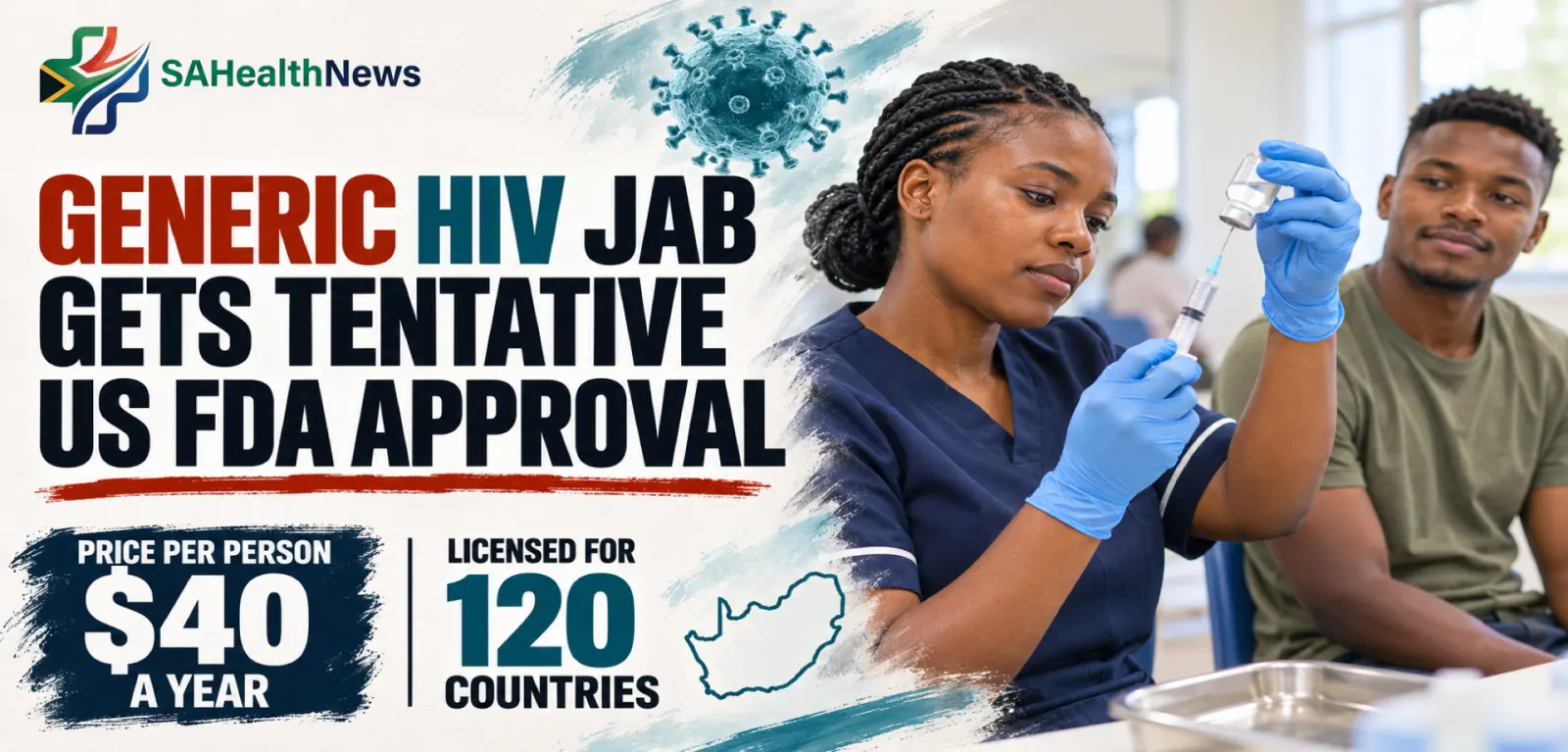
Dr. Reddy's generic lenacapavir has tentative FDA approval at $40 a year, in a deal backed by Wits RHI. SAHPRA must still register it for use here.
A six-monthly HIV prevention injection at about the price of daily pills is now one step closer for countries that cannot pay a rich-world list price. It is not yet a new option at a South African clinic. A generic version of lenacapavir has received tentative approval from the United States Food and Drug Administration. It is the first generic of the injection to get an FDA decision, and it is priced at US$40 per person per year, about the cost of daily prevention pills.
The product is made by Dr. Reddy's Laboratories of India. Unitaid, the global health agency that helped finance its development, announced the approval on 2 November, roughly 16 months after the FDA approved Gilead Sciences' original product for HIV prevention in June 2025.
A Johannesburg institute is part of the deal behind it. Wits RHI, the University of the Witwatersrand research institute, joined Unitaid and the Clinton Health Access Initiative (CHAI) in a pricing agreement with Dr. Reddy's announced in September 2025. The three organisations gave the company financial, technical and regulatory support. The approval is a regulatory milestone for that agreement. It is not a delivery date for a clinic in South Africa.
Tentative approval is the FDA's standard designation for a generic that meets its quality, safety and efficacy requirements while the original is still under patent. The generic cannot be sold in the United States, where Gilead's brand, Yeztugo, has a list price of $28,218 a year. The designation does allow US government programmes to buy it for other countries, and regulators elsewhere can lean on it when they assess the product themselves.
The gap between those two prices is the point of the licence. A year's doses at $28,218 is a private American list price. A year's doses at $40 is the figure written into the access deal. Tentative approval says the copy has cleared the FDA's quality bar. It does not put a vial on a shelf, and it does not override another country's regulator.
The $40 price applies in the 120 low- and middle-income countries covered by Gilead's voluntary licence, which the company began granting to six generic manufacturers in late 2024. Dr. Reddy's is the first of the six with an FDA decision. The other five are still in the queue. Being first at the FDA is not the same as being first through every national regulator, and it is not the same as having stock.
Unitaid expects first supplies to reach countries before the end of 2026, with wider availability in 2027. Some countries will need their own regulatory approval first. "Before the end of 2026" is an expectation for the earliest countries, not a promise that every licensed country, South Africa included, will have the generic by then.
South Africa began offering Gilead's branded lenacapavir in the public sector on 5 June, at 360 facilities in six provinces. By 8 October, 76,922 people had received their first injections, according to health department figures. That is a real start. It is also a small share of the people modellers say would need to begin the injection if the aim is to interrupt transmission.
Health economists advising the government estimate that between 1.7 million and 2.3 million people would have to start the injection each year for at least five years to break the chain of HIV transmission. Set 76,922 first injections against the bottom of that range and the distance is obvious. Lenacapavir is on the country's essential medicines list on condition that generics become available at $40 for a year's doses. The FDA decision meets the price on paper. It does not, by itself, meet the condition for use in a public clinic here.
None of the six licensed generic manufacturers is South African. Before any generic can be used in public clinics here, the South African Health Products Regulatory Authority (SAHPRA) must register it. As of late August, only one licensee, Hetero, had submitted a dossier to SAHPRA. Neither Unitaid nor Dr. Reddy's has said when the newly approved product might reach South Africa. A dossier from a different company is not this product's dossier. Until Dr. Reddy's, or a partner, files here and SAHPRA decides, the tentative FDA approval stays an American designation.
Professor Saiqa Mullick, director of implementation science at Wits RHI, said in the Unitaid statement that "an affordable drug alone is not enough". Countries, she said, "need health systems that are ready to deliver new prevention options".
Wits RHI's own Len4PrEP study gives a sense of demand. Of 1,538 participants whose choice was recorded, 85.8% picked the injection over daily pills. People who were offered the choice mostly wanted the jab. Wanting it, and a clinic being able to give it, are different problems. Staff, cold storage, counselling and a reliable supply all have to be in place before a preference becomes an appointment.
Money is the other constraint. "The work is not done. Now, we need the funding to actually buy it for everyone who needs it," Carolyn Amole, who leads CHAI's HIV programme, said.
Unitaid says more than 125,000 people in 10 early-adopter African countries have started on Gilead's product so far. Those are starts on the brand, paid for through the early programmes, not starts on the $40 generic.
Nothing changes at clinics yet. The injection offered in South Africa's public sector is still Gilead's branded product, supplied through the Global Fund, and it is free at participating facilities. People taking daily oral PrEP should keep taking it unless a nurse or doctor advises a switch. A headline about a $40 generic is not an instruction to stop pills, to skip a booked injection, or to buy a product that is not registered here.
None of this replaces advice from a clinic, a nurse or a doctor. Prevention that is already working should stay in place until the person prescribing it says otherwise.
Source: SA Health News