Breaking
Latest health news from South Africa and around the world•Wellness, nutrition, and fitness updates daily•Medical breakthroughs and healthcare updates•Science-backed health explainers and guides•Health tech, reviews, and upcoming events•
 SA Health News Desk
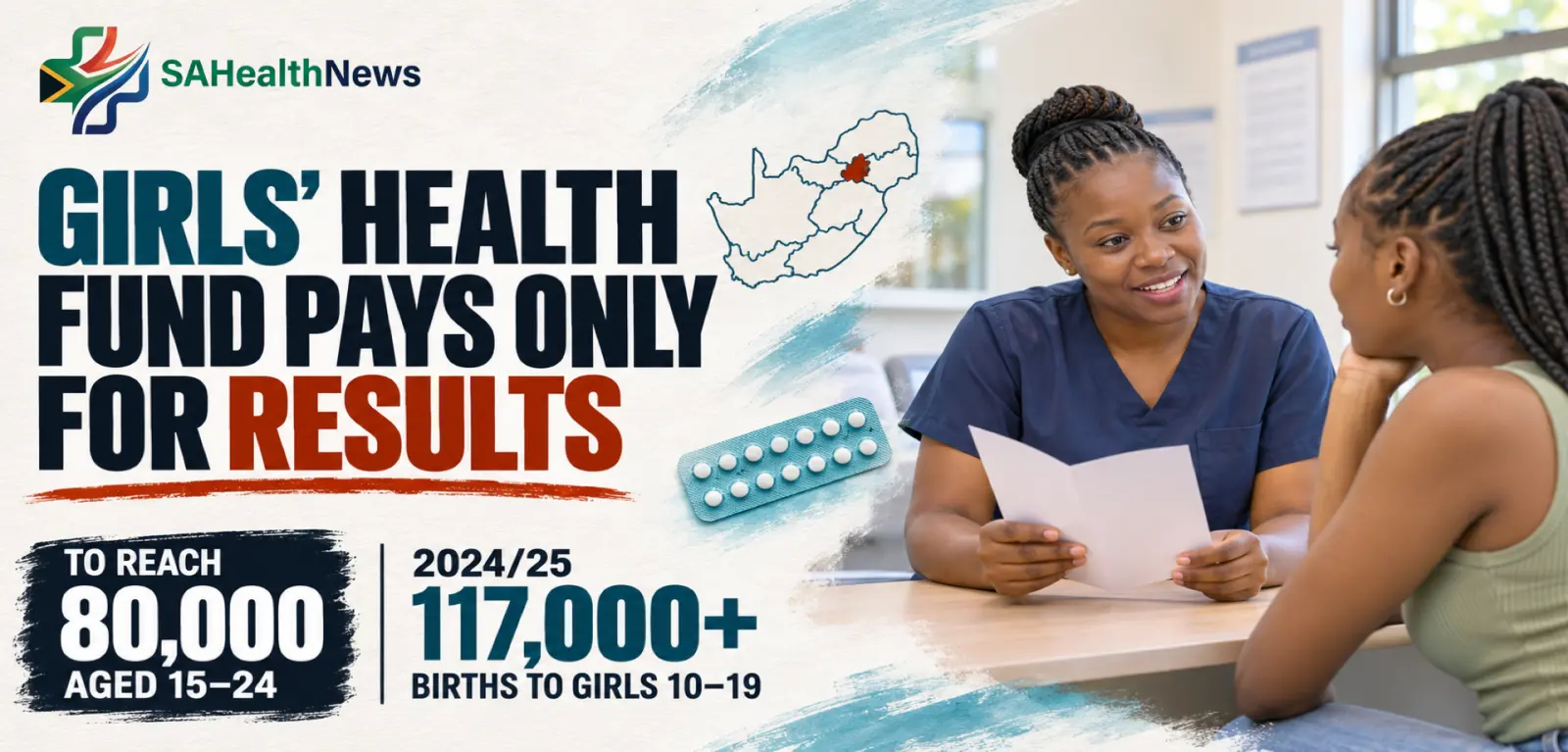
A new girls' health fund launched in Ekurhuleni pays only for verified results. It aims to reach 80,000 aged 15–24 with contraception and HIV care.
A new financing scheme for adolescent sexual and reproductive health has been launched in Ekurhuleni with a target of 80,000 girls and young women aged 15 to 24. Its outcome payments will be released only when results are independently verified.
The Girls' Partnership Platform is a joint project of the Department of Women, Youth and Persons with Disabilities (DWYPD), the South African Medical Research Council (SAMRC), the United Nations Population Fund (UNFPA), the pharmaceutical company Organon and Tiko, which connects girls to free health services through community networks. The SAMRC announced the launch on 29 October.
Tiko will deliver the services against targets agreed in advance. The SAMRC lists them as modern contraception, HIV testing, PrEP, starting and staying on antiretroviral treatment, mental health screening, and screening and support for survivors of sexual and gender-based violence.
The work starts in Ekurhuleni, the City of Johannesburg and Tshwane, where Tiko's networks are already in place. It is then due to expand to Sedibeng and the West Rand in Gauteng, Moretele in North West, and Newcastle and eThekwini in KwaZulu-Natal. The release gives no timeline for the expansion.
The first three places are where the network already exists. The later list is a plan without a date: two more Gauteng districts, one place in North West, and two in KwaZulu-Natal. A girl in eThekwini is named in the expansion. She is not in the starting service. The services themselves are a fixed list. Contraception, an HIV test, PrEP, starting treatment and staying on it, a mental health screen, and screening plus support after sexual and gender-based violence. Tiko delivers them against targets that were agreed before the work. The release does not print those targets.
The SAMRC describes the platform as a shift away from paying for activities towards paying only for verified, measurable health outcomes.
The outcome payments will come from a pool funded by UNFPA South Africa, the National Treasury through the SAMRC, and Organon. The SAMRC and DWYPD will co-lead the platform, with support from the national Department of Health and the Department of Basic Education.
The release does not say how much money is in the pool, what each verified outcome is worth, or who will do the verification.
Three funders are named and no rand figure is attached to any of them. UNFPA South Africa, Treasury's money via the SAMRC, and Organon put money into a pool. Payment leaves that pool when an outcome is verified. What an outcome is worth, and who checks it, is not in the announcement. Co-leadership sits with the SAMRC and DWYPD. Health and Basic Education are named as support, not as the payers.
Dr Nevilene Slingers, who heads the SAMRC's Investment4Health programme, said the platform builds on the Imagine Social Impact Bond, which delivered reproductive health services to school-going girls in South Africa. "This platform helps ensure the South African health system remains accessible and responsive to girls' needs amid falling international aid resources," she said.
The SAMRC cites three figures to make the case: more than 117,000 girls aged 10 to 19 gave birth in 2024/25, about 1,000 new HIV infections occur every week among women and girls, and roughly a third of young mothers never go back to school.
Mmapaseka Steve Letsike, the Deputy Minister of Women, Youth and Persons with Disabilities, said at the launch that the platform "aligns directly with our national priority to safeguard adolescent wellbeing, reduce teenage pregnancy, and keep girls in school".
Slingers was not the only partner to point to shrinking donor money. UNFPA's country representative in South Africa, Yu-Yu, said the collaboration "shows how innovative financing can unlock essential health choices for girls directly in their communities" at a time when development funding is under pressure, and that the model could later be used elsewhere in the region.
The 80,000 is a reach target for ages 15 to 24. The birth figure the SAMRC cites is a different age band, 10 to 19, and a different year, 2024/25. The HIV figure is weekly, and it is for women and girls, not only the 15-to-24 group in the three starting metros. The school figure is about young mothers, about a third of whom do not return. Those three numbers are the case for the platform. They are not a baseline the contract says it will move, because the contract's own targets are not published.
The test for the platform will be its numbers: how many of the 80,000 it reaches, which outcomes trigger payment, and whether the results are published. Outcomes-based contracts depend on clear targets and independent checks, and the partners have not yet published the targets or named the verifier.
Girls and young women who need contraception, HIV testing or PrEP can get them free at public clinics. The platform does not replace that. It adds a paid-on-results layer, in three metros first, for a list of services that includes those clinic services and goes on to treatment, mental health and support after violence. Until the pool, the price of an outcome and the verifier are published, the launch is a structure and a target of 80,000, not a set of results. The 29 October announcement is the start of that structure. It is not the first verified payment.
Source: SA Health News