Breaking
Latest health news from South Africa and around the world•Wellness, nutrition, and fitness updates daily•Medical breakthroughs and healthcare updates•Science-backed health explainers and guides•Health tech, reviews, and upcoming events•
 SA Health News Desk
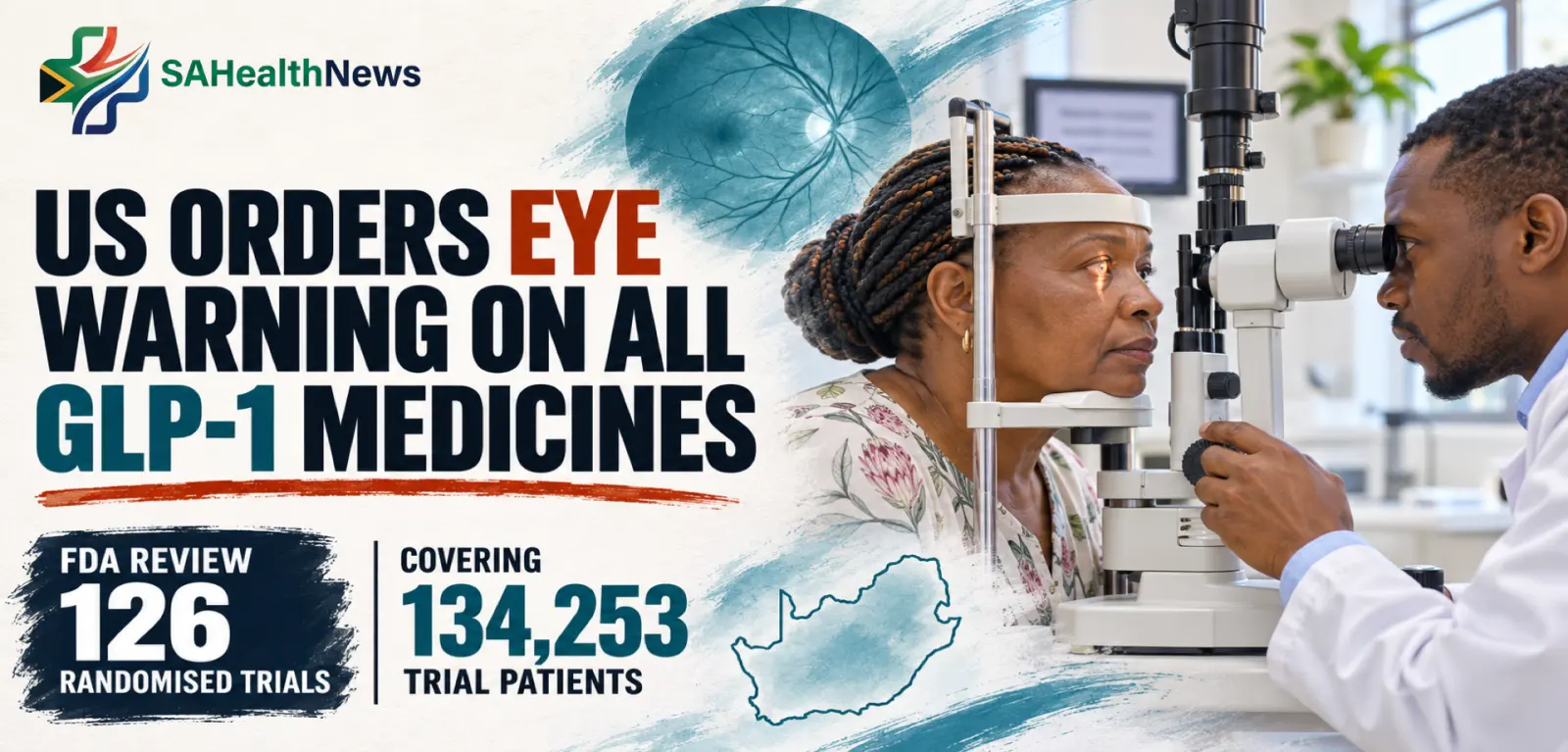
The FDA has ordered a warning on all GLP-1 medicines about a rare condition that can blind one eye. Ozempic, Wegovy and Mounjaro are all sold in SA.
The US Food and Drug Administration (FDA) on Monday ordered the makers of every GLP-1 medicine on the American market to add a warning about a rare eye condition that can cause sudden, permanent loss of sight in one eye. The class includes semaglutide, sold as Ozempic and Wegovy, and tirzepatide, sold as Mounjaro, all of which are also on sale in South Africa's private sector.
The condition is non-arteritic anterior ischemic optic neuropathy, or NAION. It happens when blood flow to the front of the optic nerve falls. It is painless, usually affects one eye, and the vision lost can be permanent.
The FDA describes a "potential increased risk" of NAION. It has not concluded that the medicines cause it. The new wording goes into the warnings and precautions section of the US label for the whole class, from older medicines such as liraglutide (Victoza, Saxenda) and dulaglutide (Trulicity) to the new pill orforglipron (Foundayo).
The agency pooled 126 randomised controlled trials covering 134,253 patients. Across them it counted 15 probable NAION cases: 10 in people taking GLP-1 medicines and five in people on placebo. That works out to 6.4 cases per 100,000 patient-years on the medicines, against 3.8 in the comparison groups.
It also ran its own study through Sentinel, its drug-safety monitoring system, of adults with type 2 diabetes treated between 2019 and 2024. People on GLP-1 medicines had a 43% higher rate of NAION than people on DPP-4 inhibitors, an older class of diabetes tablets. Against SGLT-2 inhibitors, another diabetes class, the difference was not statistically significant.
NAION is uncommon to begin with. The FDA puts the background rate at 2.3 to 10.2 cases per 100,000 adults over 50 each year. Its risk factors include diabetes, high blood pressure, sleep apnoea, smoking, anaemia and kidney disease, which are common among people who use these medicines and make single case reports hard to read. NAION has been reported with every GLP-1 medicine currently sold in the US.
Europe's medicines regulator reached a similar finding last year. In June 2025 the European Medicines Agency's safety committee concluded that NAION is a very rare side effect of semaglutide, affecting up to one in 10,000 people who take it, and the EU product information for Ozempic, Rybelsus and Wegovy was changed to say so. The World Health Organization issued a medical product alert on the same risk later that month.
Novo Nordisk, which makes Ozempic and Wegovy, said during the European review that the data did not establish a causal link. Neither Novo Nordisk nor Eli Lilly, which makes Mounjaro, had responded to Reuters by the time it first reported the FDA decision.
The South African Health Products Regulatory Authority (SAHPRA) has not issued a public safety alert on NAION and GLP-1 medicines. None appears among the alerts on its website, the latest of which, in August, concerned swelling linked to ACE-inhibitor blood pressure tablets.
Several of the medicines in the FDA order are sold here. Ozempic is registered for type 2 diabetes. Novo Nordisk launched Wegovy for weight management in August 2025. Aspen distributes Lilly's Mounjaro, which SAHPRA approved for chronic weight management in October 2025. In July this year SAHPRA approved Sun Pharma's generic semaglutide, sold as Semagard, for type 2 diabetes.
All of them are available only on private prescription. The health department has not started assessing GLP-1 medicines for public patients with obesity, as SA Health News reported on 4 November.
The FDA tells anyone taking a GLP-1 medicine to contact a doctor straight away if they notice sudden vision loss in one eye, blind spots, tunnel vision, distorted colours, or blurry or hazy central vision. People who have had NAION before should ask their doctor whether to continue.
Doctors are told to refer suspected cases promptly to an ophthalmologist, and to consider stopping the medicine in a patient who develops NAION "unless the benefits of treatment clearly outweigh the risk".
The warning is not advice to stop treatment without medical guidance. The absolute risk is small, and diabetes, which many users are being treated for, is itself a risk factor for the condition.
South Africans who suspect a side effect from any medicine can report it to SAHPRA through the Med Safety app or the regulator's online reporting portal, or ask a doctor or pharmacist to report it. SAHPRA said last week that people "do not need to be certain that a medicine caused their symptoms" before they report.
The FDA pooled 126 randomised trials and 134,253 patients, and counted 15 probable NAION cases: 10 in people taking a GLP-1 medicine and five in people on placebo. That is 6.4 cases per 100,000 patient-years on the medicines, against 3.8 in the comparison groups. The agency calls this a potential increased risk. It has not concluded that the medicines cause NAION.
Its Sentinel study, of adults with type 2 diabetes treated between 2019 and 2024, found a 43% higher rate of NAION in people on GLP-1 medicines than in people on DPP-4 inhibitors. Against SGLT-2 inhibitors the difference was not statistically significant. The background rate the FDA cites is 2.3 to 10.2 cases per 100,000 adults over 50 each year. Diabetes, high blood pressure, sleep apnoea, smoking, anaemia and kidney disease are already risk factors, and they are common among people who use these medicines. A single case report is hard to read for that reason. NAION has been reported with every GLP-1 medicine currently sold in the US.
Europe's safety committee reached a similar finding in June 2025, and described NAION as a very rare side effect of semaglutide, up to one in 10,000 people who take it. The EU product information for Ozempic, Rybelsus and Wegovy was changed. The World Health Organization issued a medical product alert the same month. Novo Nordisk said during that review that the data did not establish a causal link. Neither Novo Nordisk nor Eli Lilly had responded to Reuters when it first reported the FDA order.
SAHPRA has not issued a public safety alert on NAION and these medicines. None appears among the alerts on its website. The latest alert there, in August, was about swelling linked to ACE-inhibitor blood pressure tablets. Ozempic is registered here for type 2 diabetes. Wegovy launched for weight management in August 2025. Aspen distributes Mounjaro, which SAHPRA approved for chronic weight management in October 2025. In July this year SAHPRA approved Sun Pharma's generic semaglutide, Semagard, for type 2 diabetes. All of them are private prescriptions. The health department has not started assessing GLP-1 medicines for public patients with obesity.
The FDA's instruction to patients is to contact a doctor straight away for sudden vision loss in one eye, blind spots, tunnel vision, distorted colours, or blurry or hazy central vision. People who have had NAION before should ask whether to continue. Doctors are told to refer suspected cases to an ophthalmologist promptly, and to consider stopping the medicine unless the benefits clearly outweigh the risk. That is not advice to stop a prescribed medicine without a doctor. The absolute risk is small, and diabetes itself is a risk factor for the condition.
South Africans can report a suspected side effect to SAHPRA through the Med Safety app or the regulator's online portal, or ask a doctor or pharmacist to report it. SAHPRA said last week that people do not need to be certain a medicine caused their symptoms before they report. This report is not a diagnosis, and it is not personal medical advice.
Source: SA Health News