Breaking
Latest health news from South Africa and around the world•Wellness, nutrition, and fitness updates daily•Medical breakthroughs and healthcare updates•Science-backed health explainers and guides•Health tech, reviews, and upcoming events•
 SA Health News Desk
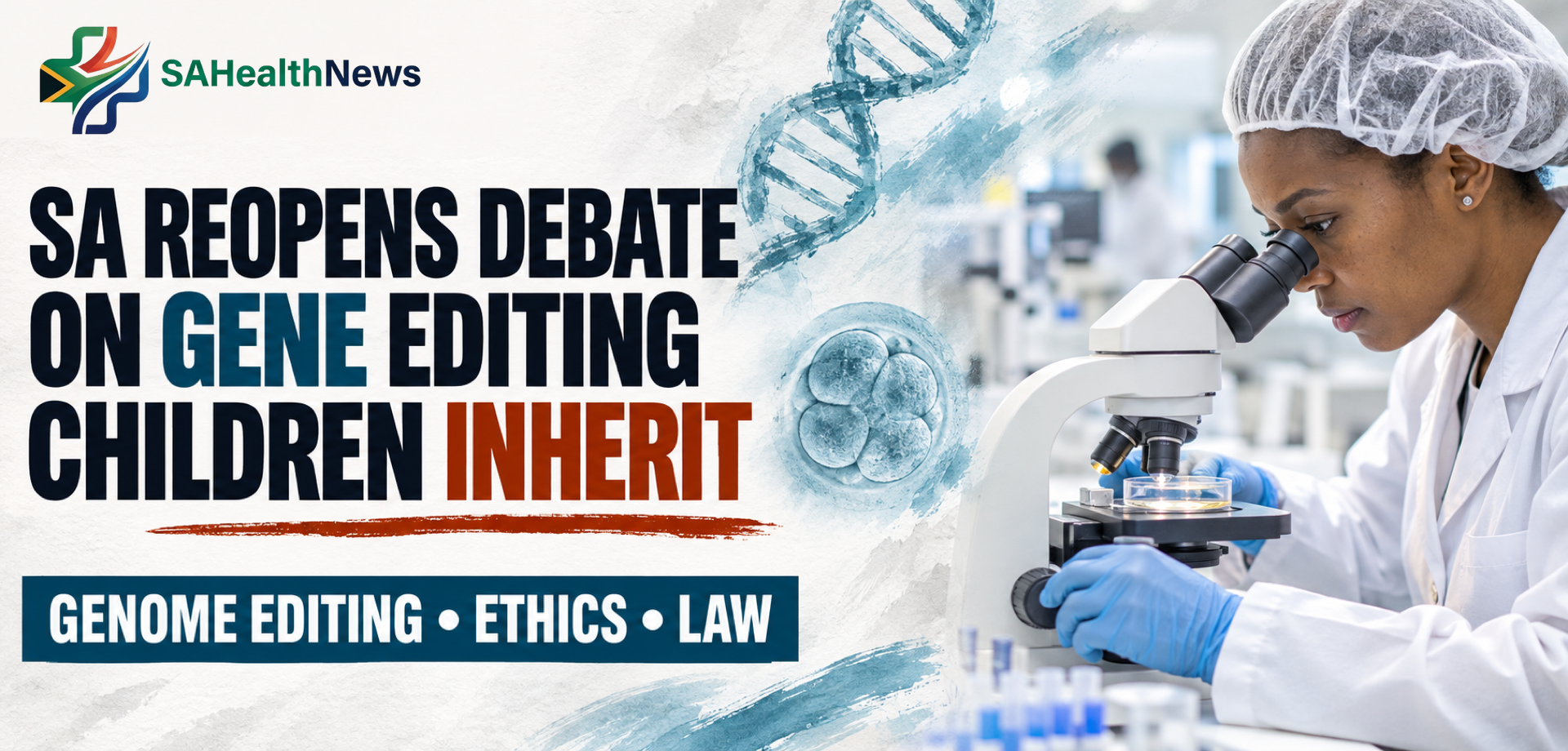
A Pretoria dialogue on heritable genome editing ended without a decision. Scientists, lawyers and patient advocates want wider public consultation.
South Africa has restarted its debate on whether doctors should ever be allowed to edit the genes of embryos, eggs or sperm in ways that children would inherit. A national dialogue in Pretoria in late October ended without a decision, and its organisers say much wider public consultation has to come first.
The meeting opened the 6th National Cell and Gene Therapy Conference at the University of Pretoria's Future Africa campus, which ran from 27 to 29 October. Wits University, whose Sydney Brenner Institute for Molecular Bioscience was a partner, published an account of it on 11 November.
In 2024 the National Health Research Ethics Council (NHREC) issued research ethics guidelines that included a section on heritable human genome editing. Scientists, legal scholars, ethicists and patient advocates objected and asked for broader consultation, and the council withdrew the section in 2025. The replacement text says further national stakeholder engagement is needed.
That left a gap. Professor Michael Pepper, a member of the dialogue's organising committee, called for national expertise and clearer guidance to fill it.
Gene therapies already in South African trials, for haemophilia and hereditary angioedema, change cells in one patient's body. Those changes are not passed on.
Heritable editing alters sperm, eggs or embryos used to start a pregnancy, so the change would be carried by the child and by that child's descendants. No country has a law that explicitly permits it. A Chinese researcher's 2018 experiment, which he said was meant to protect babies against HIV infection, was widely condemned.
Professor Michèle Ramsay, director of the Sydney Brenner Institute, and Dr Janine Scholefield of the CSIR led the session on science and safety. The unsolved problems they set out include unintended genetic changes and editing that reaches only some of an embryo's cells. Checking every cell would destroy the embryo.
Many families at risk already have another route. IVF with genetic testing of embryos lets couples avoid serious single-gene disorders. When both parents carry the cystic fibrosis gene, for example, each conception has a 75% chance of producing an unaffected child. Heritable editing might one day help only in the very rare cases where every embryo would inherit a disorder.
Editing could not guarantee health or chosen traits. Conditions such as cancer, diabetes, heart disease and asthma, and traits such as intelligence or athletic ability, depend on many genes and on environment, and the relevant combinations are not known.
Section 57 of the National Health Act prohibits reproductive cloning. Whether it also covers heritable editing is contested. The NHREC has said that neither the Act nor its 2024 guidelines authorise heritable editing as a treatment.
Professors Sheetal Soni and Donrich Thaldar of the University of KwaZulu-Natal argued for "a robust legislative process that does not presume a particular outcome". Thaldar suggested the issue could be considered as part of constitutionally protected reproductive autonomy.
Rare disease advocate Nomsa Mtshali warned that the technology could deepen inequality and urged that patients be involved early. Dr Phila Msimang of Stellenbosch University warned of eugenic misuse and of "ethics washing", where a practice is presented as ethical without its real problems being dealt with. Professor Jantina de Vries of the University of Cape Town's EthicsLab called for carefully designed public deliberation and drew a line between preventing disease and enhancement.
The meeting concluded that "technological readiness alone would not resolve the ethical questions".
A report on the meeting is planned for the journal Gene Therapy, and it will record the disagreements as well as the points of agreement. Any future guidance will have to settle the legal uncertainty and take in views from groups that were not in the room, according to the Wits account.
Sources: University of the Witwatersrand, 11 November 2026; South African Medical Journal correspondence on the withdrawal of the NHREC section, August 2025.
Source: SA Health News