Breaking
Latest health news from South Africa and around the world•Wellness, nutrition, and fitness updates daily•Medical breakthroughs and healthcare updates•Science-backed health explainers and guides•Health tech, reviews, and upcoming events•
 SA Health News Desk
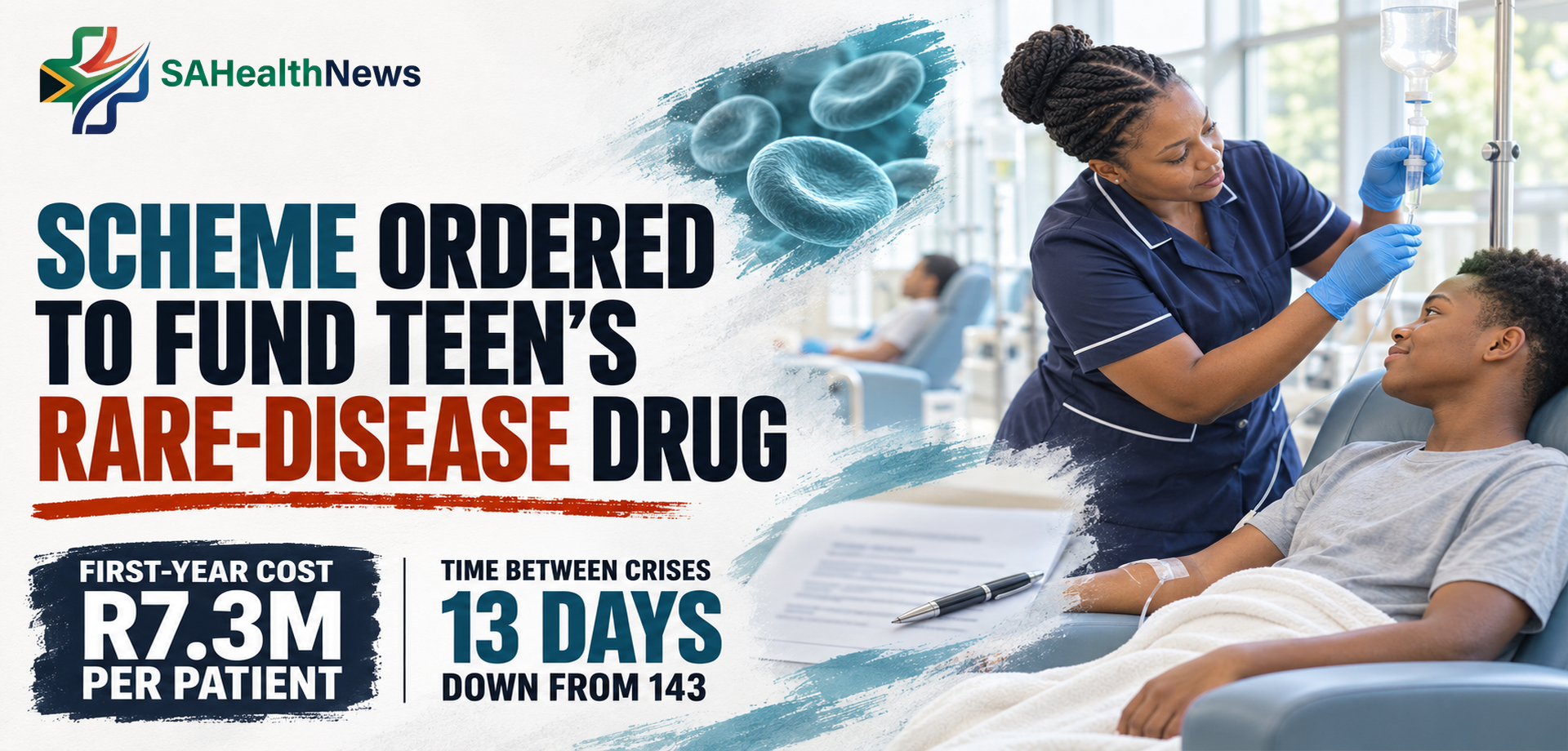
The CMS appeals committee says KeyHealth must fund ravulizumab for a teen with PNH as a PMB, with no upgrade or co-payment. The scheme plans to appeal.
KeyHealth Medical Scheme must pay in full for ravulizumab, a rare-disease medicine costing about R7.3 million in its first year, for a 15-year-old member, the Council for Medical Schemes' appeals committee has ruled. The scheme has told the council it intends to appeal.
The committee delivered its ruling on 29 October. It set aside a decision by the Registrar of Medical Schemes, dated 3 August, that had backed KeyHealth's refusal to fund the drug unconditionally, and ordered the scheme to fund it as a prescribed minimum benefit (PMB) "without requiring an option upgrade, co-payments, deductibles, or the utilization of medical savings accounts". The order was to take effect immediately.
The CMS confirmed on 2 November that it had received correspondence from KeyHealth signalling an appeal, the financial advice publication Moonstone reported on 5 November. Under section 50(3) of the Medical Schemes Act, a party can take a council decision to the Appeal Board within 60 days, and an appeal generally suspends the decision while it is pending. KeyHealth had not responded to Moonstone by the time of publication.
The boy, who is not named in the ruling, was diagnosed in July 2022 with paroxysmal nocturnal haemoglobinuria (PNH), a rare acquired blood disorder in which the immune system's complement proteins destroy red blood cells inside the blood vessels. PNH is a listed PMB condition, which means schemes must pay for its diagnosis, treatment and care.
His treating haematologist at Universitas Academic Hospital in Bloemfontein prescribed ravulizumab (sold as Ultomiris), a long-acting complement inhibitor given every eight weeks. The ruling records that his haemoglobin fell as low as 5.7 g/dL, and that the gaps between his crises shortened from 143 days to 23 days and then to 13. In March 2026 he was admitted as an emergency and given three units of packed red cells.
The dispute was never about whether PNH is a PMB condition. KeyHealth accepted that it is. The scheme argued that ravulizumab is not part of the PMB level of care because it is not on the public sector's essential medicines list, and that supportive care (blood transfusions, iron and folic acid, and anticoagulation) is what public hospitals provide.
In a letter on 23 June, KeyHealth offered to fund 50% of the medicine on conditions. The family would have to move from the Equilibrium option to the scheme's Platinum option, accept a lock-in and claw-back terms, and have funding reassessed if the boy was admitted to hospital. The family proposed that Alexion, the drug's maker, cover half the cost through a co-funding programme, which would have capped KeyHealth's first-year exposure at R3.089 million. The scheme declined, and the family later withdrew the offer.
The committee found that the supportive care KeyHealth relied on had failed the boy and had harmed him, citing the falling haemoglobin, severe haemolytic crises and side effects from repeated iron infusions. Under regulation 15H(c), it said, a scheme must make an exception without penalty when a standard protocol is ineffective or harmful.
It held that the explanatory note pointing schemes to public-hospital practice could not override regulation 8(1), which requires PMB treatment to be paid in full, and could not "penalize rare disease patients for state-sector budgetary/procurement lags". It recorded the treating haematologist's unchallenged evidence that the essential medicines list was last updated in 2010.
It described KeyHealth's conditional offer as "a coercive commercial package", and found the option upgrade, the 50% cap and the use of savings inconsistent with the regulations. It also rejected the scheme's sustainability argument, noting that KeyHealth's audited 2025 financial statements show a solvency ratio of 41.6%, above the legal minimum of 25%, and a net surplus of R249.1 million.
The committee gave weight to section 28(2) of the Constitution, which makes a child's best interests paramount.
The committee was explicit that its decision applies to this boy alone and must not be read as setting a general rule; similar cases must be judged on their own facts. The order allows third-party co-funding, such as the Alexion programme, to be taken into account.
Moonstone reported that ravulizumab costs roughly R6.1 million a year after the first year. The CMS told the publication it respects the decision but cannot comment on its implications while the ruling is subject to appeal.
MediCheck, which represented the family, called the ruling a landmark victory for members with PMB conditions. Its chief executive, Mark Hyman, told Moonstone:
"A Prescribed Minimum Benefit is the same on the cheapest option as on the most expensive."
The family also went to the High Court in Pretoria for interim relief pending the appeal, with a return date of 30 October, and the committee directed that its ruling be served on that court.
For members, the lesson is narrower than the price tag. If a scheme tells you that treatment for a PMB condition depends on which option you are on, ask it to put the legal basis in writing. You can lodge a complaint with the CMS if you disagree.
Sources: CMS Appeals Committee ruling, CMS 95911, delivered 29 October 2026; Moonstone, 5 November 2026; MedicalBrief, 4 November 2026.
Source: SA Health News