Breaking
Latest health news from South Africa and around the world•Wellness, nutrition, and fitness updates daily•Medical breakthroughs and healthcare updates•Science-backed health explainers and guides•Health tech, reviews, and upcoming events•
 SA Health News Desk
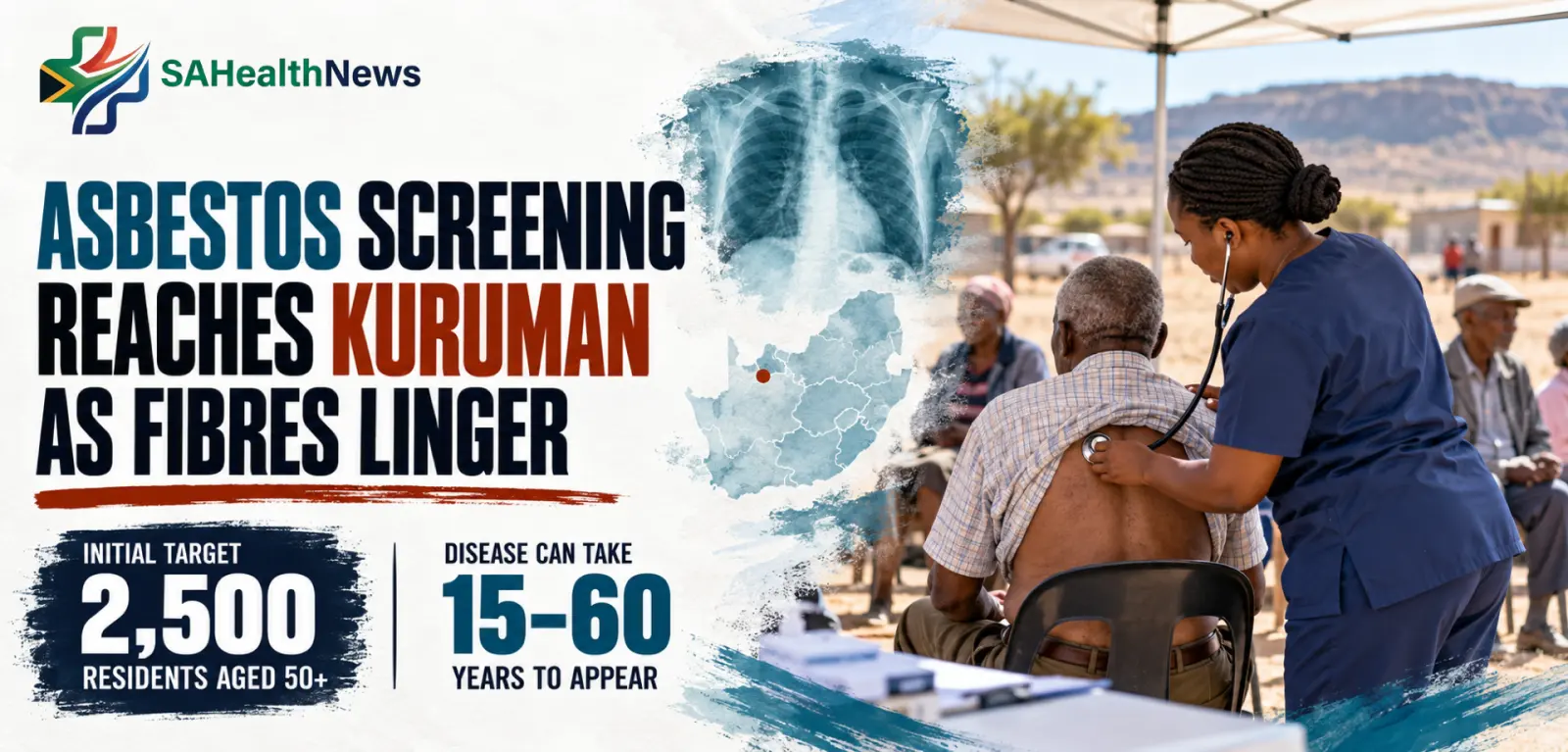
Motsoaledi led community asbestos screening at GaMopedi, Kuruman, where unrehabilitated blue asbestos dumps still expose residents to fibres.
Health Minister Aaron Motsoaledi has taken an asbestos health screening programme to Kuruman in the Northern Cape, where unrehabilitated blue asbestos dumps still leave residents breathing in fibres.
Motsoaledi led a community screening at GaMopedi village outside Kuruman, with Northern Cape Premier Zamani Saul and the province's health MEC, Nontobeko Vilakazi. The national Department of Health had said the minister, the premier and the MEC would lead integrated community screening in the John Taolo Gaetsewe District, which includes Kuruman, on Monday 26 October. SABC News reported on 27 October that the screening at GaMopedi had taken place. According to eNCA, it is initially aimed at 2,500 residents aged 50 and older.
The department has described a blue asbestos mining legacy of dumps that were never rehabilitated. It has not, in the statements read for this story, said how many years ago the Kuruman mines closed.
The department said the programme offers respiratory and general health checks, early detection, health education and referral for further care. It is meant to find people with asbestosis, lung cancer and pleural thickening, a scarring of the lining around the lungs, who have never been diagnosed, and to connect them with treatment and with compensation processes.
"Primary health care starts right there in the house at home, where you screen people."
"But if you screen and catch it early, you can actually act on it."
Motsoaledi said both of those lines to SABC News. The point of a village screening, on his account, is to find disease before a person arrives at a hospital already ill. The department said government remains committed to a coordinated response that combines health screening with the rest of the work. The published wording of that line was incomplete in the 25 October statement, so it is not quoted here.
The department said blue asbestos mining in the province left dumps that were never rehabilitated, along with contaminated soil, roads and public spaces, so residents still breathe in fibres today. SABC News reported that closing the mines has not stopped the disease. That is a statement about illness continuing. It is not a date for when the last mine shut.
Asbestos illness is slow. When Motsoaledi launched the same kind of programme at Mafefe in Limpopo in August, he noted that exposure can take 15 to 60 years to cause disease. In that Limpopo programme, the mines had closed more than 30 years earlier. The Kuruman statements read for this story do not put the same figure on the Northern Cape closures. A disease that can appear decades after exposure is the reason a screening of people aged 50 and older can still find new cases. It is not, by itself, a date for Kuruman.
The Mafefe programme was set up after the death of Mampuru Thobejane, 48, whose family says he had been diagnosed with asbestosis. It used portable digital X-ray machines that the department bought from South Korea, which Motsoaledi described as machines "you can carry on your back". Residents there were also offered TB screening, HIV testing and counselling, and blood pressure and diabetes checks. The department has not said whether the same X-ray units are being used in Kuruman.
In Limpopo, health workers screen while the Department of Mineral and Petroleum Resources works with the Minerals Council to rehabilitate the old mines. Residents there told Health-e News in September that removal work by a contractor appointed in February had not yet started. Screening and rehabilitation are different jobs. One finds the illness. The other is supposed to stop the exposure. At Mafefe, the second job had a contractor and, as of that September report, had not begun.
The first target is 2,500 people aged 50 and older. That age cut-off follows from the disease itself, as Motsoaledi described it at Mafefe: exposure can take 15 to 60 years to cause illness, so the people most likely to be diagnosable now are not the young. The Kuruman programme, on the department's account, offers respiratory and general checks, early detection, health education and referral. The conditions it is looking for are asbestosis, lung cancer and pleural thickening. A person found to have one of those is supposed to be connected to treatment and to compensation processes. The department has not said how many of the 2,500 have been seen, or how many have been referred.
Screening does not remove the dumps. In Limpopo, the Department of Mineral and Petroleum Resources is the department working with the Minerals Council on rehabilitation, and residents told Health-e News in September that a contractor appointed in February had not started removal. The Kuruman statements do not name a contractor for the Northern Cape dumps, and they do not say the GaMopedi screening includes the portable X-ray machines used at Mafefe. What they do say is that the dumps, the soil, the roads and public spaces are still contaminated, and that people are still breathing the fibres in.
The department has not yet published results from either screening drive, or said how many people in the John Taolo Gaetsewe District it expects to reach beyond the first 2,500. Until those figures exist, the public record of the Kuruman programme is the visit, the target, and the department's description of dumps that were never rehabilitated.
Sources: SAnews, 25 October 2026; SABC News, 27 October 2026; eNCA, 27 October 2026; Jacaranda FM, 17 August 2026, on Mafefe; Health-e News, 15 September 2026.
Source: SA Health News