Breaking
Latest health news from South Africa and around the world•Wellness, nutrition, and fitness updates daily•Medical breakthroughs and healthcare updates•Science-backed health explainers and guides•Health tech, reviews, and upcoming events•
 SA Health News Desk
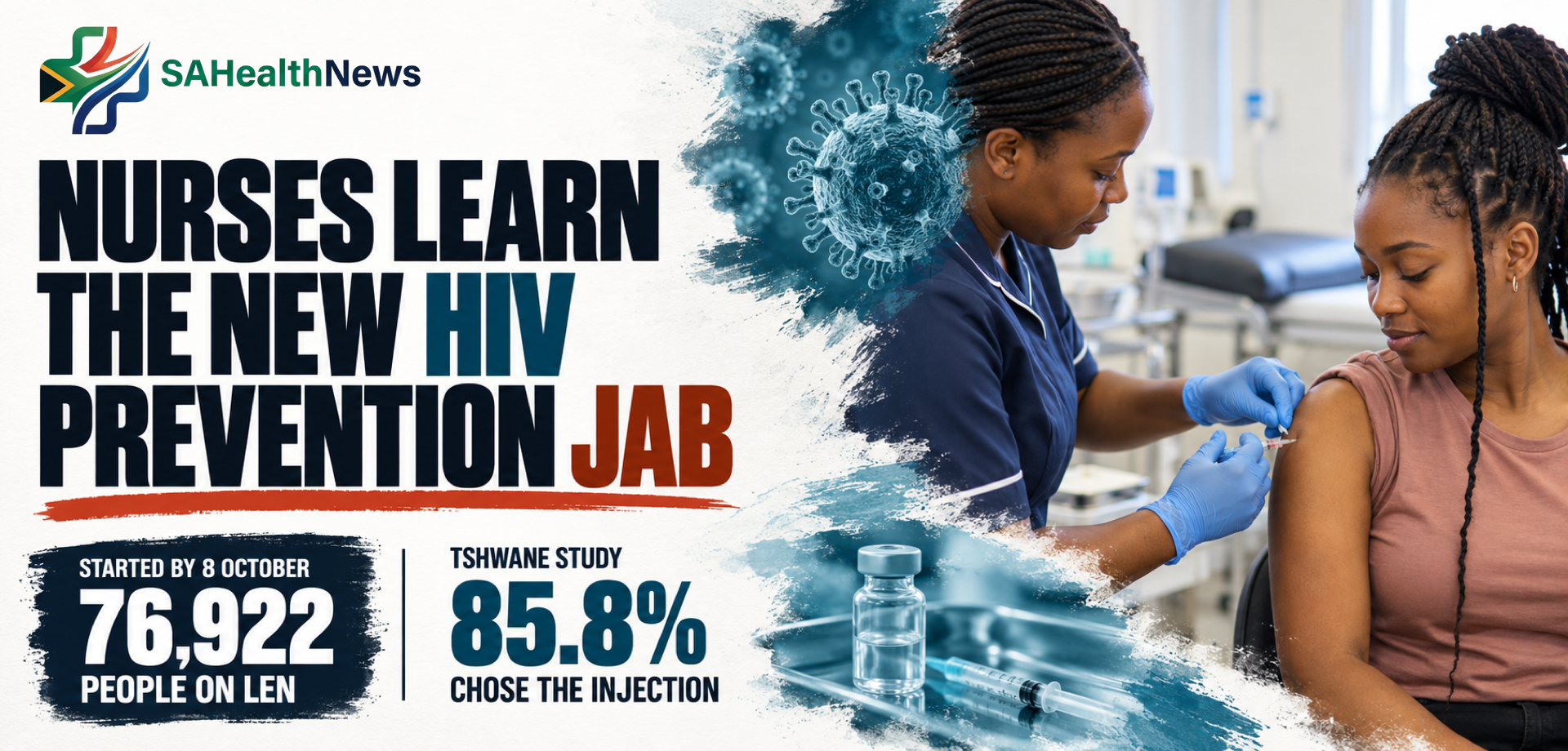
The health department says 76,922 people had their first lenacapavir jab by 8 October. In Tshwane, nurses are learning to give the thick, slow injection.
Close to 77,000 South Africans had received their first lenacapavir injection by 8 October, four months after the public sector began offering the six-monthly HIV prevention jab. The national health department's figures show 76,922 people had started, 36,733 of them at 133 facilities in Gauteng.
Health department spokesperson Foster Mohale gave the numbers to Spotlight, which reported this week on how nurses are learning to give the injection. The national roll-out began on 5 June at 360 public health facilities in six provinces.
For context, South Africa had an estimated 140,000 new HIV infections in 2025, according to Spotlight's HIV dashboard, and about 350,000 people were taking daily oral PrEP in mid-2025, by Thembisa model estimates. Modelling presented to the South African National AIDS Council in October 2025 suggested that reaching 1.4 million to 2.1 million lenacapavir starts a year by 2030 could prevent between 32,200 and 51,700 infections a year.
Lenacapavir, known as LEN, is given as two 1.5ml injections under the skin at the same visit, in the upper arm, buttocks, abdomen or thigh. The person chooses the site. On the day of the first injections they also take two tablets, and two more 24 hours later.
The solution is thick and has to be pushed in slowly to limit leakage. Nurses first complete the compulsory Nurse-Initiated Management of Antiretroviral Therapy (NIMART) course, then practical LEN training on preparing and giving the injection, eligibility, side effects, HIV testing and counselling, backed by videos and clinical mentoring.
Sister Keitumetse "Tumi" Senokwane, a professional nurse with 26 years' experience, manages the two Tshwane sites in the Wits RHI Len4PrEP study, Maria Rantho Community Health Centre and Phedisong 1 Clinic. She told Spotlight the hands-on training helped her get used to the thicker solution, and that she wished she had known from the start that it cannot be injected quickly. A Wits RHI pharmacist showed the team a way to draw it up with the vial kept upright, which she said was faster and lets a nurse prepare both injections at once.
When nurses outside the study began giving LEN in June, Senokwane went to their sites to demonstrate the technique.
Len4PrEP recruited 1,544 people between November 2025 and June 2026, with follow-up running to June 2027. Of the 1,538 whose choice was recorded, 85.8% chose the injection, 13.7% chose daily pills and 0.5% chose no PrEP. Among the 1,319 who started LEN, about half of the women chose the buttocks and about half of the men chose the upper arm.
Professor Saiqa Mullick, Wits RHI's director of implementation science, presented early findings at the Southern African HIV Clinicians Society conference on long-acting treatment in Johannesburg in September. Convenience and privacy were the main reasons people gave for picking the injection.
The clinics offer family planning, screening and treatment for sexually transmitted infections, and HIV prevention in one visit. Appointments took about 90 minutes at first and fell to an hour or less once the flow was reorganised: a navigator, registration, an HIV test, vital signs, then the nurse.
Lumps under the skin at the injection site are common. In one clinical trial of 2,140 people who received lenacapavir, about 64% developed these nodules. Clinics advise a warm or cold compress, or a painkiller, if they are sore.
Study investigator Dr Catherine Martin said real-world experience showed nurses things a manual could not, and that the team consulted trial experts early on about leakage. Mohale said feedback from the early sites would be used to refine training and guidelines.
Source: SA Health News