Breaking
Latest health news from South Africa and around the world•Wellness, nutrition, and fitness updates daily•Medical breakthroughs and healthcare updates•Science-backed health explainers and guides•Health tech, reviews, and upcoming events•
 SA Health News Desk
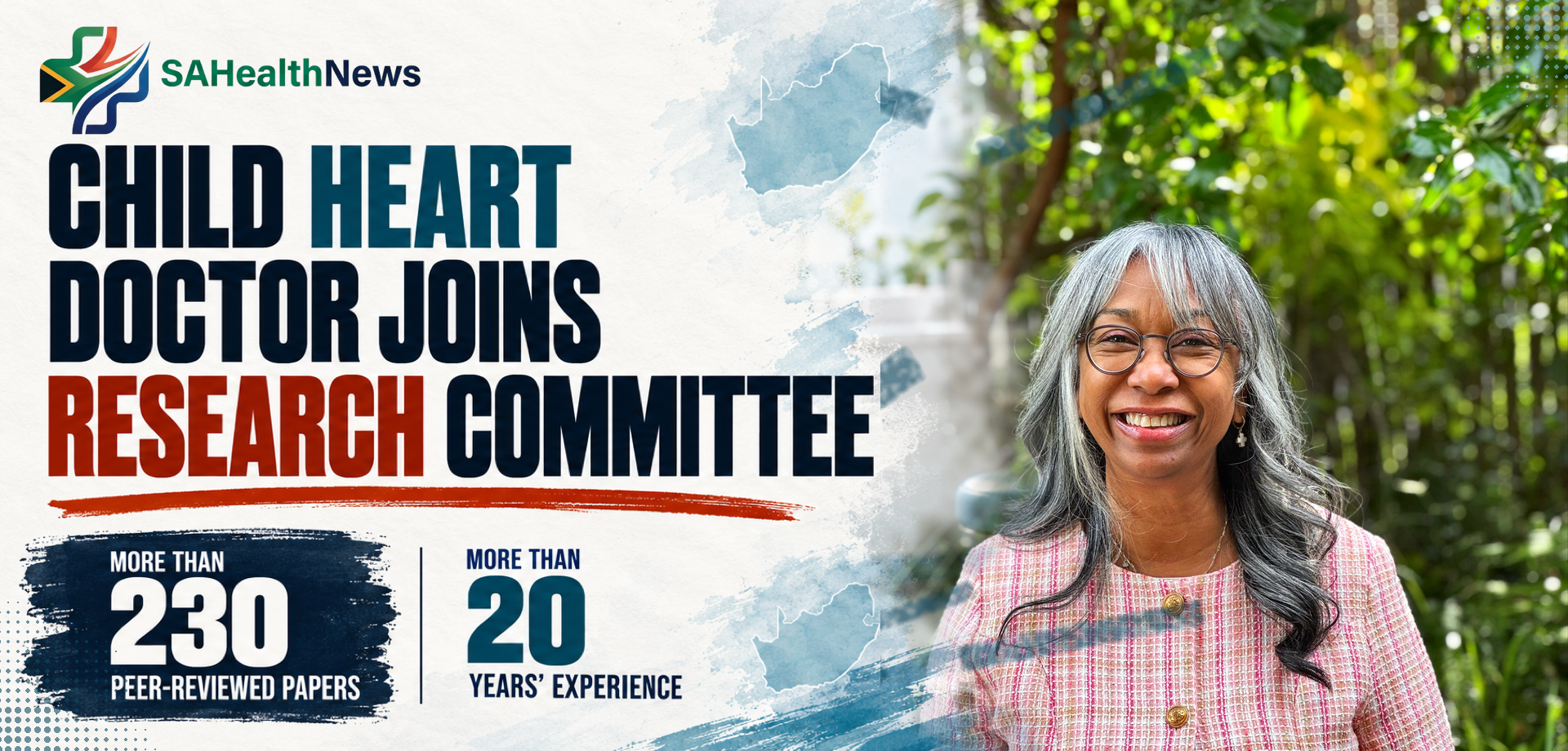
Paediatric cardiologist Liesl Zühlke joins the committee advising the health minister on research and takes up a first honorary chair in Gqeberha.
Prof Liesl Zühlke has spent more than two decades treating and studying children with heart disease. This month she took on two new roles: a seat on the committee that advises the Minister of Health on what South Africa should research, and the first honorary professorship at Nelson Mandela University's young medical school.
The South African Medical Research Council (SAMRC), where Zühlke is Vice-President for Extramural Research and Internal Portfolio, announced on 1 October that the Acting Minister of Health, Stella Ndabeni, had appointed her to the National Health Research Committee (NHRC).
The committee is set up under the National Health Act. Its job is to advise the minister on national health research priorities, line research up with the country's health needs and push findings into policy and practice.
"South Africa faces complex health challenges that require research which is both scientifically excellent and responsive to the needs of our communities," Zühlke said in the SAMRC statement.
Zühlke is a paediatric cardiologist and a University of Cape Town (UCT) graduate, with her medical degree, a master's in public health and a PhD all from the university. Her research centres on rheumatic heart disease, which can follow an untreated streptococcal throat infection, and on congenital heart disease. She also works in health systems research and implementation science, the study of how proven treatments actually reach patients.
She calls rheumatic heart disease a disease of poverty. "It has been eradicated in high-income countries, yet it remains 100% preventable," she told UCT News in May. Part of her doctoral research was done in Langa and Bonteheuwel in Cape Town.
The SAMRC lists her as a B1-rated researcher with the National Research Foundation and the author of more than 230 peer-reviewed papers. She has held leadership positions in the South African Heart Association, the Pan-African Society of Cardiology, the World Heart Federation and the NCD Alliance.
In June she received the 2026 L'Oréal-UNESCO For Women in Science International Award for Africa and the Arab States at UNESCO's headquarters in Paris. She was one of five laureates chosen from 504 nominations in 89 countries.
She credits her late mentor, the cardiologist Prof Bongani Mayosi, with the mantra "Lift as you rise".
On 16 October Zühlke gave a public lecture at Nelson Mandela University's Faculty of Health Sciences to mark her honorary professorship in the Department of Public Health. It is the first honorary professorship in the university's Medical School, which was established in 2021.
Her title was "Leaving No One Behind: Congenital and Rheumatic Heart Disease as a Lens on Comprehensive Health Services". According to the SAMRC's account of the lecture, she argued that childhood heart disease cannot be left to cardiologists alone. Children need connected services, from prevention and early diagnosis in primary care through referral, surgery and intensive care, backed by community health workers and social services.
Handheld heart ultrasound, artificial intelligence and digital health can improve detection, she said, but technology will not fix inequity by itself. She called for reliable African datasets, better disease surveillance and registries, and referral systems that work in practice. Trained health workers closer to communities could use focused heart ultrasound to pick up disease earlier.
She also asked researchers to plan for impact before a study starts rather than after publication, with patients and communities, "experts by experience" in her words, helping to set the questions.
The NHRC does not run studies; it advises on where national research effort should go. Zühlke said she looks forward to working with the department and the wider research community "to help strengthen the country's health research agenda".
At Nelson Mandela University the appointment is meant to bring collaboration, postgraduate training and supervision to the Eastern Cape medical school.
Source: SA Health News