Breaking
Latest health news from South Africa and around the world•Wellness, nutrition, and fitness updates daily•Medical breakthroughs and healthcare updates•Science-backed health explainers and guides•Health tech, reviews, and upcoming events•
 SA Health News Desk
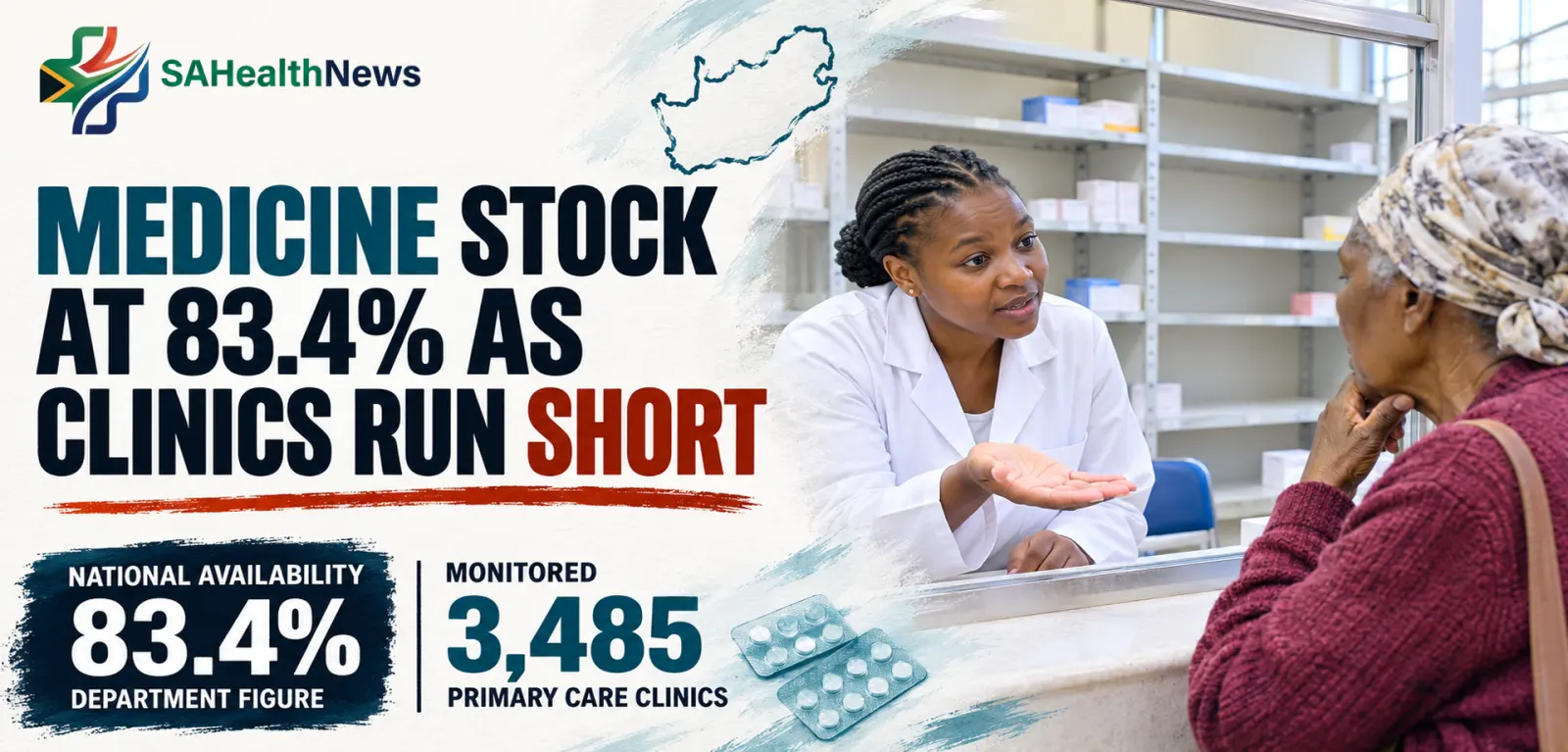
The department says 83.4% of medicines are in stock. Patients report empty shelves, SAHPRA disputes the blame and MPs got no answers from the minister.
A national figure of 83.4% can sound like the medicine shelves are almost full. For someone sent home from a clinic with nothing in a packet, it does not feel that way. The national health department says 83.4% of medicines are available across the public sector, a small step up from 83% two weeks earlier. Patients and a stock-out monitoring group say some clinics have nothing to hand over. The medicines regulator has pushed back against the department's account of who is responsible.
Department spokesperson Foster Mohale gave the 83.4% figure on 13 November, in an account of patients being sent home without treatment. The department tracks about 3,485 primary healthcare facilities and 385 public hospitals. Mohale could not say how many of them were out of particular medicines, because stock levels change continuously. An average that moves by less than half a percentage point does not tell a nurse which cupboard is empty this morning.
The Stop Stockouts Project, a civil society group that runs a complaints hotline, said some facilities have had complete stock-outs. The medicines it listed were diabetes medication, psychiatric drugs, painkillers and contraceptives. Those are not rare items. They are medicines people take every day, or need the day pain or a family-planning visit brings them in.
Complaints posted on X named Randburg Clinic, the Block JJ and Block BB clinics, Dr George Mukhari Academic Hospital and Kalafong Hospital. Those posts have not been independently verified. They are leads, not a confirmed map of empty pharmacies. One patient, identified only as Yolanda, wrote: "There is nothing they can help me with because cupboards are empty, no medication, nothing."
Stop Stockouts put the shortages down to delayed tender awards, quality assurance processes, import authorisations and suppliers that cannot meet demand. That is a chain. A tender that is late, a batch that fails a check, an import that is still waiting for a signature, or a factory that cannot fill the order can all end in the same place: a person standing at a dispensary window.
Mohale cited manufacturing constraints, supplier delays, regulatory requirements, poor distribution of stock between facilities and congestion at the Port of Durban. He said facilities can prescribe a suitable alternative, move stock from one site to another or arrange a follow-up visit.
"Patients should not simply be sent away without medication," he said. He added that the department would investigate reports of patients being told to buy their medicine privately, and that it is talking to suppliers and looking at other sources, among them authorised imports.
He gave no date for when supply would settle. "It is difficult to give a single date by which all medicine supplies will stabilise," he said.
The alternatives he named only help if the alternative is actually on the shelf, if another clinic has stock it can spare, or if the person can come back. A follow-up visit costs transport and a day. Being told to buy privately shifts the bill onto a household that uses the public clinic because it cannot pay a private pharmacy. The department has said it will look into those reports. It has not said how many such reports it has, or when the investigation will report back.
The department said earlier this month that some local manufacturers with state contracts had failed to meet the standards of the South African Health Products Regulatory Authority (SAHPRA), and that this was one reason for the shortages.
SAHPRA answered on 11 November. Communications manager Rodgers Baloyi said shortages have several causes, among them manufacturing constraints, disruption to global supply chains and shortages of active ingredients.
"Regulatory compliance interventions are not necessarily the sole cause of shortages," he said.
Baloyi said the regulator inspects manufacturers against Good Manufacturing Practice requirements and makes them correct any deficiencies it finds. He would not name the manufacturers found wanting, say when they were inspected or describe what was wrong. SAHPRA, he said, does not routinely publish that information unless patients or public health are at risk.
That leaves a gap a patient cannot close. The department has pointed at manufacturers who failed a standard. The regulator says compliance work is not the only cause, and it will not say which plants, which faults or which dates. Professor Renier Coetzee, president of the Pharmaceutical Society of South Africa, said there was too little reliable information about how widespread the shortages are and whether promised deliveries would arrive. "Expanding local production will not resolve the immediate shortages," he said. A factory that might produce more next year does not fill a script today.
Parliament's Portfolio Committee on Health met this week to discuss shortages of antiretrovirals, among other matters. Health Minister Dr Aaron Motsoaledi and Deputy Minister Dr Joe Phaahla did not attend, according to a report on 12 November. Director-General Dr Thembisile Xulu was also absent, reportedly because of engagements overseas planned earlier.
EFF MP Naledi Chirwa-Mpungose called the antiretroviral shortage "a catastrophic crisis" and said the absence of both political heads showed disregard for Parliament. "To just leave on that all three of them are not in the meeting I think it's going to be a problem," she said.
The committee first raised the shortages on 14 October. MPs have asked for stock reports at facility level and for urgent meetings with provincial health departments and MECs. A month on, the people who can order those reports were not in the room. Antiretrovirals are the medicines that keep HIV treatment continuous. A missed month is not a paperwork delay for the person who takes them.
A national average says little about a single clinic shelf. The department's own October list of medicines below target stock ran to 165 lines, with some at 0% availability, so a patient who needs one of those can leave empty-handed even when most other items are on the shelf. Availability of "medicines" as a blended percentage can rise while the one item a person was sent to collect stays at zero.
Provincial health departments have told patients to keep collecting their medication and not to stop or change it without speaking to a nurse, pharmacist or doctor. Anyone given a different medicine should ask why before taking it. A different brand, a different strength or a gap of several days is a clinical decision, not something to guess at home.
None of this replaces advice from the clinic, a pharmacist or a doctor who knows the prescription. If a facility has no stock, the questions worth asking there are whether a suitable alternative is available, whether stock can be moved from another site, and when to come back. Do not stop a prescribed medicine, and do not start a substitute bought privately, unless a clinician has said so.
Source: SA Health News