Breaking
Latest health news from South Africa and around the world•Wellness, nutrition, and fitness updates daily•Medical breakthroughs and healthcare updates•Science-backed health explainers and guides•Health tech, reviews, and upcoming events•
 SA Health News Desk
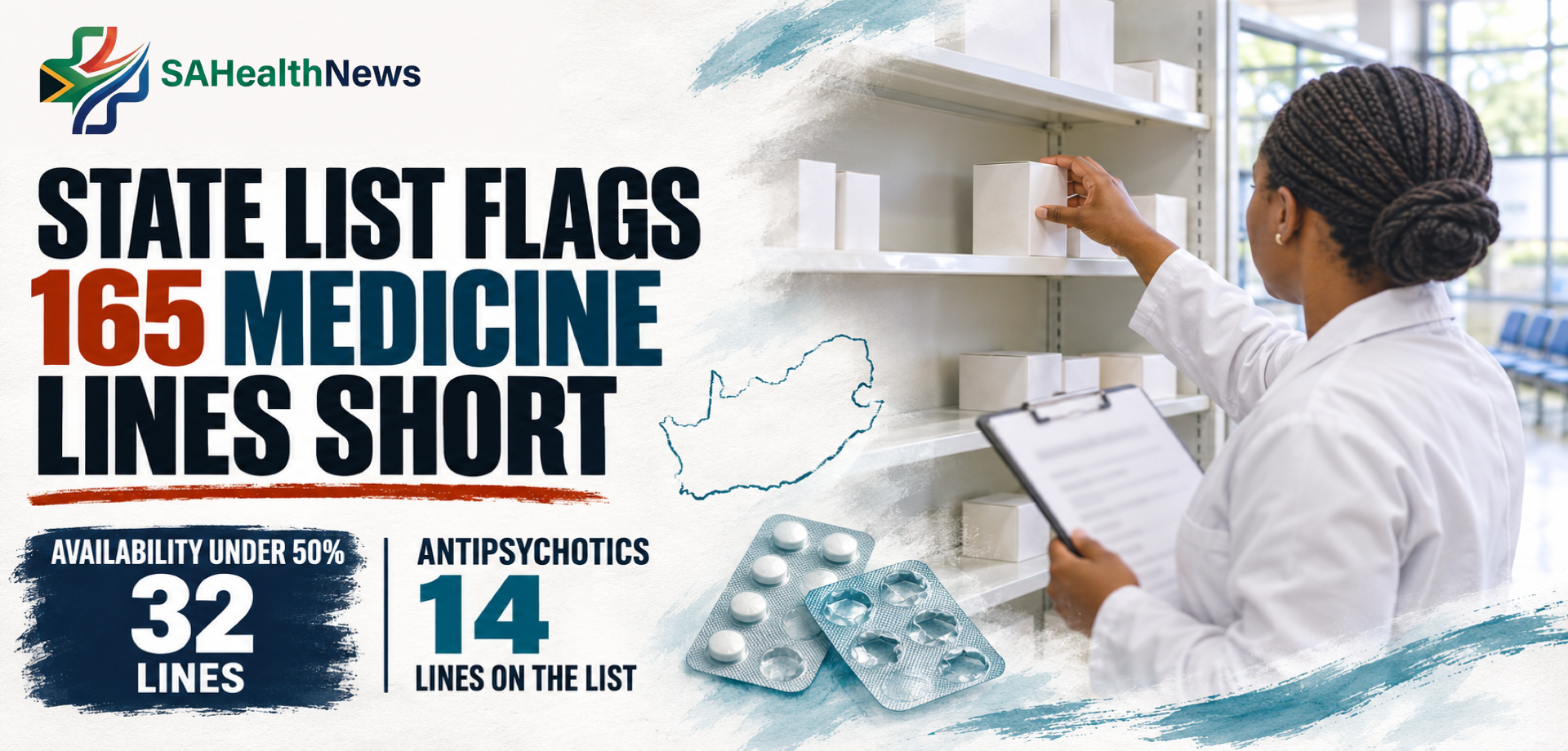
The state's October hotlist puts 165 medicine lines below target stock, 32 under half, as SAHPRA closures and unpaid provincial bills hit supply.
The national health department's own list of medicines in short supply runs to 165 lines. Its October hotlist, compiled by the department's contract management unit, names 154 different products, among them antiretrovirals, antipsychotics, cancer medicines, an anaesthetic muscle relaxant and a common blood pressure tablet.
The spreadsheet is dated 7 October and covers 22 September to 6 October. Every line on it is a medicine on national contract whose availability has fallen below target; the best-stocked line on the list stands at 85%. Thirty-two lines are at less than half. Thirty-two lines are also new to the list this month, while 133 have been on it longer.
That is more than three times the "up to 50" critical medicines the DA cited on 28 October, when it asked Parliament's health committee to investigate.
Health department spokesperson Foster Mohale told Business Day, in a report published on 5 November, that the disruption was unprecedented. He said "some local manufacturers holding government contracts have not complied with regulatory standards", and that the South African Health Products Regulatory Authority (SAHPRA) had closed certain manufacturing lines. He named the affected companies as Barrs, Adcock Ingram, Wrapsa, Sonke and Aspen Pharmacare.
The hotlist bears out part of that. Two Barrs lines, both compound benzoin tincture, give the root cause as "Barrs manufacturing site closed down". A Barrs calamine lotion line reads: "Production has stopped due to SAHPRA enforcement."
Other lines are waiting on the regulator rather than shut down by it. Unimed Healthcare's propranolol 40mg tablets, a blood pressure and heart medicine, are at 0% availability, held up by SAHPRA variation approvals or post-importation testing. The same cause is given for aciclovir injection, metronidazole tablets and one strength of filgrastim. A second filgrastim strength, at 27%, and levetiracetam 250mg tablets for epilepsy are delayed pending SAHPRA approval of a product variation. A pack of propranolol 10mg tablets is waiting for a SAHPRA inspection.
Mohale said the department is looking for alternatives through public procurement or, "where no locally registered supplier is available, through special imports under Section 21 of the Medicines Act". He said it is working with companies "in regular consultation with the national essential medicines list committee" and helping provinces with payment delays.
Antipsychotics account for 14 lines: olanzapine, quetiapine, risperidone and haloperidol. Aurogen's olanzapine lines are marked "Currently out of stock" because of manufacturing delays, with the 5mg dispersible tablet at 27% and the 10mg tablet at 43%.
Nine lines are HIV medicines. Mylan's lopinavir/ritonavir tablets are at 18% and 19%, and a planning note on both strengths says: "No supplier pipeline has been confirmed." Mylan's efavirenz 200mg and 600mg tablets are at 21% and 23%, and its 90-tablet pack of tenofovir, emtricitabine and efavirenz is at 25%.
Six lines are cancer treatments or support medicines: carboplatin, docetaxel, two strengths of imatinib and two of filgrastim, which boosts white blood cells during chemotherapy.
Among the rest, cisatracurium injection, a muscle relaxant used in theatre and intensive care, is at 7% in its 5mg strength. Ferrous sulfate compound tablets for anaemia are at 19%. Several metformin lines for type 2 diabetes are short; for two of them the cause given is the late award of the tender, which delayed the start of manufacturing.
A separate tab lists seven lines held back because provinces have not paid. Supplier notes for human immunoglobulin, anti-D immunoglobulin and lyophilised plasma say customers will be supplied except for blocked accounts in the North West, Eastern Cape and Northern Cape. Albumin is held up by a blocked account at the Port Elizabeth depot. The plan recorded for one immunoglobulin line is simply: "Once payments are made from respective provinces."
Anti-D is given to Rhesus-negative mothers to protect later pregnancies, and immunoglobulin and plasma products are used for immune disorders and bleeding.
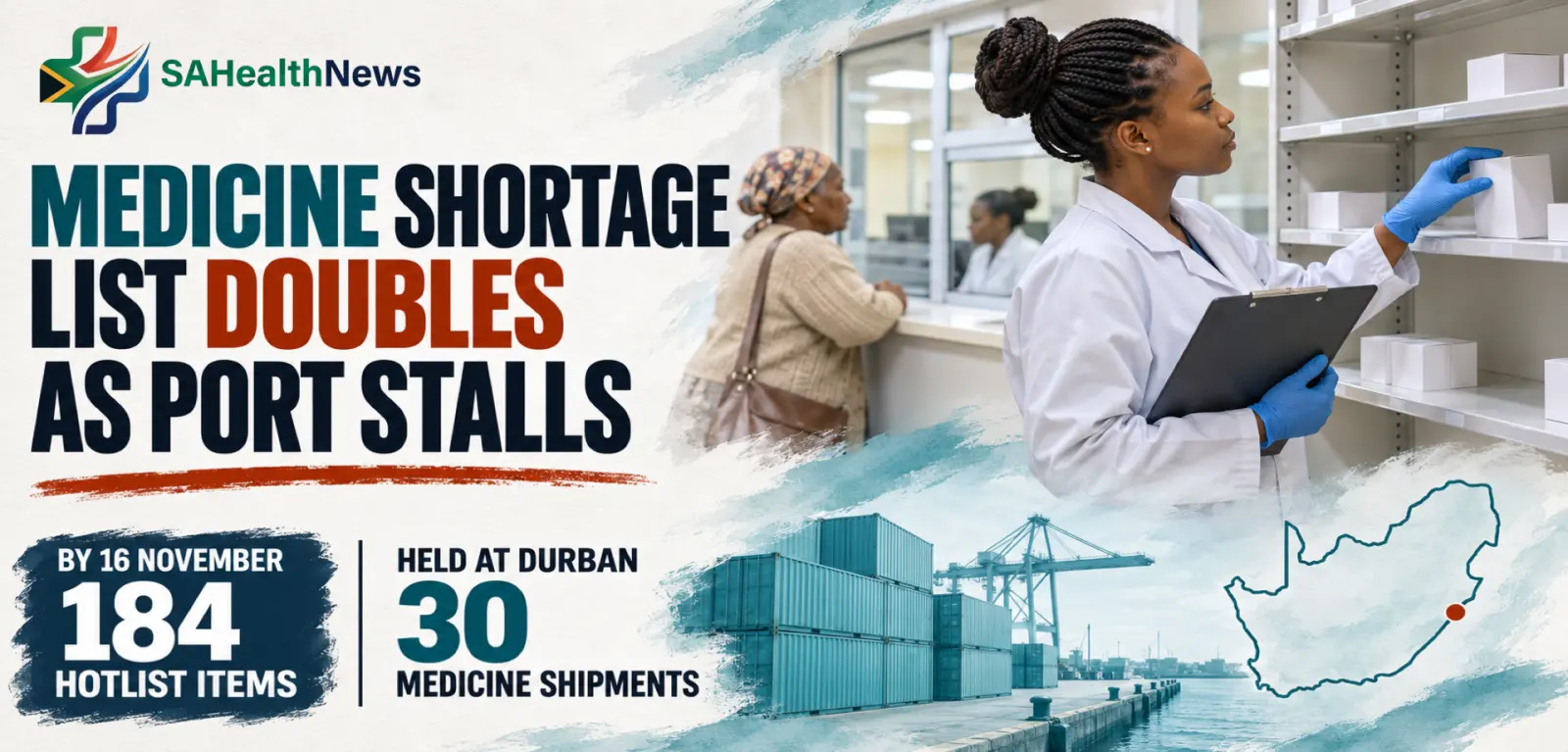
Business Day's report also points to congestion at the port of Durban, production delays linked to conflict in the Middle East, multinationals dropping older, unprofitable medicines, and a requirement to hold two months of buffer stock that some manufacturers cannot meet. Stavros Nicolaou, who chairs the Pharmaceutical Task Group, called the list of medicines in short supply the longest "in living memory".
Patients who can afford it are being given prescriptions to fill at private pharmacies, which psychiatrist Mvuyiso Talatala, past president of the South African Society of Psychiatrists, told the paper is an ethical obligation.
"It's multiple drugs, from multiple pharmaceutical companies, for multiple disorders."
He warned that "changing a patient's medication could cause severe side effects or trigger a relapse requiring hospital admission". Taswill Welcome, a mental health advocate whose Cape Town support group has about 40 members, said they have struggled to get chronic medication since June. Three have recently relapsed and been admitted to hospital.
The Independent Community Pharmacy Association, which represents about 1,200 retail pharmacies, reported trouble with only a handful of items. The shortages appear to sit mainly in the public sector.
Provincial departments' advice to patients has not changed: keep collecting your medication, and do not stop it or change how you take it without speaking to a nurse, pharmacist or doctor. If your tablets look different, ask why before you take them.
The October list is the latest on the department's website. It records stock as it stood on 6 October; a November edition had not been posted by the morning of 6 November.
Sources: National Department of Health, Contract Management Unit, Hotlist October 2026 (report date 7 October 2026); Business Day/TimesLIVE, 5 November 2026; DA statement, 28 October 2026.
Source: SA Health News