Breaking
Latest health news from South Africa and around the world•Wellness, nutrition, and fitness updates daily•Medical breakthroughs and healthcare updates•Science-backed health explainers and guides•Health tech, reviews, and upcoming events•
 SA Health News Desk
Early findings place the contamination inside Rhodes University's and St Albans prison's own water systems, not the town supply. Lab results are pending.
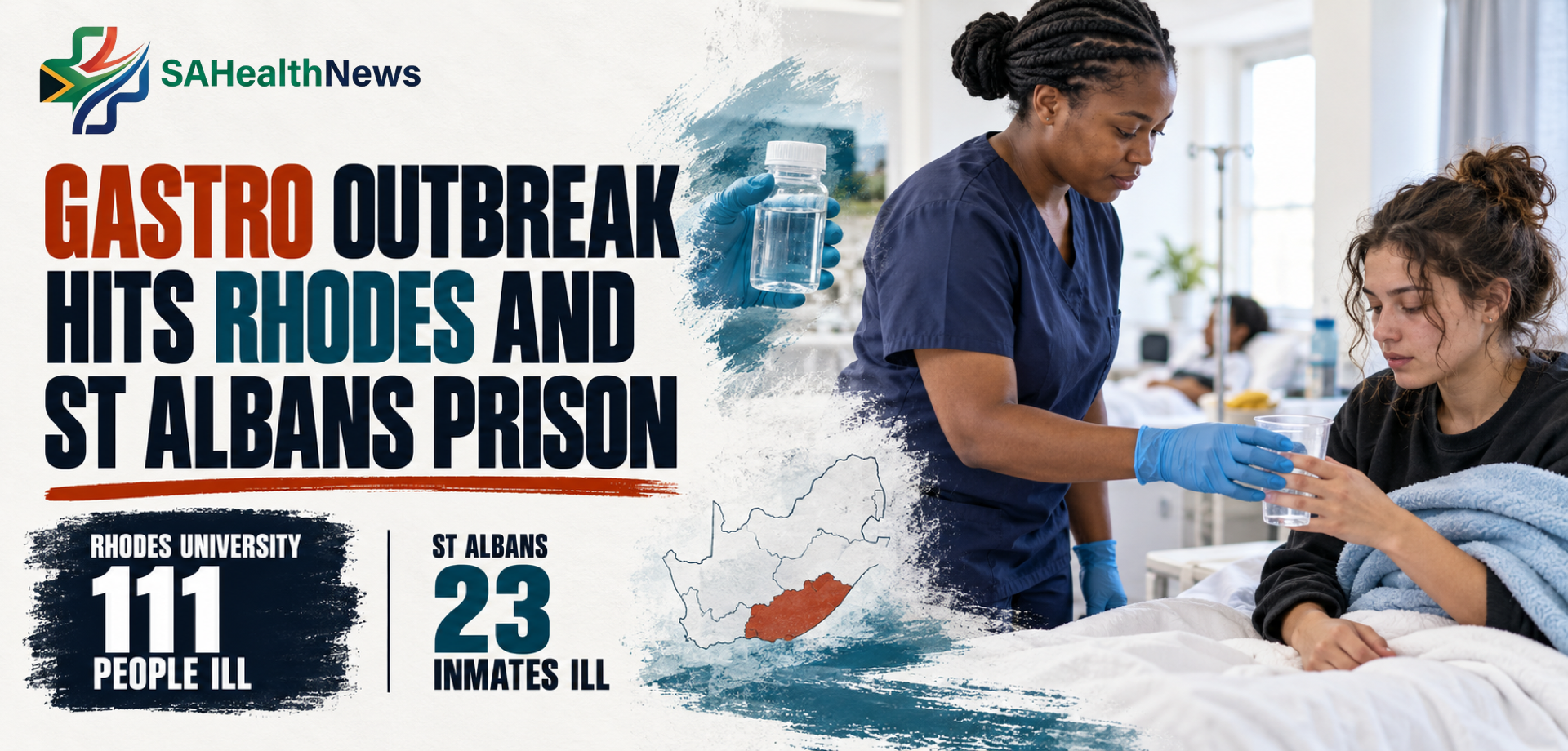
The government has opened an investigation after 111 people at Rhodes University in Makhanda and 23 inmates at St Albans Correctional Centre in Nelson Mandela Bay fell ill with gastrointestinal symptoms this week.
Patients went for treatment with severe abdominal cramps, diarrhoea, vomiting and dehydration, according to a government statement published by SAnews on Thursday, 22 October.
The statement says the illness is concentrated at the university and the prison, and that preliminary findings place the contamination "within their internal water distribution systems" rather than in the municipal supply. It also says that "laboratory test results of all the samples taken are still pending", so the cause has not been confirmed.
Samples were taken from Makana's water sources, from the university's own water storage and distribution system, and from the elevated water storage tower at St Albans.
Water and Sanitation Minister Pemmy Majodina and Eastern Cape Premier Oscar Mabuyane led an intergovernmental meeting on Wednesday evening with Makana mayor Yandiswa Vara and Nelson Mandela Bay mayor Babalwa Lobishe. The technical team now working on the outbreak includes the Department of Water and Sanitation, the provincial health and cooperative governance departments, Sarah Baartman District Municipality, the two municipalities, the National Institute for Communicable Diseases (NICD), Amatola Water and the university.
Rhodes spokesperson Olwetu Gwanya announced the cluster on Tuesday, 20 October, and said it might extend beyond campus. The university first counted 109 cases and confirmed 111 on Wednesday. Students with severe symptoms were taken to hospital and have since returned to campus. The university has not said how many were admitted.
Makana Local Municipality spokesperson Anele Mjekula told Daily Maverick the municipality was investigating a reported E. coli detection at the university. The municipality said there were no conclusive signs of wider contamination and no related cases reported outside Rhodes so far, contradicting the university's earlier suggestion. Municipal teams are checking clinics and schools for further cases.
The outbreak has arrived during exams. Rhodes has handed out bottled water and says it is coordinating medical support for students.
Makhanda's water problems predate this week. In the Department of Water and Sanitation's 2023 Blue Drop report, the town's drinking-water quality score fell to 32.46%, from 70% in 2014, and Makana was found not to have issued boil-water alerts when its water failed to meet standards. In June 2026 the South African Human Rights Commission found that the municipality had infringed residents' constitutional rights, including access to water and dignity, and traced the problems to institutional and operational breakdown rather than a shortage of water.
The Eastern Cape cases follow the outbreak in Bronkhorstspruit, Tshwane, where 408 people fell ill between 7 and 18 October after water left the local treatment works unchlorinated.
Officials ask anyone with symptoms to seek care early and to report suspected cases to a clinic or the local health authority. Wash hands with soap after using the toilet and before handling food.
Rhodes advises students and staff to drink boiled-and-cooled or bottled water, to use safe water for cooking and brushing teeth, and to avoid ice and raw produce washed in untreated water. Anyone with a fever or severe symptoms should get urgent care. Students who fall ill should tell their warden or sub-warden. The Rhodes University Health Care Centre is on 046 603 8523; after hours, call ER24 on 010 205 3068. ## What the samples can and cannot show
The government statement, published by SAnews on Thursday 22 October, is careful about the limit of what is known. Illness is concentrated at Rhodes University and at St Albans Correctional Centre. Preliminary findings place the contamination inside those institutions' own water distribution systems, not in the municipal supply. The same statement says laboratory results on all the samples are still pending. Until those results are published, the cause is unconfirmed, including any reported E. coli detection.
Samples were taken from Makana's water sources, from the university's own water storage and distribution system, and from the elevated water storage tower at St Albans. That spread of sampling is why officials can talk about an internal system without yet naming an organism or a broken pipe. A preliminary finding is not a completed outbreak investigation.
Makana spokesperson Anele Mjekula told Daily Maverick the municipality was investigating a reported E. coli detection at the university, and that there were no conclusive signs of wider contamination and no related cases reported outside Rhodes so far. That account sits next to the university's earlier comment, from spokesperson Olwetu Gwanya on Tuesday 20 October, that the cluster might extend beyond campus. The two statements are not the same, and neither is a lab result.
Gwanya's Tuesday announcement was the first public count. The university first counted 109 cases and confirmed 111 on Wednesday. Students with severe symptoms were taken to hospital and have since returned to campus. The university has not said how many were admitted. At St Albans, the government statement puts the number of inmates who fell ill at 23. The symptoms described are severe abdominal cramps, diarrhoea, vomiting and dehydration.
Water and Sanitation Minister Pemmy Majodina and Eastern Cape Premier Oscar Mabuyane led an intergovernmental meeting on Wednesday evening with Makana mayor Yandiswa Vara and Nelson Mandela Bay mayor Babalwa Lobishe. The technical team named in the statement includes the Department of Water and Sanitation, the provincial health and cooperative governance departments, Sarah Baartman District Municipality, the two municipalities, the National Institute for Communicable Diseases, Amatola Water and the university.
The outbreak has arrived during exams. Rhodes has handed out bottled water and says it is coordinating medical support for students.
Makhanda's water problems predate this week. In the Department of Water and Sanitation's 2023 Blue Drop report, the town's drinking-water quality score fell to 32.46%, from 70% in 2014, and Makana was found not to have issued boil-water alerts when its water failed to meet standards. In June 2026 the South African Human Rights Commission found that the municipality had infringed residents' constitutional rights, including access to water and dignity, and traced the problems to institutional and operational breakdown rather than a shortage of water.
That record explains why a gastro cluster in Makhanda is immediately a water story. It does not prove that this week's illness came from the municipal supply. The preliminary finding in the government statement points the other way: inside the university and the prison. The Blue Drop score and the commission's finding stay in the piece as the town's record, not as the laboratory result that is still outstanding.
The Eastern Cape cases follow the outbreak in Bronkhorstspruit, Tshwane, where 408 people fell ill between 7 and 18 October after water left the local treatment works unchlorinated. The two outbreaks are not the same event, and this article does not treat the Tshwane failure as the cause in Makhanda or at St Albans.
What is confirmed is the count and the response. One hundred and eleven people at Rhodes and 23 inmates at St Albans fell ill. Senior officials from water, the province and both municipalities met. Samples are with the laboratories. Bottled water is out on campus, and the university has told students and staff to drink boiled-and-cooled or bottled water, to use safe water for cooking and brushing teeth, and to avoid ice and raw produce washed in untreated water.
What is not confirmed is the organism, the point of contamination, how many students were admitted, and whether any cases sit outside the two institutions. Officials ask anyone with symptoms to seek care early and to report suspected cases to a clinic or the local health authority, and to wash hands with soap after using the toilet and before handling food. Anyone with a fever or severe symptoms should get urgent care. Students who fall ill should tell their warden or sub-warden. The Rhodes University Health Care Centre is on 046 603 8523; after hours, call ER24 on 010 205 3068.
This report is journalism, not individual medical advice. The ledger moves when the pending laboratory results are published, not when a social-media total circulates without a sample behind it.
Source: SA Health News