Breaking
Latest health news from South Africa and around the world•Wellness, nutrition, and fitness updates daily•Medical breakthroughs and healthcare updates•Science-backed health explainers and guides•Health tech, reviews, and upcoming events•
 SA Health News Desk
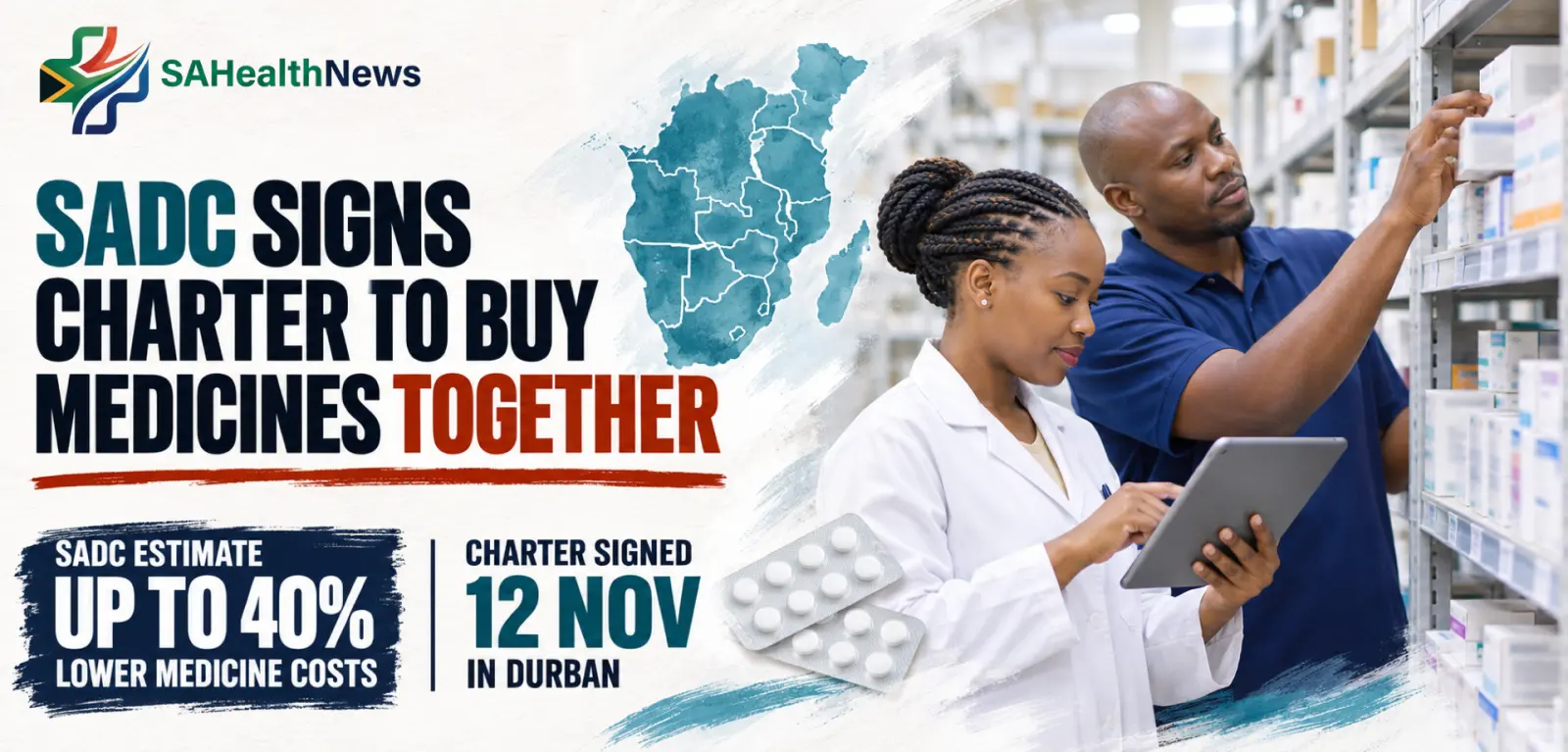
SADC health ministers signed the charter for a joint medicine-buying body in Durban on 12 November. SADC says pooled buying could cut costs by up to 40%.
Health ministers from the region have signed the charter for a body that would buy medicines and health supplies as one bloc. The signing happened in Durban on 12 November, the last day of a four-day meeting of Southern African Development Community ministers of health and ministers responsible for HIV and Aids. SADC officials say the project has been in preparation since 2014. A person collecting a repeat prescription this week will not see a difference at the dispensary window because of it.
The charter establishes the SADC Pharmaceuticals Pooled Procurement Services, the SPPS. The SADC Secretariat said Tanzania was the first member state to sign. It did not say which other countries signed on the day. A charter that exists, and a list of who has joined it, are different facts. Only the first of those is public.
The service is built on group contracting. Member states would share price and supplier information, pool what they need, and negotiate with suppliers together. SADC says that could cut medicine costs by up to 40%, improve the availability of essential medicines and make supply more secure. It also expects a larger, more predictable market to support medicine manufacturing in the region.
"Up to 40%" is the secretariat's estimate, not a price a clinic has been quoted. No tender has been issued. No medicine has been named. A cut of that size, if it arrives, would be measured against whatever each country pays now, on whatever list is eventually put out. Until that list exists, the percentage is a reason the ministers signed, not a saving a hospital can book.
Tanzania has been the designated host since November 2017. Its Medical Stores Department built the electronic system, eSPPS, in 2018. By the end of March 2026, eight countries had finished in-country assessments and training: Botswana, Eswatini, Malawi, Mozambique, Namibia, Tanzania, Zambia and Zimbabwe. South Africa is not on that list. At a meeting in Dar es Salaam, Dr Lamboly Kumboneki of the SADC Secretariat said the service was expected to be fully operational by the last quarter of 2026. That quarter is the one we are in.
The Durban programme listed South Africa, Mozambique, Lesotho, Seychelles and Tanzania to sign commitments to take part in group contracting. The secretariat's statement did not confirm that those commitments were signed. Being on a programme and having signed are not the same, and the article can only report the second where the secretariat has said it.
Deputy Health Minister Dr Joe Phaahla, who chairs the ministers, opened the meeting on 12 November. He called for regional solidarity and for member states to finance more of their own health systems. Falling aid, he said, and growing competition for resources, meant countries had to build their own capacity to finance, manufacture, buy and regulate essential health products.
"Our future cannot rest on the goodwill of others alone," he said.
That is an argument about who pays, not a claim that the joint buying body is already buying. The goodwill he is talking about is donor funding. The capacity he is talking about includes factories, regulators and a procurement system that more than one country trusts with an order. The charter is a step toward the last of those. It does not, by itself, put a plant on stream or a packet on a shelf.
The SPPS steering committee, set up in July 2025, is chaired by Marione Schonfeldt, a senior pharmaceutical policy specialist in the national Department of Health. At the committee's meeting in Sandton in April she described pooled buying as "a moral imperative". The moral claim and the operational one sit side by side. A senior official in the national department chairs the committee that has to make the buying real. The same department's clinics are where a failed supply shows up as a person sent home with nothing.
Under the charter the SPPS becomes a SADC institution in its own right and takes over from the interim steering committee. That is an institutional change. It is not a delivery. The secretariat calls the signing a milestone on the way to making the service work. Milestones are how secretariats mark a signature. Patients meet a different test: is the medicine there, is it the one prescribed, and what does it cost the province that buys it.
South Africa already buys for a large public system. Joining a regional pool would matter if the pool's price, quality checks and delivery dates were better than the ones the country gets alone, and if the medicines on the joint list were the ones facilities actually run out of. None of that comparison has been published. The eight countries that have done the training are further along the preparation than a country that has only been listed, unverified, for a group-contracting commitment.
For HIV and Aids, the meeting that produced the charter was also a meeting of the ministers responsible for that epidemic. The statement does not say that antiretrovirals, or any other class of medicine, will be in the first joint buy. Anyone on a lifelong medicine needs continuity more than they need a regional announcement. A gap of a month is a clinical problem. A charter signed in Durban does not fill it.
SADC has not named the first medicines to be bought jointly, and it has not given a date for the first joint tender. It has not said whether South Africa signed the group-contracting commitment that appeared on the programme. It has not said which countries, after Tanzania, signed the charter on 12 November.
None of this replaces advice from a clinic, a pharmacist or a doctor. Do not change or stop a prescribed medicine because a regional buying body has been created. Nothing in the charter, as the secretariat has described it, changes what should be collected this week.
The useful next facts are narrow. The names on the charter. Whether South Africa's group-contracting commitment was actually signed. The first list of medicines. And a tender date. Until those appear, the Durban signing is a decision to build a buying body, not a lower price at the dispensary.
Source: SA Health News