Breaking
Latest health news from South Africa and around the world•Wellness, nutrition, and fitness updates daily•Medical breakthroughs and healthcare updates•Science-backed health explainers and guides•Health tech, reviews, and upcoming events•
 SA Health News Desk
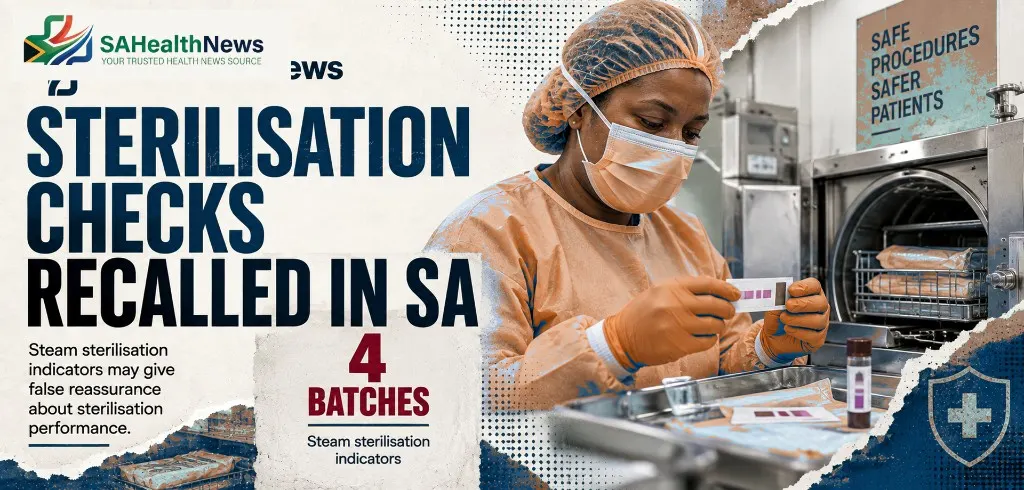
Four batches of STERIS VERIFY biological indicators are recalled after spore counts fell below shelf-life specs — risk of false sterilisation reassurance, not confirmed patient harm.
South African hospitals and healthcare facilities are being told to immediately stop using four batches of biological indicators designed to verify whether steam sterilisation equipment has worked properly. SAHPRA posted the recall in September, making it one of the regulator’s newest patient-safety actions. The affected product is the STERIS VERIFY Dual Species Self-Contained Biological Indicator for Steam and ETO, model S3060, distributed locally by SafMed. The affected batches are 260810, 261106, 270116 and 270302.
SAHPRA classifies the action as a Class II, Type C recall. This is not a recall of a medicine given directly to patients. The device sits further upstream in patient safety. It helps healthcare facilities check whether sterilisation processes used on medical equipment have worked.
Biological sterilisation indicators deliberately contain resistant bacterial spores. The logic is straightforward.
A sterilisation process is challenged with organisms that are deliberately difficult to kill. If those spores are successfully inactivated under the correct test conditions, the result provides evidence that the sterilisation cycle performed as intended.
STERIS found that the population of Geobacillus stearothermophilus spores in the affected indicators had fallen below the minimum shelf-life specification. That creates an unusual failure mode.
The indicator could potentially show no microbial growth after a steam sterilisation cycle — normally interpreted as evidence that sterilisation succeeded — when the test contained fewer viable spores than it was supposed to contain.
In other words, the concern is not simply that the indicator “doesn’t work”. The concern is false reassurance.
Healthcare sterilisation is built around eliminating microorganisms from instruments and devices before they are reused. A biological indicator is one component of the quality-assurance system. If a compromised indicator incorrectly suggests that a cycle performed effectively, staff could potentially overestimate the reliability of the sterilisation process. SAHPRA describes the problem more cautiously: the defect could result in an inaccurate interpretation of the effectiveness of the monitored steam sterilisation cycle.
The recall notice does not report patient infections or confirmed sterilisation failures caused by the affected indicators. That distinction should be maintained. The recall addresses a potential monitoring failure, not evidence that contaminated surgical instruments have already harmed patients.
The regulator’s instructions are explicit. Healthcare facilities holding affected units must:
SafMed will arrange collection after facilities confirm how much affected stock they hold and where it is stored. The distributor has asked customers to submit that information according to the recall process. The listed expiry dates extend across 2026 and 2027.
Unlike a medicine recall, this is not a situation in which patients should search through cupboards for a batch number. The indicators are professional healthcare products used inside sterilisation systems. The immediate responsibility lies with hospitals, clinics, sterilisation departments, distributors and other facilities that use them. Facilities also need to determine whether their sterilisation-quality systems rely on affected stock and follow the manufacturer and regulator’s instructions for managing any implications.
That assessment should be done by infection-prevention, sterilisation and clinical engineering teams rather than patients attempting to infer risk from the recall alone.
Modern sterilisation programmes do not normally depend on a single biological indicator in isolation. Facilities use combinations of physical cycle parameters, chemical indicators, biological monitoring, equipment maintenance and documented procedures. That redundancy exists because failures in infection prevention can have serious consequences. The recall therefore does not mean every instrument processed alongside an affected indicator was inadequately sterilised. It means one of the systems used to verify sterilisation may not have been performing to specification.
That is enough to justify removing the product.
Medical-device recalls often concern products most patients never see. That can make them sound administrative. Sterilisation monitoring shows why that interpretation is wrong. Surgical instruments, reusable medical devices and equipment can move between patients. Healthcare systems depend on validated sterilisation processes to break that chain of potential transmission. The indicator itself never has to touch a patient to matter to patient safety. Its job is to tell healthcare workers whether another process can be trusted.
SAHPRA’s recall is therefore narrow in product scope but important in function. The affected indicators should not be used to provide assurance that a steam sterilisation cycle worked.
This notice is for hospitals and sterilisation units, not for a product patients keep at home. If you are worried about a recent procedure, ask the facility whether its sterilisation checks used one of the recalled batches. That question belongs with the hospital's infection-prevention team.
Source: SA Health News