
Breaking
Latest health news from South Africa and around the world•Wellness, nutrition, and fitness updates daily•Medical breakthroughs and healthcare updates•Science-backed health explainers and guides•Health tech, reviews, and upcoming events•
 SA Health News Desk
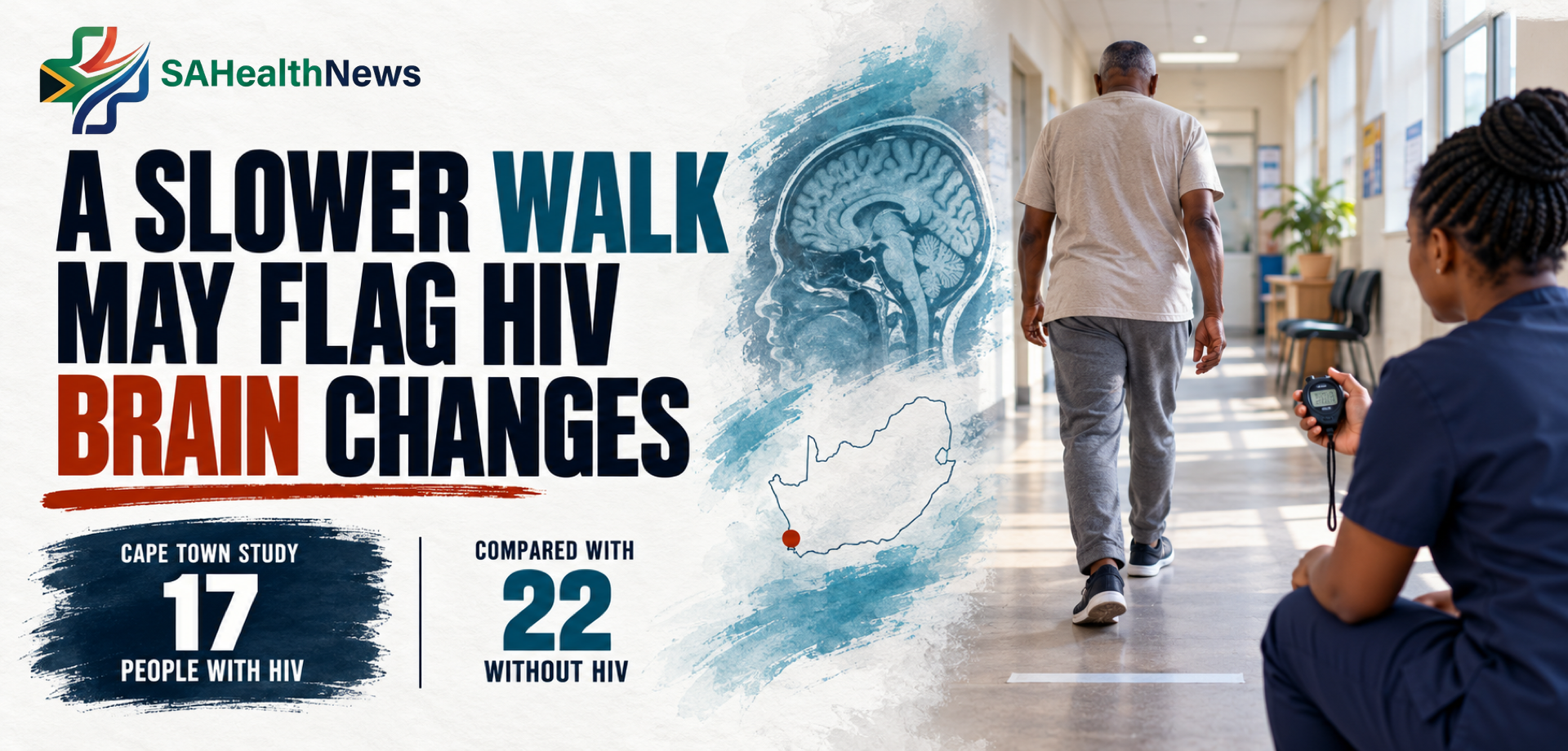
A small UCT study links slower walking to lower thinking and memory scores in people with HIV, hinting at a cheap clinic test for brain injury.
How quickly someone walks down a corridor may say something about the health of their brain. A small University of Cape Town (UCT) study has found that among middle-aged people living with HIV, a slower walking pace went with lower scores on tests of thinking and memory, and the researchers think a simple timed walk could one day help clinics pick up HIV-related brain injury early.
The study, by Dr Jonathan Ipser of UCT's Neuroscience Institute in the Department of Psychiatry and Mental Health, with co-authors Samantha Smuts, Hetta Gouse, Carla Freeman, Dan Stein and John Joska, was published in the Journal of NeuroVirology on 13 October.
Walking speed is already used as a rough guide to health in older people. "A substantial body of evidence also suggests that walking speed may serve as an informative and potentially clinically useful index of cognitive function in both the elderly and psychiatric patients," Ipser said in a UCT statement.
The researchers wanted to know whether the same link shows up much earlier in people living with HIV. Of the roughly 40 million people living with HIV worldwide, a large share have some degree of HIV-associated brain injury, which is often tied to faster ageing, the authors write. Their participants had an average age of 39.
The team recruited 39 people from a community health centre in Cape Town: 17 living with HIV and 22 without it. Each person's walking speed was measured and compared with their scores across different areas of thinking, memory and motor skill.
Participants also had resting-state functional MRI scans, which track how brain regions communicate while a person lies still. The researchers looked at seven brain networks.
Among the people living with HIV, slower walking was linked to lower overall scores on the cognitive tests, a statistically significant association (t = -3.12, p < 0.008). The same pattern held when the researchers checked it in a large public dataset of healthy older adults.
The scans pointed to the frontoparietal network, a set of brain regions involved in attention, planning and self-control, which researchers group as executive function. In people living with HIV, the connectivity of this network predicted both how fast they walked and how they scored on executive function. The authors suggest this may reflect weaker compensatory mechanisms, the ways a brain works around damage.
"Our findings indicate that a brief gait test may have potential as an early, low-resource indicator of HIV-associated brain injury," Ipser said.
The study is small, with only 17 people living with HIV, and it measured walking and cognition at one point in time. It shows that the two go together. It does not show that slow walking causes poorer thinking, or that a walking test can diagnose brain injury in any one person. Larger studies that follow people over time would be needed before a gait test could be used for screening.
The appeal for South African clinics is cost. Brain scans and full cognitive assessments are out of reach for most public-sector patients. A timed walk needs a corridor and a stopwatch, which is why the authors point to its potential "in low resourced settings".
Source: SA Health News