Breaking
Latest health news from South Africa and around the world•Wellness, nutrition, and fitness updates daily•Medical breakthroughs and healthcare updates•Science-backed health explainers and guides•Health tech, reviews, and upcoming events•
 SA Health News Desk
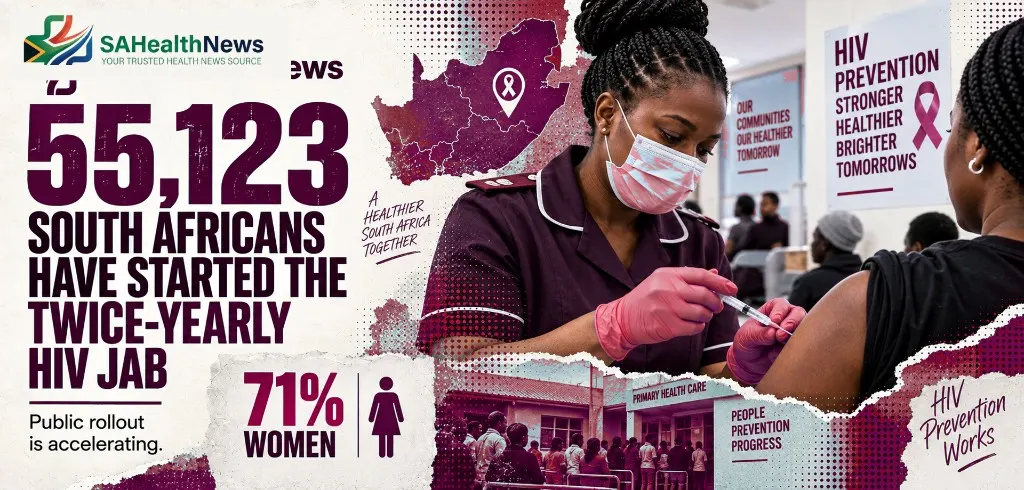
By 7 September 2026, 55,123 people had started lenacapavir across ~360 facilities. Women make up 71% of early recipients — the next test is six-month return.
South Africa’s rollout of long-acting injectable HIV prevention has moved beyond its launch phase, with 55,123 people initiated on lenacapavir by 7 September 2026.
The Department of Health says the medicine is now being delivered through approximately 360 public health facilities across 24 districts in six provinces.
Women account for 71% of recipients, with pregnant and breastfeeding women making up a substantial share of those receiving the injection.
The figures provide the clearest indication yet of how South Africans are responding to a prevention option that requires only two injections a year.
Lenacapavir is pre-exposure prophylaxis, or PrEP. It is given to HIV-negative people to substantially reduce their risk of acquiring HIV.
It is not an HIV vaccine, and it is not a treatment for someone already living with HIV.
The provincial numbers show a striking concentration.
Gauteng has recorded 26,357 initiations, accounting for almost 48% of the national total.
KwaZulu-Natal follows with 11,941.
The remaining provinces currently participating in the first phase have recorded:
That geographic distribution partly reflects how the rollout was designed.
Government did not initially send lenacapavir to every clinic in the country. The first phase prioritised high-HIV-burden districts and populations considered at substantial risk of acquiring HIV.
When the programme launched on 5 June, government said its initial network would comprise roughly 360 facilities.
The new numbers show that those facilities are now moving meaningful volumes of people through the programme.
South Africa already has effective HIV prevention options.
Oral PrEP works when taken correctly. Condoms remain important. HIV treatment dramatically reduces transmission when people living with HIV achieve viral suppression.
The problem has never been simply whether biomedical prevention exists.
People have to be able and willing to use it consistently.
A daily tablet can be difficult for someone who wants discreet HIV prevention, travels frequently, has an unpredictable routine or simply struggles to take medicine every day.
Lenacapavir changes that adherence equation.
Once administered, one injection provides approximately six months of HIV prevention. Two clinic visits can therefore provide a year of pharmacological protection, provided injections are received on schedule.
Government explicitly introduced the medicine to expand prevention choice rather than replace the methods already available.
That distinction matters.
A prevention method that works brilliantly in a clinical trial has limited population value if the people who need it do not want to use it.
Choice allows someone to select a method that fits their life.
The 71% female share deserves closer attention.
South Africa’s first-phase strategy deliberately prioritises several groups with elevated HIV risk, including adolescent girls and young women, sex workers and pregnant and breastfeeding women.
Men who have sex with men, transgender people, people who inject drugs and adolescent boys and young men are also among the priority populations.
High female uptake may therefore partly reflect programme design.
But it also raises an important question for the next phase: are men and other priority populations being reached effectively enough?
South Africa’s HIV response has repeatedly struggled to bring men into testing, prevention and treatment services at the same rates as women.
An injection that requires only two scheduled administrations per year could theoretically reduce some of those barriers.
The early national numbers do not yet show that happening at equivalent scale.
Government’s ambitions extend well beyond the current rollout.
The Department of Health has previously set an immediate goal of reaching one million people by the end of 2027, followed by three million over three years.
That puts the current 55,123 initiations in perspective.
The programme has demonstrated early demand.
It has not yet demonstrated population-level reach.
Scaling from tens of thousands of recipients to millions will require substantially more than medicine.
Facilities need trained staff. Stock has to remain available. Eligible patients need HIV testing and clinical assessment. People receiving the first injection have to return for the next one six months later.
That final point will become increasingly important.
Initiation figures tell us how many people started lenacapavir.
The stronger measure of programme performance will eventually be how many receive their second injection on time.
A long-acting medicine reduces the frequency of adherence decisions. It does not eliminate adherence.
The Department of Health says healthcare workers and implementation partners are monitoring medicine availability, uptake, quality of service, client follow-up and safety.
SAHPRA has registered lenacapavir for HIV prevention after reviewing preclinical, clinical and manufacturing evidence.
Government is also asking patients to report serious or persistent adverse events to healthcare workers.
That pharmacovigilance is normal and necessary when a medicine moves from controlled trials into large-scale public use.
Clinical trials establish whether a medicine is sufficiently safe and effective for approval.
Real-world programmes then expose it to a much larger and more varied population.
Lenacapavir prevents HIV.
It does not prevent pregnancy and does not provide protection against other sexually transmitted infections.
People receiving the injection may therefore still need condoms, contraception, STI screening and other sexual and reproductive healthcare depending on their circumstances.
That is why the Department of Health describes the programme as PrEP choice, not an injection-only HIV strategy.
The significance of the 55,123 figure is not that South Africa has found a single solution to HIV.
It is that a radically less frequent prevention option is being used at meaningful scale only three months after the national launch.
The next test is harder.
South Africa has to turn early enthusiasm into sustained six-monthly adherence — and then expand access from tens of thousands of people to millions.
Source: SA Health News