Breaking
Latest health news from South Africa and around the world•Wellness, nutrition, and fitness updates daily•Medical breakthroughs and healthcare updates•Science-backed health explainers and guides•Health tech, reviews, and upcoming events•
 SA Health News Desk
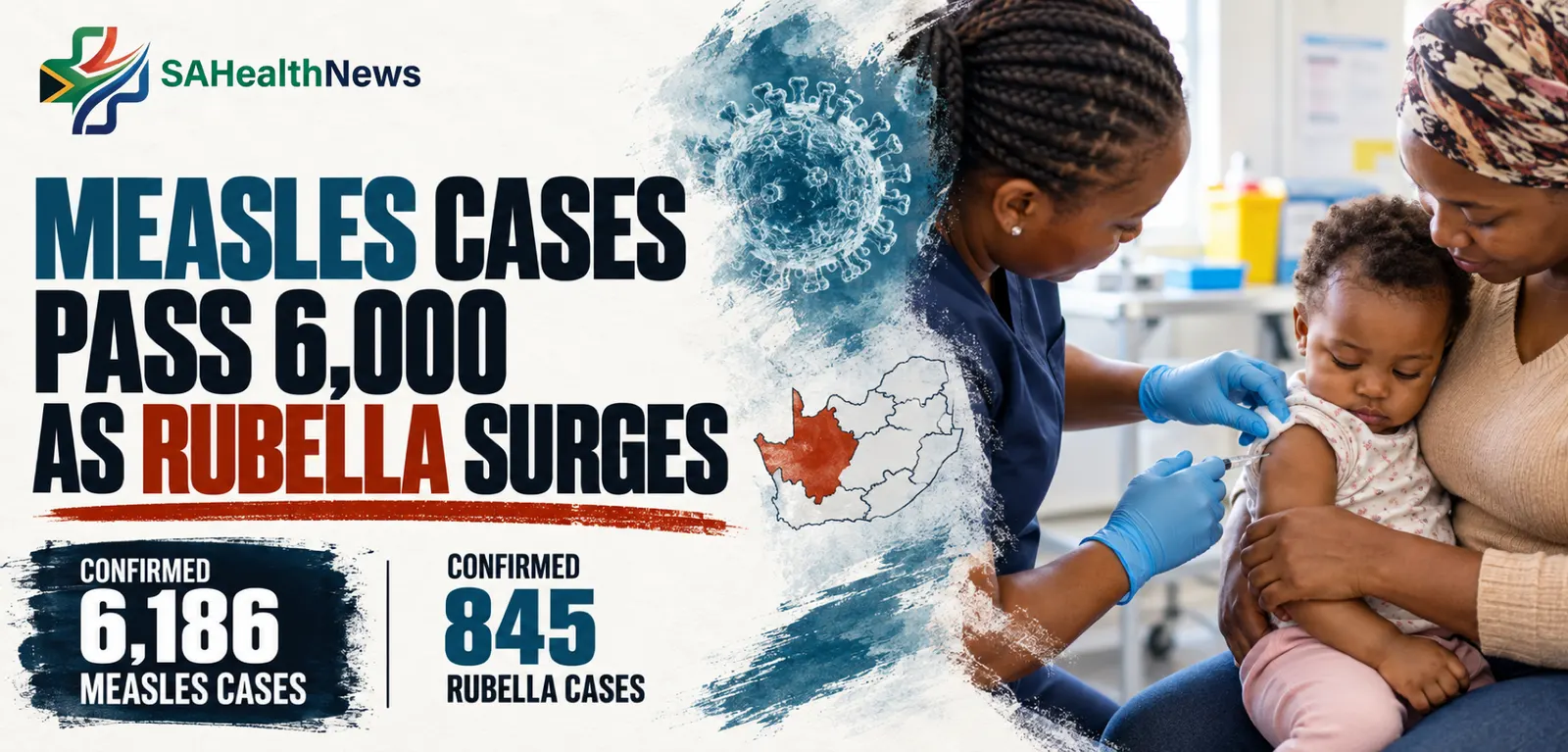
NICD data show 6,186 confirmed measles cases this year and a fast-growing rubella outbreak, with the Northern Cape the hardest hit per head.
South Africa has recorded 6,186 laboratory-confirmed measles cases this year, and a rubella outbreak running alongside it is growing quickly. The National Institute for Communicable Diseases (NICD) counted 845 confirmed rubella cases, 250 of them added since its previous weekly report.
The figures come from the NICD's latest measles and rubella situation report, which covers 29 December 2025 to 4 October 2026 and was posted on 14 October. The report added 553 measles cases in a single week. Confirmed measles cases passed 5,000 in September.
"National measles surveillance has detected an increase in measles cases nationwide," the NICD said.
The Northern Cape reported the most new measles cases in the latest week (124), followed by the Free State (87), North West (79), Gauteng (60), Western Cape (57), Limpopo (54), KwaZulu-Natal (45), Mpumalanga (40) and Eastern Cape (7).
Over the year, the Western Cape has the most confirmed cases (1,619), followed by the Free State (1,059) and the Northern Cape (831). Measured against population, the Northern Cape is worst hit, with 59.6 cases per 100,000 people against a national rate of 9.7. The Free State (34.6) and Western Cape (20.9) follow. The NICD says these three provinces are experiencing large outbreaks.
Most cases are in children. Those aged 1 to 14 account for 69.4% of measles cases (4,295), and babies under one year for 658 cases (10.6%). Babies have the highest attack rate in most provinces, at 59.7 per 100,000 nationally, because they are less likely to have been vaccinated, or have had only one dose. Among adults aged 20 and older the rate is low nationally (2.0 per 100,000) but above 4 in the Free State, Northern Cape and Western Cape.
Wastewater testing also picked up measles virus in the Free State, Gauteng, KwaZulu-Natal, Mpumalanga, North West and Western Cape in the last week with results. In eThekwini the virus was found in wastewater but not yet in clinical samples.
Of the 845 rubella cases recorded this year, 651 (77.0%) were in children aged 1 to 14. The Western Cape has the most (180), followed by the Free State (142) and Northern Cape (124).
Rubella, also called German measles, is generally self-limiting in children. The danger is in pregnancy. The NICD says rubella "can be dangerous for unborn babies if a pregnant woman becomes infected", and advises women planning a pregnancy to confirm their rubella immunity with a healthcare provider. The same measles-rubella (MR) vaccine protects against both diseases.
The Northern Cape Department of Health has recorded 767 laboratory-confirmed measles cases between 3 October 2025 and 30 September 2026, the Diamond Fields Advertiser reported. ZF Mgcawu district has 303 cases, John Taolo Gaetsewe 282, Frances Baard 156 and Pixley ka Seme 27.
Coverage for the second MR dose is below 70% in every affected district. "The outbreak has revealed a concerning immunity gap in the province, particularly among children," department spokesperson Lebogang Majaha said. More than 4,700 close contacts were vaccinated at schools in John Taolo Gaetsewe, and the department says the outbreaks in Postmasburg and Siyancuma are over.
Zama Kiti, the province's chief director for district health services, told OFM News that most of the affected children had not been immunised against measles.
The NICD urges parents and caregivers to check their children's Road to Health booklets. Children under five who missed a routine measles dose should be taken to a clinic for a catch-up dose as soon as possible. Under the national schedule the MR vaccine is given at 6 and 12 months, according to the Western Cape health department.
Measles spreads easily and can cause pneumonia, ear infections, diarrhoea, encephalitis and death. The Northern Cape department says anyone with measles must isolate at home for at least seven days.
None of this replaces advice from your own clinician or clinic sister. If a child has a fever and a rash, phone the clinic before you arrive and keep them at home. Pregnant women who think they may have been exposed to rubella should ask a healthcare provider to check immunity, rather than judging it from how they feel.
Source: SA Health News