Breaking
Latest health news from South Africa and around the world•Wellness, nutrition, and fitness updates daily•Medical breakthroughs and healthcare updates•Science-backed health explainers and guides•Health tech, reviews, and upcoming events•
 SA Health News Desk
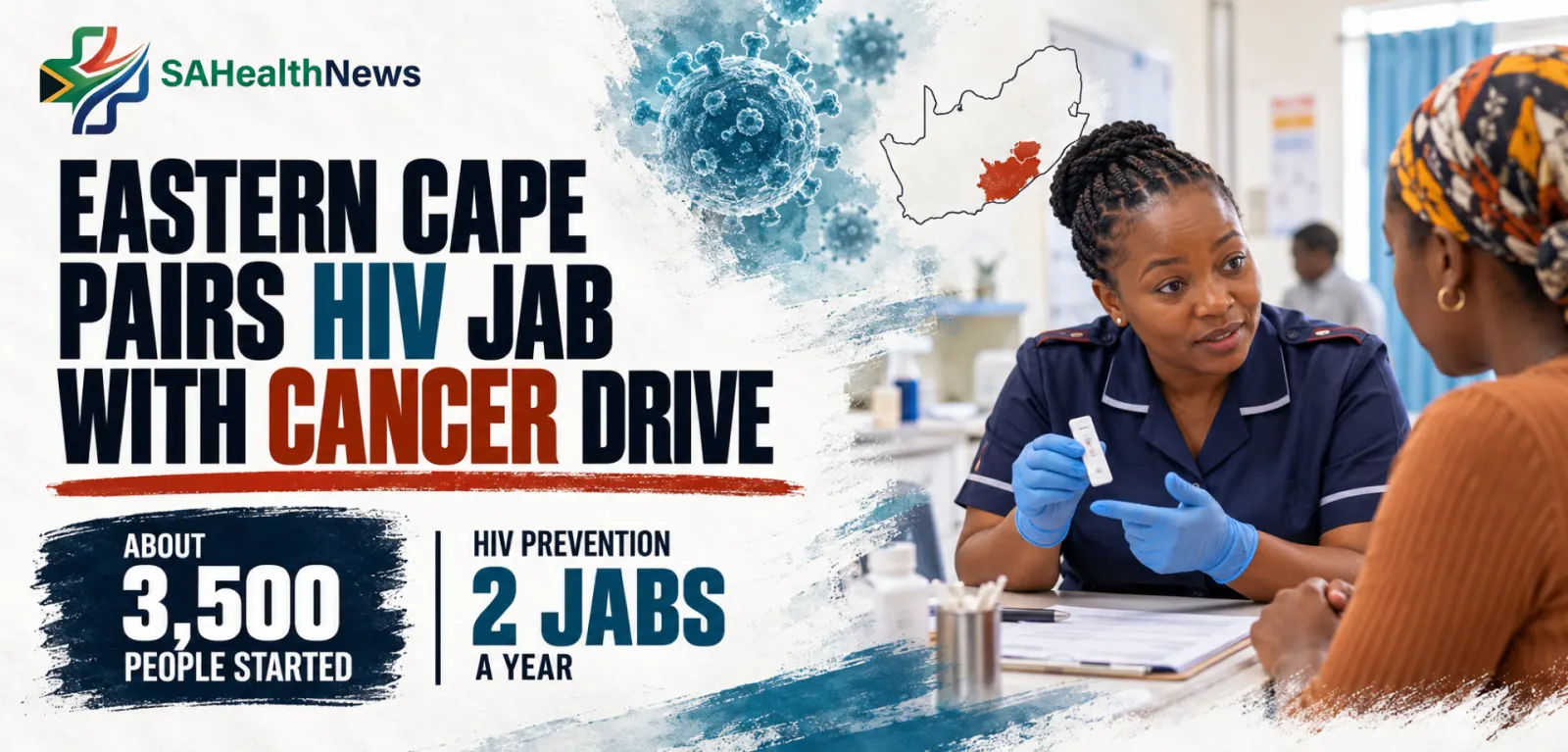
MEC Ntandokazi Capa says about 3,500 people are on the twice-yearly HIV jab, and that donor-funded dose supply will decide how fast the rollout grows.
The Eastern Cape has formally launched its Lenacapavir HIV Prevention and Cervical Cancer Elimination Strategy, folding the twice-yearly HIV prevention injection into the same provincial drive as HPV vaccination, cervical screening and early treatment.
Health MEC Ntandokazi Capa launched the strategy in KwaNoxolo, Nelson Mandela Bay, according to a government news agency report published on 20 October. The province says about 3,500 people have already been started on lenacapavir at selected public facilities.
Capa said there were enough doses at the launch, but warned that the drug is expensive and that donor support had made the rollout possible. How quickly the programme grows, she said, will depend on whether doses keep arriving.
"We are inviting everyone to come and test. If you are HIV-negative, then we will give you the injection," Capa said. "It is groundbreaking for us because now you are no longer going to take tablets every day."
Lenacapavir is a pre-exposure prophylaxis (PrEP) medicine. A healthcare worker gives it as an injection twice a year, roughly six months apart. It is for people who are HIV-negative; it is not a vaccine and it does not treat HIV. In the PURPOSE 1 trial, run in South Africa and Uganda and published in 2024, none of the young women who received the twice-yearly injection acquired HIV.
The province is offering it alongside existing options, including daily oral PrEP. Capa singled out young people and sex workers as groups who should consider it, and urged men to make more use of clinics, saying the province had set up spaces where men can raise health concerns.
Thsonono Buyeye, Nelson Mandela Bay's mayoral committee member for public health, said residents should check their eligibility with a health worker first, and warned that the new initiatives do not replace healthy lifestyles or other HIV prevention measures.
The Eastern Cape is one of the six provinces where the national rollout began in June, at about 360 public facilities in 24 districts. The National Department of Health reported 55,123 people initiated nationally by 7 September, with 3,606 of them in the Eastern Cape.
That national figure is higher than the "approximately 3 500" the province gave this week. Neither the province nor the agency report explained the difference; the provincial number may be rounded or drawn from an earlier count. Either way, the Eastern Cape had the smallest share of the six provinces in September, behind Gauteng (26,357), KwaZulu-Natal (11,941), North West (4,479), the Western Cape (4,446) and Mpumalanga (4,294).
The province has not published how many facilities now offer the injection. Capa said a list exists.
Women living with HIV face a higher risk of cervical cancer, which makes regular screening and follow-up more important for them. The national Cervical Cancer Elimination Strategy, the agency reported, "aims to eliminate cervical cancer as a public health problem by 2030" through HPV vaccination for eligible girls, screening for women and timely treatment of precancerous changes.
The agency report said HIV and TB testing and cervical cancer screening are available at public facilities.
Executive Mayor Babalwa Lobishe said the metro would support the rollout through its municipal services. "For it to succeed, it is important that we ensure our clinics function properly through efficient municipal services," she said.
People who want the injection need an HIV test first, at a public clinic offering the service. Those who test negative and meet the eligibility criteria can be started on lenacapavir. Women can ask about cervical screening on the same visit.
Anyone who has a serious reaction after the injection should report it to a health worker promptly, the national department has advised.
Source: SA Health News