Breaking
Latest health news from South Africa and around the world•Wellness, nutrition, and fitness updates daily•Medical breakthroughs and healthcare updates•Science-backed health explainers and guides•Health tech, reviews, and upcoming events•
 Health Team
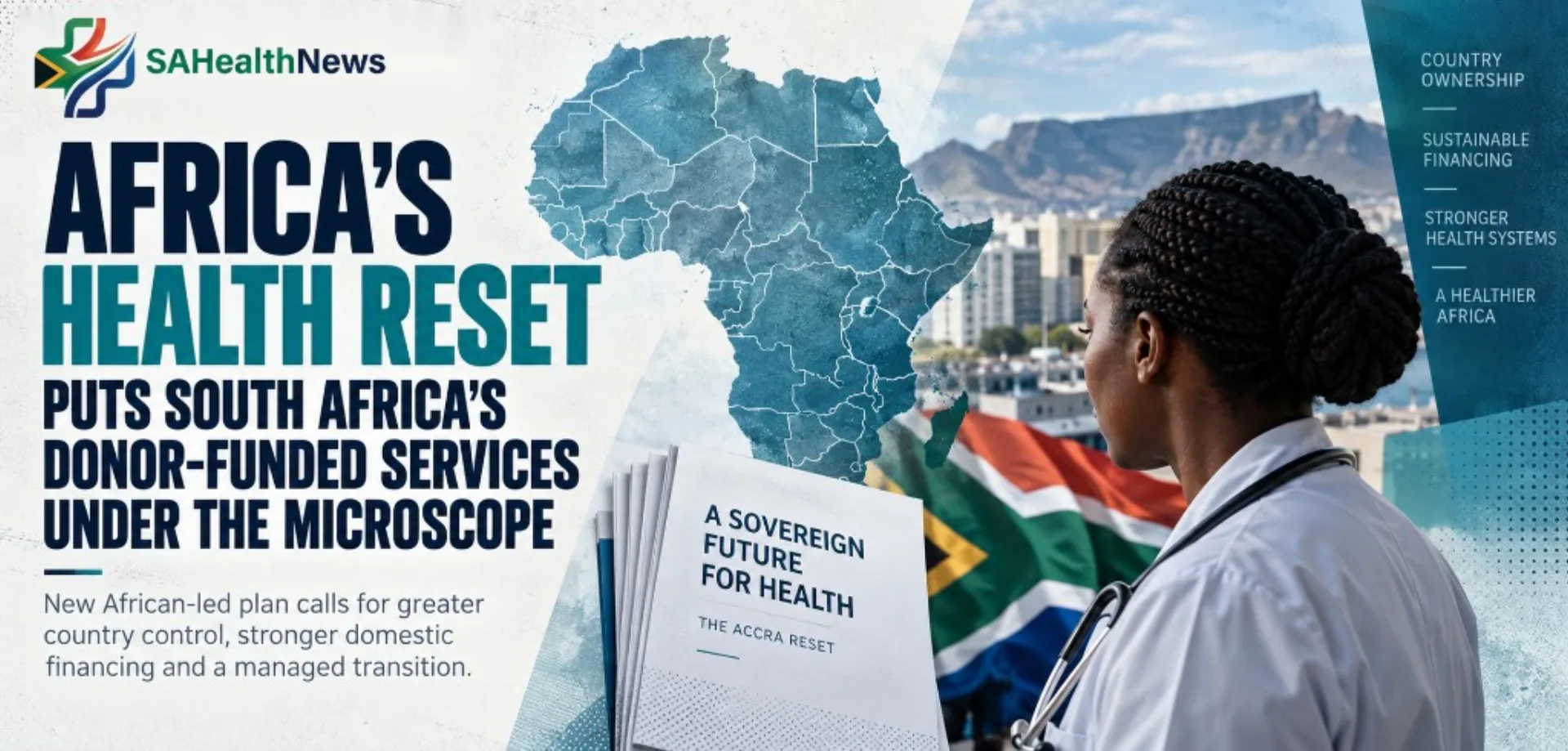
A new African-led blueprint for restructuring global health financing puts South Africa’s donor-cut experience at the centre of the push for stronger domestic control.
A new African-led blueprint for restructuring global health financing has put South Africa’s experience with abrupt donor cuts at the centre of the argument for stronger domestic control over essential health services.
The Accra Reset High-Level Panel launched A Sovereign Future for Health on 21 September at the UN General Assembly in New York. Its central proposal is that countries should organise external health support around one national plan, one costed investment plan, the public budget and a country-led coordination platform, rather than running health priorities through fragmented donor programmes.
The report proposes five broad political shifts and ten recommendations covering domestic financing, regional institutions, health manufacturing, procurement, research, emergency response and accountability. It explicitly says greater national control should be achieved through a managed transition, not an abrupt withdrawal of external support that places essential services at risk.
South Africa provides a particularly relevant test case because its HIV programme has had to absorb the consequences of major changes in US health funding.
Reporting accompanying the launch points to the withdrawal of PEPFAR support from South Africa and resulting disruption to HIV services as evidence of the vulnerability created when critical programmes depend heavily on financing decisions made outside the country.
The policy question is therefore not whether South Africa should simply replace international assistance with domestic money overnight.
It is whether core services — particularly HIV treatment, surveillance, maternal and child health, laboratory systems and health-worker capacity — can remain sufficiently dependent on external financing that a political decision elsewhere can rapidly destabilise delivery.
The panel wants countries to establish a single country compact aligning governments and external partners behind national health priorities.
It also recommends stronger pooled financing and financial protection, more regional procurement, African-led research and clinical trials, greater regional manufacturing capacity and clearer responsibility for cross-border health functions.
Its proposed timetable is unusually concrete for a global-health reform document: country-led compacts are targeted within 12 months, independent follow-up within six months, and several regional financing, manufacturing and procurement mechanisms within roughly 12 to 24 months.
These remain recommendations and implementation targets, not completed reforms.
A significant distinction in the report is that “health sovereignty” is not presented as countries cutting themselves off from international cooperation.
The proposed model keeps international financing, humanitarian assistance and global public-health functions, but seeks to place national governments in greater control of priorities, budgets and data.
That matters for South Africa.
The country participates in health systems that are inherently international: medicine and vaccine supply chains, infectious-disease surveillance, clinical research, cross-border outbreak response and financing for major disease programmes cannot realistically be managed in isolation.
The stronger argument is therefore for less vulnerability to individual donors, rather than the elimination of international partnership.
The report arrives while South Africa is already being forced to reconsider how externally supported HIV and health programmes are financed.
That makes the Accra Reset more than an abstract debate about global institutions.
If South Africa wants greater health sovereignty, the difficult questions are domestic: which services government must finance regardless of donor decisions; how much additional funding that requires; which donor-supported health workers and programmes should be absorbed into the public system; and where regional procurement or manufacturing could genuinely reduce vulnerability.
Those decisions will determine whether “country ownership” changes how healthcare is financed and delivered — or remains largely diplomatic language.
Source: SA Health News Desk