Breaking
Latest health news from South Africa and around the world•Wellness, nutrition, and fitness updates daily•Medical breakthroughs and healthcare updates•Science-backed health explainers and guides•Health tech, reviews, and upcoming events•
 SA Health News Desk
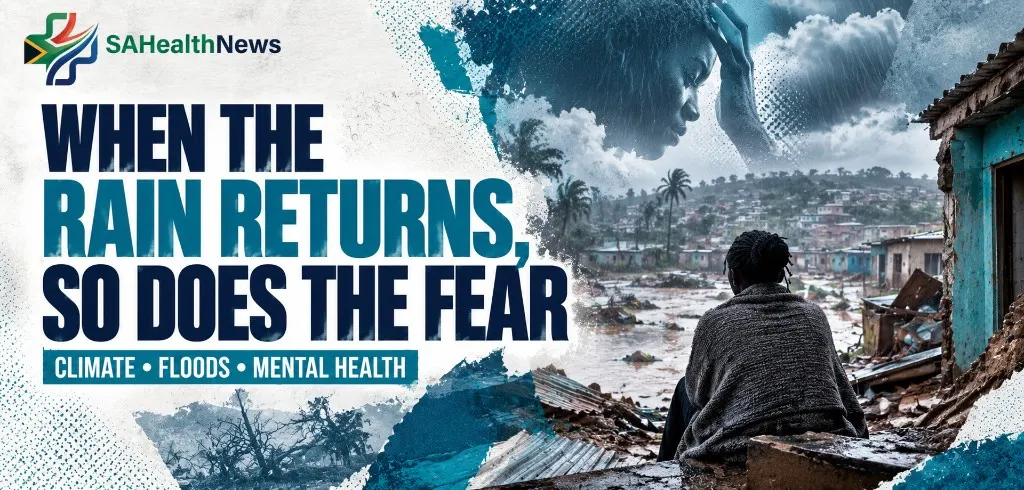
WEMA research across South Africa and three other African countries shows how floods and repeated extreme weather can leave lasting anxiety, fear and traumatic stress — especially where housing and services are already fragile.
Floods can leave a psychological footprint long after water levels fall, and a multi-country African research project is documenting how repeated extreme weather can turn rain itself into a trigger for fear, anxiety and traumatic memories.
The Weather Events and Mental Health in Africa project, known as WEMA, is studying communities affected by floods, cyclones, storms and heavy rainfall in South Africa, Mozambique, Kenya and Burkina Faso. South African fieldwork includes flood-affected communities in KwaZulu-Natal.
The project is examining depression, anxiety and post-traumatic stress disorder alongside people's lived experience of disasters. Its central question is increasingly important for South Africa: what happens to mental health when an extreme-weather event is not experienced as a once-off emergency, but as something that may happen again?
Qualitative findings from WEMA provide an important warning.
Researchers analysed digital stories created by 37 people across the four participating countries. The work has been released as a preprint, which means it has not yet completed peer review and its findings should be treated as preliminary.
Participants described the psychological effects of floods and other extreme weather as cyclical and cumulative, rather than ending when the immediate disaster was over.
Heavy rain, wind and deteriorating environmental conditions could reactivate distress. People described anticipatory anxiety during rainy periods, fear during floods and cyclones, and longer-term psychological strain associated with damaged homes, lost livelihoods, disrupted infrastructure and weakened social connections.
That does not mean everyone exposed to a flood will develop a mental health disorder. Individual outcomes vary, and distress following a disaster is not automatically a psychiatric diagnosis.
The findings instead show how repeated exposure, uncertainty and material loss can create conditions in which psychological distress persists or returns. For families who have already lived through a flood, the sound of heavy rain can become a warning signal before any water reaches the door.
Earlier South African research provides more direct evidence.
A study involving women living in low-income, flood-affected areas around Durban was able to compare mental health measurements taken before the devastating April 2022 KwaZulu-Natal floods with measurements after the disaster.
Researchers initially interviewed 73 women aged 18 to 45 and completed post-flood assessments with 69.
Loss of basic infrastructure and services — including access to drinking water, electricity and fresh food, being unable to travel to work, having to use a shelter or being unable to reach family and friends — predicted increases in emotional distress and anxiety.
Prior trauma was associated with greater post-flood emotional distress, while pre-existing food insecurity was associated with higher anxiety after the floods.
The study does not prove that every mental health change was caused by flooding, and its relatively small sample means the findings should not be generalised to the entire South African population. It does, however, show why the psychological consequences of disasters can be inseparable from housing, poverty, food security and access to basic services.
In other words, the mental health impact of a flood is not only about what people witnessed during the storm. It is also about whether they can sleep safely afterwards, feed their household, get to work and stay connected to the people who usually support them.
WEMA deliberately focuses on communities where environmental hazards interact with structural vulnerability.
Its South African research includes eThekwini and Hlabisa in KwaZulu-Natal. Researchers note that South Africa has greater resources and preparedness than some countries in the study, but extreme inequality leaves substantial parts of the population highly exposed.
A flood can therefore produce very different health consequences depending on where somebody lives, the quality of their housing, whether they can relocate, their income, access to healthcare and whether basic infrastructure recovers quickly.
This is why climate-related mental health cannot be reduced to individual resilience.
A person who remains in an unsafe home, has lost income, struggles to replace possessions or repeatedly experiences flooding is being exposed to continuing stressors rather than simply remembering a past event. Advice to “stay calm” does little when the house is still damp, the road is washed away and the next rain forecast arrives before recovery has finished.
The practical implication is that psychological support cannot be treated solely as a later-stage service.
Mental health screening, psychological first aid, referral pathways and appropriately trained community health workers can form part of disaster preparedness and recovery alongside shelter, food, sanitation, medical care and infrastructure repair.
WHO has previously warned that mental health and psychosocial support remain poorly integrated into emergency preparedness across much of Africa.
For South Africa, the policy challenge is broader than adding counsellors after a flood. Disaster planning needs to recognise the conditions that amplify psychological harm: insecure housing, displacement, disrupted healthcare, loss of income, food insecurity and repeated exposure to environmental hazards.
The country now has a national Climate and Health Surveillance platform developed with support from the South African Medical Research Council and the University of Pretoria. It is designed to improve understanding of health threats associated with extreme heat, air pollution, flooding, drought and climate-sensitive disease.
Mental health needs to remain part of that climate-health picture — not as a footnote after physical injuries and infectious disease risk, but as a core measure of whether recovery is actually working for households.
WEMA is an ongoing research programme, and some of its newest findings are preprints rather than final peer-reviewed publications.
That distinction matters.
The project should not yet be used to claim a precise national prevalence of climate-related depression, anxiety or PTSD in South Africa. Its stronger contribution at this stage is showing the pathways through which repeated weather disasters can affect psychological wellbeing and identifying the questions health systems need to answer.
For communities repeatedly exposed to floods, the emergency may not end when the water disappears.
Sometimes the next heavy rain brings part of it back.
This article provides health journalism and does not replace individual medical advice. If you or someone close to you is in crisis, contact your nearest clinic, emergency services, or a recognised mental health helpline.
Source: SA Health News Desk