Breaking
Latest health news from South Africa and around the world•Wellness, nutrition, and fitness updates daily•Medical breakthroughs and healthcare updates•Science-backed health explainers and guides•Health tech, reviews, and upcoming events•
 SA Health News Desk
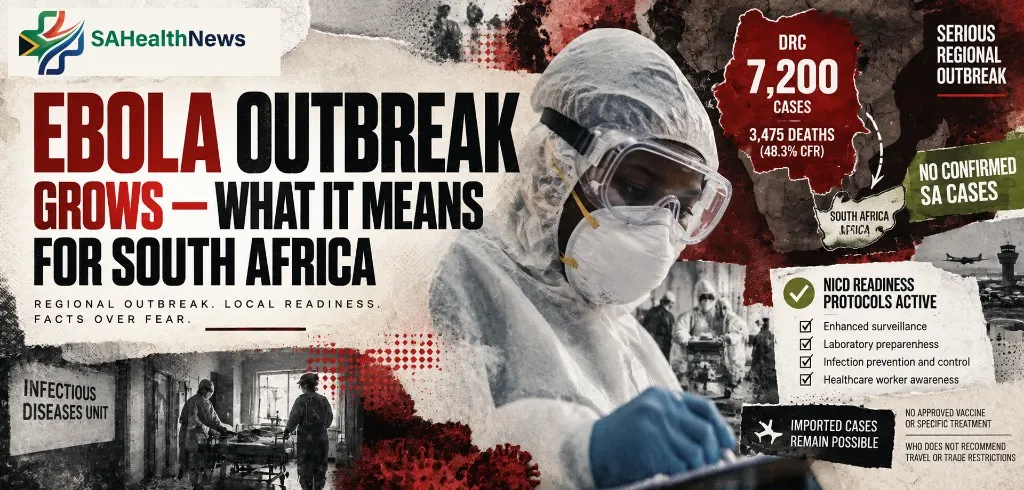
No confirmed SA cases of Bundibugyo virus disease. The DRC outbreak remains serious — the test for SA is whether an imported case would be spotted fast enough.
South Africa has no confirmed cases of Bundibugyo virus disease, but the Ebola outbreak in the Democratic Republic of the Congo remains a serious regional health threat and imported cases remain possible, according to the National Institute for Communicable Diseases.
By 12 September 2026, the DRC had recorded 7,200 laboratory-confirmed cases and 3,475 deaths, a case-fatality ratio of 48.3%. The outbreak had reached seven DRC provinces. Uganda, meanwhile, declared its outbreak over on 27 August after 42 days without a newly confirmed case.
The South African story is therefore not that Ebola has arrived here. It has not. The immediate issue is whether surveillance, laboratories and hospitals can identify and isolate an imported infection quickly if one occurs.
On 17 September, Africa Centres for Disease Control and Prevention cautioned against interpreting recent declines in some areas as proof that the outbreak had peaked.
Director-General Jean Kaseya said transmission was not yet consistently controlled across all affected areas, although infections had declined in parts of Ituri. Africa CDC said a sustained fall in cases would be needed before concluding that the peak had passed.
The NICD also says there is significant uncertainty around the true extent of transmission because community deaths, infections among healthcare workers and possible undetected transmission can leave gaps in official counts.
The NICD says South African health authorities are monitoring the outbreak with the National Department of Health, the World Health Organization, Africa CDC and regional partners.
Readiness measures include enhanced surveillance, laboratory preparedness, infection-prevention and control procedures and increased healthcare-worker awareness so a suspected imported case can be identified and managed rapidly.
Bundibugyo virus disease does not occur naturally in South Africa. The NICD says no confirmed cases have been reported in the country to date.
An imported infection remains possible if a traveller is exposed in an affected country and enters South Africa before developing symptoms or before the infection is recognised.
Bundibugyo ebolavirus spreads through direct contact with blood or other body fluids from an infected person. These can include vomit, diarrhoea, urine, saliva, sweat, breast milk and semen.
Infection can occur when infectious fluid reaches broken skin or the eyes, nose or mouth. Contaminated bedding, clothing, medical equipment and needles can also transmit the virus.
Healthcare-associated transmission and unsafe burial practices are particularly important because they can expose multiple people to infectious body fluids.
The NICD states that Bundibugyo ebolavirus is not spread through the air, water or ordinary casual social contact without direct exposure to infectious fluids.
One difficulty with Bundibugyo virus disease is that its early symptoms are not distinctive.
Symptoms can include sudden fever, headache, weakness, sore throat and body or joint pain. Vomiting and diarrhoea can follow. Bleeding can occur, but is not present in every patient.
That overlap with illnesses such as malaria and typhoid makes travel and exposure history particularly important when clinicians assess someone returning from an outbreak area.
A person with fever in South Africa should not assume they have Ebola simply because an outbreak is occurring elsewhere in Africa. The relevant concern is compatible illness combined with plausible exposure or travel history.
The current outbreak is caused by Bundibugyo virus, not the Zaire ebolavirus targeted by established Ebola vaccines and monoclonal-antibody treatments.
There is currently no licensed vaccine or approved specific therapeutic for Bundibugyo virus disease. Treatment therefore centres on early supportive care, including replacing fluids lost through vomiting and diarrhoea and treating complications.
Researchers are evaluating candidate vaccines and investigational treatments, but these should not be confused with established protection against the current virus.
The distinction matters because “Ebola vaccine” does not describe a vaccine that necessarily works against every Ebola virus species.
WHO does not currently recommend travel or trade restrictions because of the outbreak, and the NICD repeats that position in its South African guidance.
South Africa’s preparedness instead rests on surveillance, rapid laboratory diagnosis, infection control and clinical recognition.
The situation therefore needs proportionate communication.
There is no confirmed South African Ebola outbreak. But the DRC epidemic is large, regional transmission has occurred, and Africa CDC says it remains serious.
For South Africa, the critical test is whether the health system can recognise an imported infection quickly enough that one case does not become a chain of transmission.
Source: SA Health News