Breaking
Latest health news from South Africa and around the world•Wellness, nutrition, and fitness updates daily•Medical breakthroughs and healthcare updates•Science-backed health explainers and guides•Health tech, reviews, and upcoming events•
 SA Health News Desk
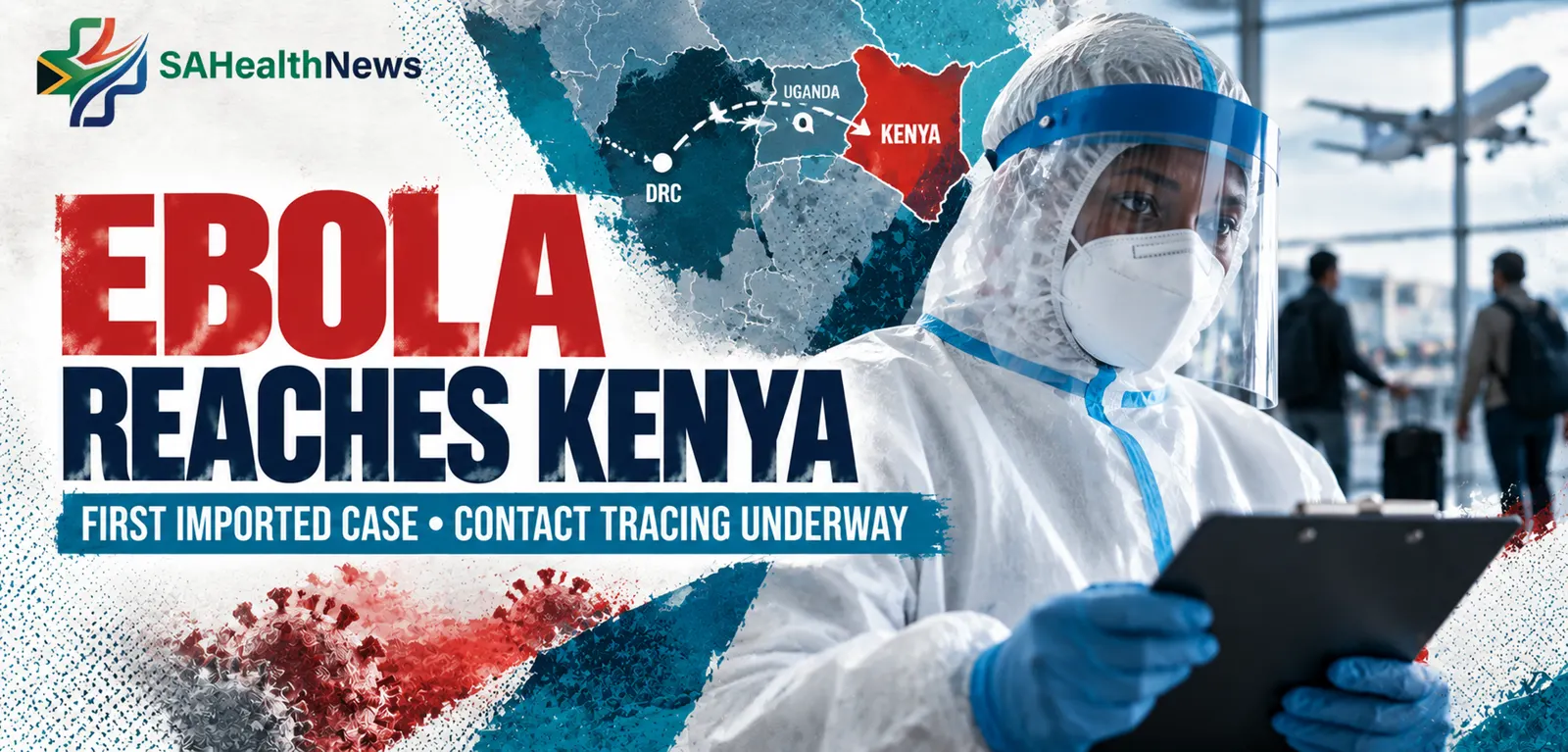
Kenya confirmed its first imported Bundibugyo Ebola case after travel from the DRC via Uganda. South Africa's traveller screening and referral hospitals remain the practical local lens.
Kenya has confirmed its first imported case of Bundibugyo virus disease, extending the regional footprint of the Ebola emergency and putting renewed attention on surveillance at airports and borders --- including South Africa's existing screening arrangements for travellers linked to affected countries.
The World Health Organization said the patient was a Kenyan citizen who became ill while living in the Democratic Republic of the Congo, where the current Bundibugyo outbreak is centred.
The patient travelled by road from the DRC through Beni to Kampala, Uganda, on 2 October, then flew to Nairobi on 3 October. The patient was taken to hospital after arrival and isolated.
Samples tested positive for Bundibugyo virus at both Kenya's National Virology Reference Laboratory and the Kenya Medical Research Institute. Despite supportive care, the patient died on the night of 5 October and was buried the following day using an Ebola safe-burial protocol.
Kenya formally notified WHO on 6 October.
Kenyan authorities have listed 28 contacts, including family members and health workers who cared for the patient.
They are also tracing 23 passengers and four crew members who were on the same flight. People assessed to have had a relevant exposure are being followed up and quarantined where appropriate.
Ebola contact monitoring normally covers the virus's maximum incubation period of 21 days. A contact is not automatically a case: the purpose of monitoring is to identify symptoms rapidly if infection develops.
Kenya had already been preparing for importation since outbreaks were declared in the DRC and Uganda in May.
WHO says that by 6 October the country had screened more than *652,000 incoming travellers*, tested 267 suspected samples and trained about 5,000 health workers in Ebola prevention and management. Isolation capacity has been assessed in 27 high-risk counties.
The case therefore demonstrates both sides of border-health preparedness: screening reduces risk but cannot guarantee that every infected traveller will be identified before symptoms or exposure history trigger further investigation.
South Africa has not announced a confirmed case linked to Kenya's imported infection in the official sources reviewed for this article.
The development nevertheless broadens the regional travel context.
South Africa introduced traveller-health screening during the current Bundibugyo outbreak and has identified hospitals in both the public and private sectors for suspected or confirmed Ebola cases.
The Department of Health's traveller questionnaire asks about symptoms including fever, diarrhoea, abdominal pain, rash, headache, muscle pain, sore throat, unexplained bruising or bleeding and jaundice. It also provides for monitoring for Ebola symptoms for up to 21 days after a suspected exposure.
Earlier South African preparedness plans identified *24 public and 12 private hospitals* to receive suspected or confirmed Ebola patients. The country's approach has focused on early detection, risk assessment, safe referral, laboratory confirmation, contact tracing and rapid response rather than routine quarantine of every returning traveller.
Kenya's case gives that system a fresh test of assumptions because the patient's journey crossed several countries and included commercial air travel.
Bundibugyo virus disease is severe and can be fatal, but it does not spread through ordinary airborne transmission in the way measles does.
WHO says infection occurs through direct contact with the blood or other body fluids of an infected person, or with materials contaminated by those fluids.
That makes exposure history central to assessing risk.
A person who simply shares a country, airport or city with an Ebola case is not automatically considered exposed. Public-health teams assess the nature and timing of contact, whether the infected person was symptomatic and whether bodily fluids were involved.
Early symptoms can include fever, fatigue, muscle pain, headache and sore throat. Vomiting, diarrhoea, rash, impaired kidney or liver function and, in some cases, bleeding can occur as illness progresses.
There are currently *no approved vaccines or specific treatments for Bundibugyo virus disease*, according to WHO. Candidate products are being evaluated in clinical trials.
That distinction is important because vaccines and antibody treatments developed for Zaire ebolavirus cannot simply be assumed to provide established protection against Bundibugyo virus.
Current outbreak control therefore depends heavily on rapid diagnosis, isolation, supportive clinical care, infection prevention, contact tracing, safe burial practices and community cooperation.
WHO currently advises against general travel or trade restrictions involving the DRC, Uganda or Kenya on the basis of the available information.
For South Africans travelling through the region, the practical message is narrower: comply with port-health requirements, keep an accurate recent travel history and seek medical attention promptly if compatible symptoms develop after a relevant exposure.
Healthcare workers assessing an unwell returning traveller should establish the travel route and exposure history early rather than relying on symptoms alone.
Kenya's first imported case does not mean Ebola is spreading unchecked across East Africa. It does show why regional surveillance has to work across borders, airlines and health systems at the same time.
This article provides health journalism and does not replace individual medical advice.
Source: SA Health News