
Breaking
Latest health news from South Africa and around the world•Wellness, nutrition, and fitness updates daily•Medical breakthroughs and healthcare updates•Science-backed health explainers and guides•Health tech, reviews, and upcoming events•
 SA Health News Desk
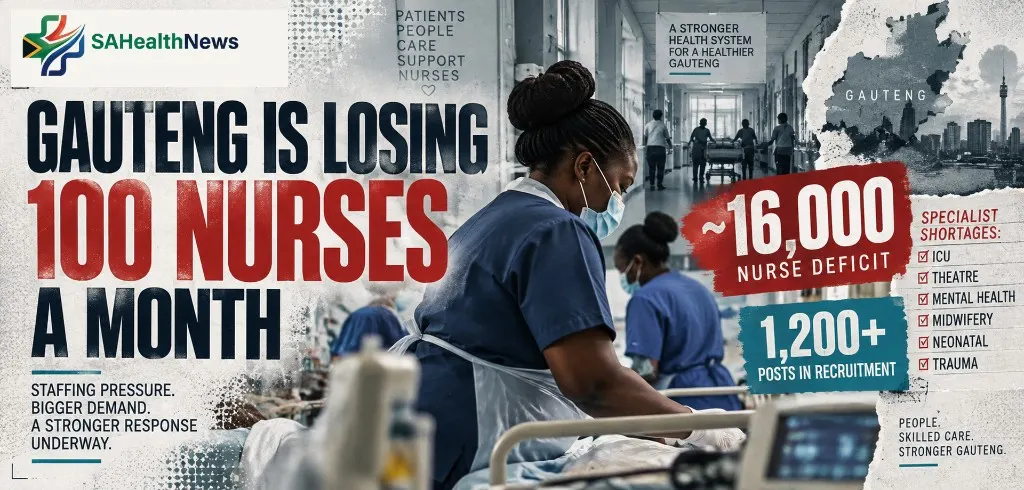
Gauteng is losing at least 100 nurses a month while facing an estimated ~16,000-nurse deficit. Recruitment of 1,200+ posts is under way — retention is the harder test.
Gauteng’s public health system is losing at least 100 nurses a month, while the province faces an estimated nursing shortage approaching 16,000 posts.
The staffing pressure affects a health system responsible for some of South Africa’s busiest hospitals and clinics, where nursing shortages can translate directly into longer queues, heavier workloads, delayed care and reduced capacity in specialist services.
Gauteng Health says the province currently has 27,670 filled nursing posts, with 2,272 vacant funded posts and another 1,186 unfunded posts. Filling the wider estimated gap would require at least R5.7 billion, according to provincial estimates.
The problem is not simply the total number of nurses.
Gauteng also faces shortages in specialised areas including intensive care, theatre nursing, mental health, midwifery, neonatal care and trauma.
Those skills cannot be replaced immediately by recruiting general nurses. Specialist nurses require additional training and experience, which means shortages can persist even when broader recruitment improves.
The consequences are particularly important in services where safe staffing levels matter minute by minute: operating theatres, neonatal units, intensive-care wards and emergency departments.
The province says restrictions on filling clinical vacancies have been lifted and that more than 1,200 nursing positions are at different stages of recruitment.
Gauteng Health spokesperson Steve Mabona said more than 1,000 posts had reached the shortlisting stage.
The department has also renewed some contracts for retired specialist nurses and says it intends to expand nursing intake and specialist training.
A provincial nursing summit is planned for November.
Those steps may help stabilise staffing, but they do not immediately solve the rate at which experienced nurses are leaving.
A hospital can replace a vacant post numerically without immediately replacing the experience that disappeared with the nurse who left.
Senior nurses often carry institutional knowledge, supervise junior staff, manage complex wards and recognise deterioration in patients before it becomes obvious.
When experienced staff leave faster than replacements can be trained, the remaining workforce carries a larger clinical and supervisory burden.
That pressure can itself contribute to burnout and further resignations.
The province’s 2,272 funded nursing vacancies are important because they represent posts that already exist within the funded establishment.
But the broader estimate of a roughly 16,000-nurse deficit shows why filling existing vacancies alone will not close the staffing gap.
Population growth, rising demand, ageing patients, chronic disease and pressure on tertiary services all increase the number and mix of nurses required.
That means the staffing challenge is both a recruitment problem and a workforce-planning problem.
The immediate test is whether the positions currently being recruited translate into nurses actually taking up posts in facilities with the greatest shortages.
The longer-term test is retention.
Recruitment can refill vacancies, but it will have limited effect if experienced nurses continue leaving at roughly 100 a month.
Gauteng’s nursing crisis therefore cannot be measured only by how many advertisements are issued or how many posts reach shortlisting.
The more useful indicators will be whether vacancy rates fall, specialist units become more stable and the monthly loss of nurses begins to slow.
Source: SA Health News