Breaking
Latest health news from South Africa and around the world•Wellness, nutrition, and fitness updates daily•Medical breakthroughs and healthcare updates•Science-backed health explainers and guides•Health tech, reviews, and upcoming events•
 SA Health News Desk
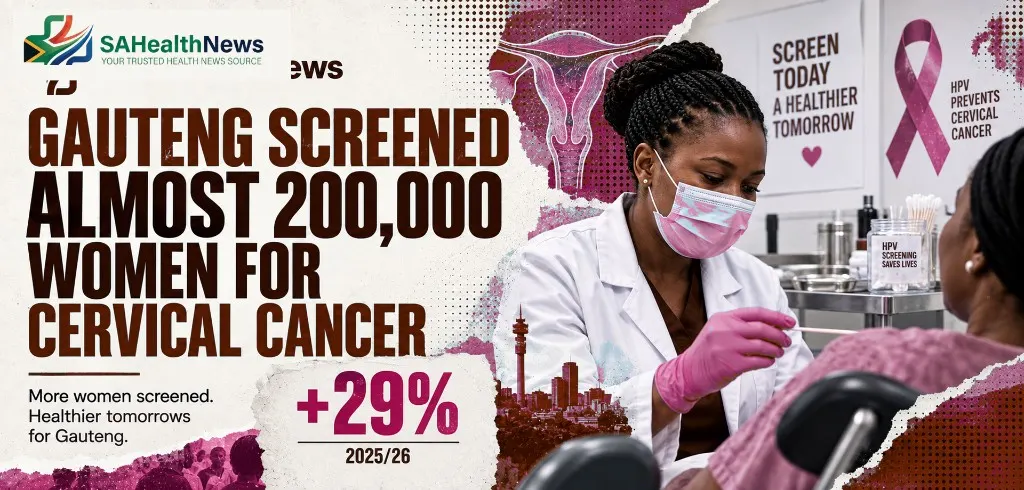
Gauteng screened almost 200,000 women for cervical cancer in 2025/26 — a 29% jump. The harder test is whether abnormal results become diagnosis and treatment.
Gauteng screened almost 200,000 women for cervical cancer during the 2025/26 financial year, a 29% increase on the previous year, according to new figures released by the provincial health department.
The increase is substantial. But the more important question is whether women with abnormal results successfully move from screening into diagnosis and treatment.
Gauteng Health says that is now a central part of its cervical-cancer programme as South Africa begins implementing its 2026–2030 cervical cancer elimination framework.
Cervical cancer remains South Africa’s second most commonly diagnosed cancer among women. Unlike many cancers, however, most cases are linked to persistent infection with high-risk types of human papillomavirus, or HPV, giving the health system opportunities to intervene before invasive cancer develops.
The new Gauteng figure represents one of the clearest recent provincial indicators of whether more women are actually being reached.
Nearly 200,000 screenings were completed during 2025/26, 29% more than during the previous financial year. Gauteng Health attributes part of the increase to awareness campaigns and efforts to expand access.
More screening is useful only if it reaches women at risk and is connected to functioning follow-up care.
A screening programme can perform thousands of tests and still fail patients if abnormal results are not communicated, diagnostic procedures take too long or treatment is inaccessible.
The department says its approach increasingly treats screening as the beginning of a care pathway rather than the endpoint.
That distinction is important as South Africa changes the technology it uses to find cervical disease.
The national elimination framework confirms that South Africa has started transitioning from conventional cervical cytology towards primary HPV DNA screening.
Traditional cytology looks for abnormal cells collected from the cervix.
HPV testing instead searches for high-risk types of the virus responsible for the overwhelming majority of cervical cancers.
A positive high-risk HPV result does not mean a woman has cancer.
Most HPV infections do not become cancer. The concern is persistent infection with high-risk HPV types, which can cause precancerous cellular changes over time.
That long progression is precisely what makes screening valuable.
Precancer can often be identified and treated before an invasive tumour develops.
The national framework sets three major goals for 2030:
The first target attacks the cause.
The second tries to find high-risk infection and precancer before symptoms appear.
The third determines whether detection actually saves lives.
South Africa already reports annual HPV-vaccination coverage above 80% among Grade 5 girls receiving at least one dose, and the school programme expanded to private and independent schools in 2024.
The screening and treatment targets remain harder.
A woman can receive an abnormal screening result and still fall out of the healthcare system before receiving treatment.
South Africa’s framework explicitly identifies this as a problem.
Government has started a results-for-action dashboard intended to track patients and reduce loss to follow-up. It is also decentralising treatment of precancerous lesions away from tertiary hospitals towards district and regional hospitals.
Colposcopy services have been expanded to almost all regional hospitals, while treatment using large-loop excision of the transformation zone — usually shortened to LLETZ — is being pushed closer to patients.
LLETZ removes abnormal cervical tissue using a thin electrically heated wire loop.
For appropriately selected precancerous lesions, treating abnormal tissue before it becomes invasive cancer can prevent the disease rather than waiting to treat cancer later.
Cervical-cancer prevention has additional importance in South Africa because of the country’s HIV burden.
Women living with HIV have a higher risk of persistent high-risk HPV infection and cervical disease because immune suppression can make it more difficult for the body to clear HPV.
South Africa’s elimination framework specifically says screening pathways for women living with HIV have been streamlined to improve early detection.
That means aggregate screening totals need eventually to be broken down further.
Knowing that almost 200,000 women were screened in Gauteng is useful.
Knowing which women were reached, how many tested positive, how quickly they received follow-up and how many completed treatment will tell us considerably more about whether the programme is preventing cancer deaths.
A 29% annual increase demonstrates that the province can expand screening.
It does not establish that Gauteng has reached the national 70% screening target, because the newly released figure is a count of screenings rather than a population coverage rate.
Those measures should not be conflated.
Nor does the figure reveal how many abnormal results led to completed treatment.
South Africa’s national framework divides implementation into three phases: acceleration through 2027/28, stabilisation in 2028/29 and sustainability through 2030.
Gauteng’s new numbers show movement during the acceleration phase.
The stronger measure of success will be whether the system can follow women from HPV vaccination → screening → abnormal result → diagnosis → treatment without losing them between services.
Cervical cancer is unusually preventable.
That makes every failure in that chain more consequential.
Source: SA Health News