Breaking
Latest health news from South Africa and around the world•Wellness, nutrition, and fitness updates daily•Medical breakthroughs and healthcare updates•Science-backed health explainers and guides•Health tech, reviews, and upcoming events•
 SA Health News Desk
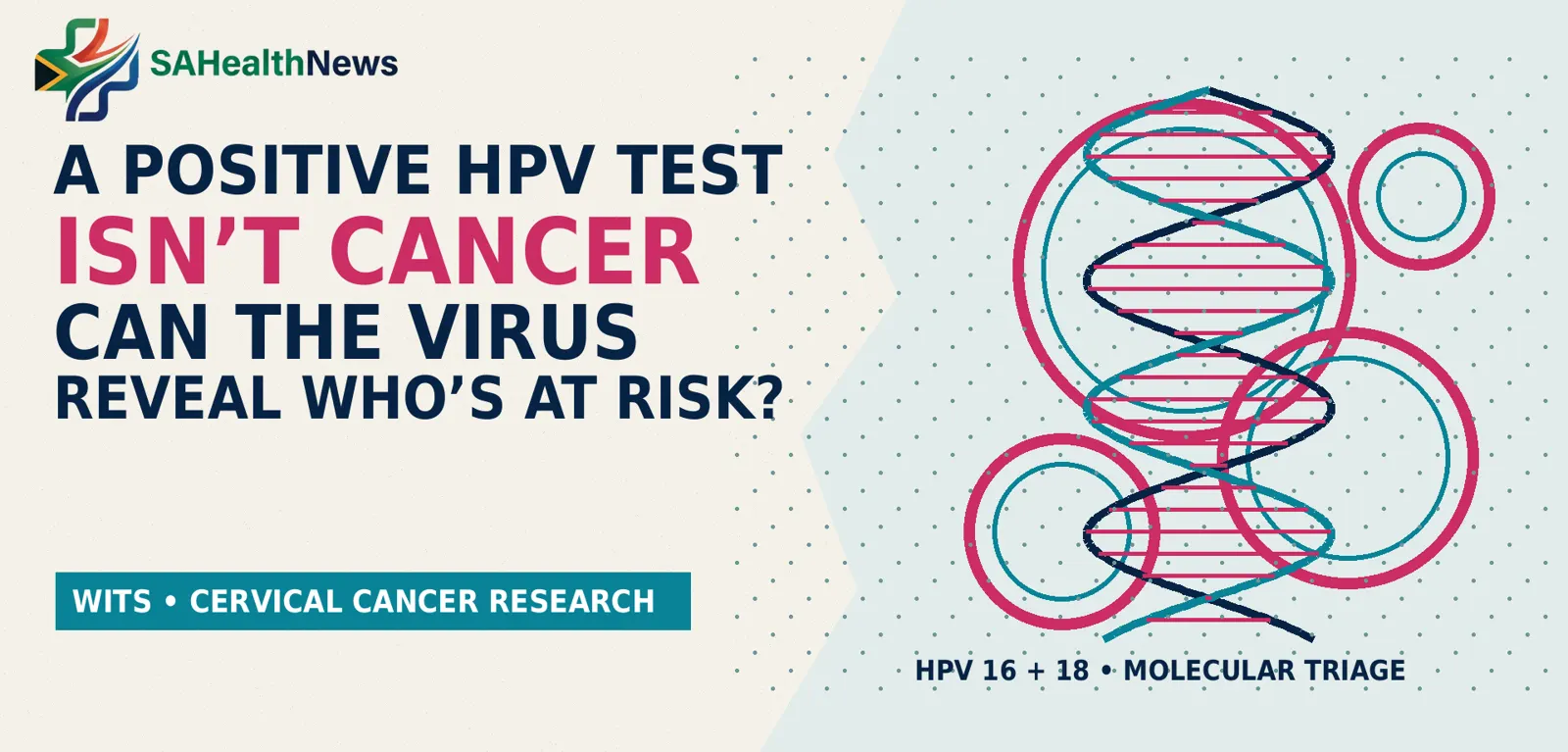
Wits-linked researchers are studying HPV 16/18 molecular markers that may one day improve triage after a positive HPV test. It is not a cancer diagnosis — and not a clinic-ready test yet.
A positive high-risk human papillomavirus test can identify women who carry a virus capable of causing cervical cancer, but it cannot by itself show whether that infection has already produced clinically important changes in the cervix.
Researchers at the University of the Witwatersrand are investigating whether molecular changes inside the virus could eventually help close that gap.
The work focuses on HPV types 16 and 18, the two high-risk types responsible for roughly three-quarters of cervical cancers. Nigerian virologist Dr Ijeoma Ifeorah is conducting part of the research at Wits through an Africa Research Excellence Fund Research Development Fellowship.
Her project examines mutations and DNA methylation patterns in HPV 16 and 18 samples from Nigerian women living with HIV who have different grades of cervical lesions.
This is exploratory research, not a new diagnostic test available to patients. Its potential value lies in whether molecular patterns can reliably distinguish infections associated with more significant cervical changes from infections that may not require the same level of intervention.
Persistent infection with high-risk HPV is the main cause of cervical cancer, but most HPV infections do not progress to cancer.
That creates a screening challenge.
A highly sensitive HPV test can identify women who carry a high-risk type, but a positive result does not mean cancer is present. Health systems therefore need a way to determine which HPV-positive patients require closer investigation or treatment.
That second stage is known as triage.
Depending on the programme and clinical setting, triage can involve cervical cytology, visual assessment, HPV genotyping or other tests designed to identify evidence of clinically important cervical changes.
The Wits-linked research asks whether the virus itself may contain an additional signal.
DNA methylation is a chemical modification of DNA that can influence how genetic material behaves without changing the underlying genetic sequence.
Researchers are investigating whether particular methylation patterns — together with viral mutations — become more common when high-risk HPV infection is associated with increasingly severe cervical lesions.
If a reliable relationship is demonstrated, the molecular information could potentially support a triage test using the *same cervical sample already collected for HPV testing*.
That could be important in health systems where requiring patients to return repeatedly for additional testing creates opportunities for people to be lost between screening, diagnosis and treatment.
But that possibility remains a research objective. The current project has not established a clinically validated test, and the findings cannot yet be used to predict an individual woman's cancer risk.
South Africa has committed to eliminating cervical cancer as a public-health problem and has adopted a national *2026--2030 cervical cancer elimination framework*.
The framework aligns with the World Health Organization's 90--70--90 elimination targets: vaccinating 90% of girls against HPV by age 15; screening 70% of women with a high-performance test by ages 25 and 55; and ensuring that 90% of women diagnosed with precancer receive treatment and 90% of women with invasive cancer receive appropriate care.
The National Department of Health says South Africa now screens more than 800,000 women a year and is transitioning nationally to HPV-DNA-based screening.
That transition makes the question of what happens after a positive HPV test increasingly important.
A screening programme is only effective if women with clinically significant disease can be identified, investigated and treated in time.
The research population is also relevant to southern Africa because women living with HIV have a substantially higher risk of persistent high-risk HPV infection and cervical cancer than women without HIV.
HIV-related immune suppression can make it more difficult for the body to clear HPV infection, increasing the chance that a high-risk infection persists.
That does not mean an HPV-positive woman living with HIV has cervical cancer. It means screening, follow-up and appropriate management are particularly important.
The Wits project's focus on women living with HIV may help researchers understand whether viral molecular markers can improve risk stratification in a population where the clinical need is high.
For a molecular marker to become useful in routine screening, researchers would need to show that it performs reliably across sufficiently large and representative populations.
A useful triage test must correctly identify clinically important disease while avoiding unnecessary procedures for women at low risk. It must also be affordable, reproducible and practical in the laboratories and clinics expected to use it.
Those requirements are especially important in South Africa, where a technically sophisticated test has limited public-health value if it cannot be deployed at scale.
For now, the practical message for patients remains unchanged: a positive high-risk HPV test is not a cancer diagnosis, but it does require the follow-up recommended by the screening programme or healthcare professional.
The new research is about making that next decision more precise.
This article provides health journalism and does not replace individual medical advice.
Until a molecular triage tool is validated, women should treat a high-risk HPV-positive result as a reason for the follow-up their clinic recommends — cytology, visual inspection, genotyping or colposcopy — not as a cancer diagnosis and not as something that can wait indefinitely.
Clinic managers rolling out HPV-DNA screening should watch the gap between test volumes and completed triage. An 800,000-a-year screening programme only reduces cervical cancer if the women who screen positive can be assessed and treated without being lost between facilities.
The Wits-linked work may eventually tighten that second step. For now it is laboratory science with a clear public-health question attached: can the same swab that detects HPV also help decide who needs the next appointment soonest.
The Care Room position is narrow. The research is worth following. It is not yet a change in how any South African woman should read her result.
Source: SA Health News