Breaking
Latest health news from South Africa and around the world•Wellness, nutrition, and fitness updates daily•Medical breakthroughs and healthcare updates•Science-backed health explainers and guides•Health tech, reviews, and upcoming events•
 SA Health News Desk
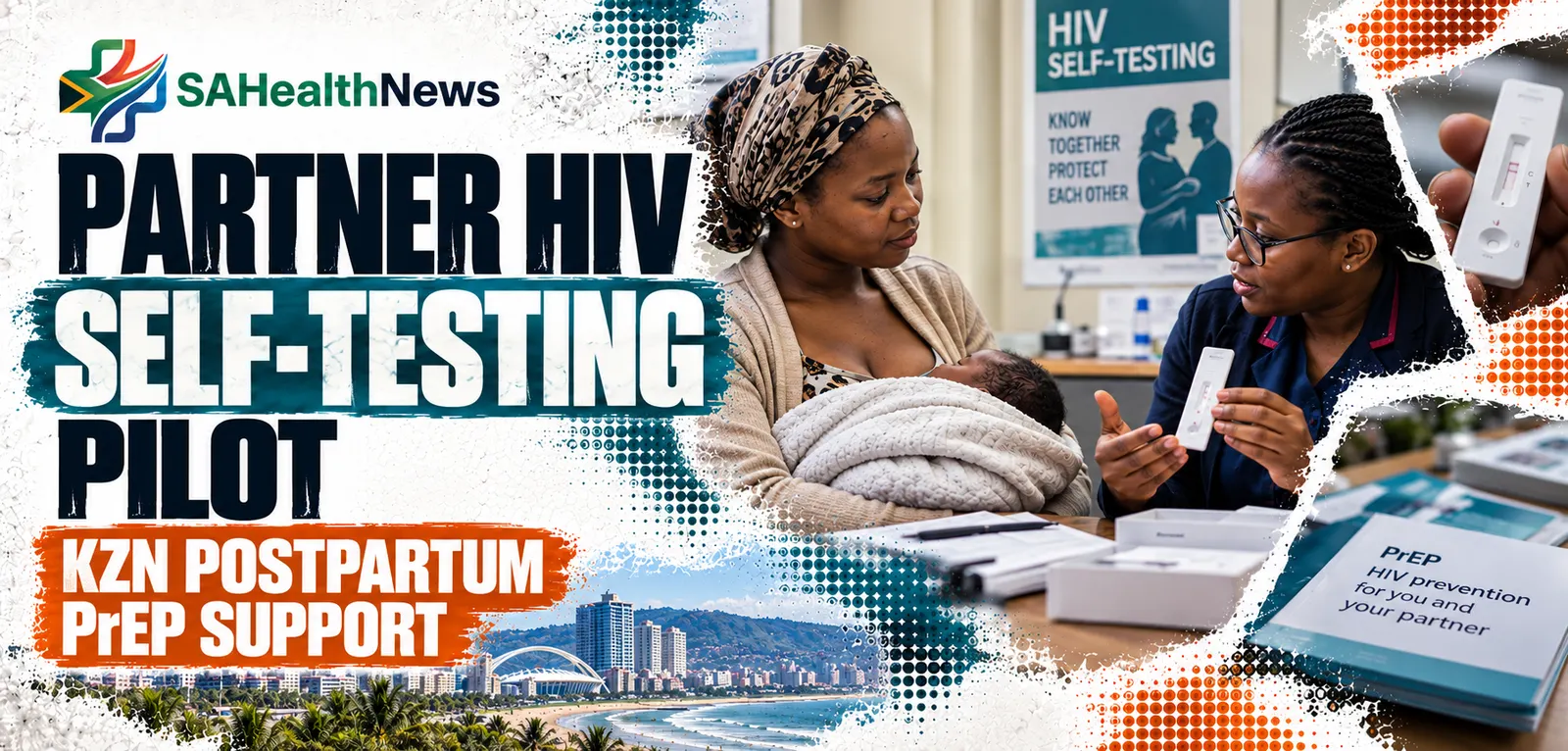
The H4P pilot in KwaZulu-Natal tests partner HIV self-testing plus PrEP support for HIV-negative women in late pregnancy whose partner status is unknown.
A South African pilot is testing whether bringing male partners into HIV prevention can help protect women during the postpartum period, when HIV acquisition remains an important risk and a new infection can also create a transmission risk during breastfeeding.
The H4P study is being conducted in KwaZulu-Natal among HIV-negative women in late pregnancy whose male partner’s HIV status is unknown.
The intervention combines partner HIV self-testing with support for pre-exposure prophylaxis, or PrEP, for women who remain HIV-negative.
The study is a pilot. It is designed to test feasibility, acceptability and preliminary effectiveness, not to establish that the intervention already prevents HIV infections at population scale.
Postpartum HIV prevention has historically received less attention than preventing transmission from women already living with HIV to their babies.
One practical barrier is that many women do not know their partner’s HIV status.
The H4P protocol therefore gives participating women oral HIV self-test kits to share with their male partners, together with standard information on HIV testing and PrEP.
Women in the intervention arm receive additional counselling built around communication skills, motivational interviewing and problem-solving. The aim is to make partner testing easier to discuss and to help women make informed decisions about PrEP.
Unknown partner status is not a private inconvenience. It is a clinical information gap at a moment when breastfeeding, clinic visits and relationship power dynamics already shape what prevention options a woman can use.
The protocol is designed around 60 HIV-negative women aged 18 or older in their third trimester of pregnancy, with male partners also eligible to participate.
The field period was planned for March to September 2026 in KwaZulu-Natal.
That small scale matters. A pilot can show whether an intervention is practical and acceptable and can provide early signals about behaviour or uptake. It cannot, on its own, prove that the approach reduces HIV incidence.
If the model performs well, a larger trial would still be needed before drawing stronger conclusions.
Readers should also separate study enrolment from public-health rollout. A protocol published or underway is not the same as a Department of Health programme offer at every clinic.
South Africa already has oral PrEP available for HIV prevention, while longer-acting prevention options are changing the discussion about adherence and choice.
For postpartum women, the core issue is not simply whether a prevention product exists. It is whether women know they are at risk, can access an appropriate option, and can use it consistently while navigating infant care, relationships and clinic visits.
The H4P study tests whether partner HIV self-testing can become part of that decision-making process rather than leaving women to make prevention choices with little information about their partner’s status.
Longer-acting products may reduce daily-pill friction for some women, but they do not remove the need for risk assessment, counselling and follow-up. Partner testing is one way to sharpen that assessment; it is not a substitute for a woman’s own prevention choice.
For a pilot, useful success metrics are practical: partners willing to test, women able to discuss results safely, PrEP start and continuation among those who need it, and clinic workflows that do not collapse under counselling time.
Unsafe disclosure environments can turn a self-test kit into a risk. Counselling that includes communication and problem-solving is therefore not soft packaging — it is part of the intervention’s safety design.
H4P is a KwaZulu-Natal feasibility pilot linking partner HIV self-testing to postpartum PrEP support for HIV-negative women whose partner status is unknown. It is not proof of population impact and not a national programme announcement.
Watch for results on acceptability, partner testing uptake and PrEP engagement — and demand a larger trial before treating the model as settled prevention policy.
Check primary NICD or SAHPRA notices before repeating secondary claims. Programme facts, batch numbers and case counts should be verified against the official source on the day of reading.
KwaZulu-Natal remains a high-priority geography for HIV prevention research because of sustained incidence among young women and the density of maternal services where late-pregnancy contact is still possible. That makes the province a logical pilot site, but it also means findings must be read against local clinic capacity before anyone proposes national scale-up language.
Funders and programme managers should watch whether male partners engage without coercion, whether self-test results lead to confirmatory pathways, and whether PrEP counselling stays available after birth when clinic attendance often drops. Those operational details decide whether a neat protocol survives contact with real postpartum life.
A Care Room publish standard still applies: keep the checkable facts in the lead, name the source for every number, and do not upgrade preliminary reports into settled outcomes. Readers should confirm facility notices, batch lists and case counts against the primary authority on the day they act.
A Care Room publish standard still applies: keep the checkable facts in the lead, name the source for every number, and do not upgrade preliminary reports into settled outcomes. Readers should confirm facility notices, batch lists and case counts against the primary authority on the day they act.
A Care Room publish standard still applies: keep the checkable facts in the lead, name the source for every number, and do not upgrade preliminary reports into settled outcomes. Readers should confirm facility notices, batch lists and case counts against the primary authority on the day they act.
Source: SA Health News