Breaking
Latest health news from South Africa and around the world•Wellness, nutrition, and fitness updates daily•Medical breakthroughs and healthcare updates•Science-backed health explainers and guides•Health tech, reviews, and upcoming events•
 SA Health News Desk
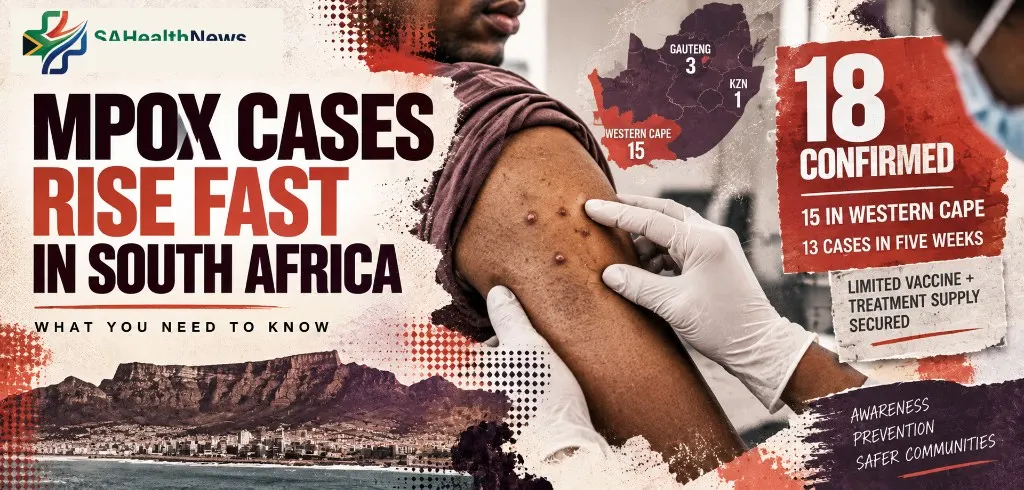
18 confirmed mpox cases and one probable case — 13 in five weeks, mostly in Cape Town. Limited vaccine and treatment supplies secured for targeted control.
South Africa has recorded 18 laboratory-confirmed mpox cases and one probable case, with health authorities warning that infections have risen rapidly over the past five weeks.
The National Department of Health says 13 of the cases were recorded between 13 August and 17 September 2026, a pattern it says suggests rapid local transmission. Fifteen confirmed cases are in the Western Cape, concentrated mainly in Cape Town, while Gauteng has recorded three. The probable case is in KwaZulu-Natal.
The affected patients are aged 23 to 50, with a median age of 36.5 years. Eighteen of the 19 confirmed or probable cases are men.
The Western Cape accounts for 15 of South Africa’s 18 confirmed infections.
Western Cape health authorities say 11 provincial cases were confirmed between August and 18 September, showing how sharply the outbreak has accelerated recently.
That does not mean transmission is confined to one population or one province.
Mpox can affect anyone exposed to the virus. The Department of Health has specifically warned against stigma because it can discourage people from seeking testing and treatment.
One of the most recent patients travelled to Spain and returned to South Africa on 14 September.
The person had undergone testing in Spain after being informed that they were considered a probable case. South African authorities are working with their Spanish counterparts to confirm the laboratory result.
That case should not be used to explain the wider increase.
The Department of Health’s concern is specifically the number of infections appearing locally over a relatively short period.
Mpox can cause fever, headache, muscle aches, back pain and fatigue, followed or accompanied by a rash or skin lesions.
Lesions can occur on the face, hands, feet, genitals and elsewhere on the body. They may begin as flat red spots before developing into raised bumps, fluid-filled blisters, pus-filled lesions and eventually crusted scabs.
Symptoms usually develop six to 13 days after exposure, although the incubation period can range from five to 21 days.
Someone who develops an unexplained rash or compatible symptoms after close contact with a confirmed or suspected case should seek healthcare and avoid close physical contact while being assessed.
Transmission occurs primarily through close physical contact with an infected person, particularly skin-to-skin contact with lesions.
Contaminated bedding, towels and clothing can also transmit the virus.
The Department says prolonged face-to-face exposure and uncovered coughing or sneezing can provide additional opportunities for transmission.
This makes households, intimate contacts and some healthcare environments particularly important for outbreak control.
Government says it has obtained limited quantities of the MVA-BN mpox vaccine and tecovirimat treatment, with support from the World Health Organization.
These supplies are not being presented as a universal vaccination programme.
Health authorities will decide where and how the limited doses are deployed as part of targeted outbreak control.
That distinction matters. The immediate public-health strategy remains early detection, isolation where appropriate, contact management and interruption of transmission networks.
Eighteen confirmed cases is still a relatively small absolute number.
The concern is the rate and concentration of recent infections.
Thirteen cases appearing within roughly five weeks, with most infections concentrated in Cape Town, gives health teams an identifiable outbreak that may still be containable if cases and contacts are found quickly.
The next surveillance updates will matter more than the headline total alone.
If new infections continue appearing rapidly without clear epidemiological links, that would suggest transmission networks are broader than currently recognised.
If case growth slows following contact tracing, targeted vaccination and early isolation, it would indicate that the response is interrupting spread.
For now, the message is specific: South Africa is experiencing a genuine rise in mpox cases, but this is a targeted outbreak-control problem — not a reason for indiscriminate panic or stigma.
Source: SA Health News