Breaking
Latest health news from South Africa and around the world•Wellness, nutrition, and fitness updates daily•Medical breakthroughs and healthcare updates•Science-backed health explainers and guides•Health tech, reviews, and upcoming events•
 SA Health News Desk
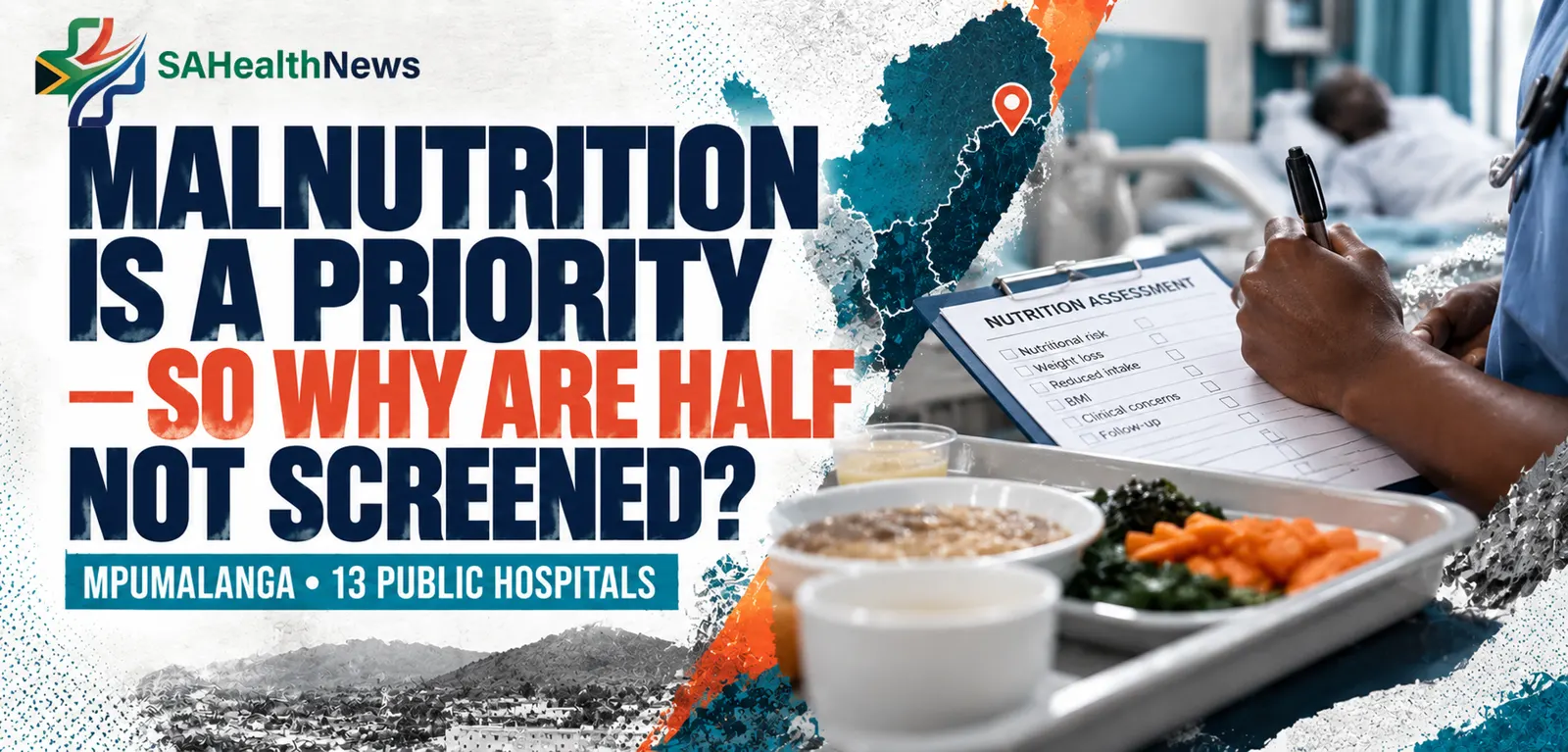
In 13 Ehlanzeni public hospitals, 74% of staff called malnutrition a priority but only 47% reported screening patients — a ward-level gap, not just an awareness problem.
A study across 13 public hospitals in Mpumalanga has found a significant gap between recognising hospital malnutrition as a priority and routinely screening patients for it.
Researchers surveyed 357 health professionals working in public hospitals in the Ehlanzeni district. While *74% said malnutrition was a hospital priority, only 47% reported screening patients for malnutrition*.
The study, published on 5 October in Health SA Gesondheid, examined knowledge, attitudes and practices around nutrition support in 10 district hospitals, two regional hospitals and one provincial hospital.
The findings do not measure the prevalence of malnutrition among patients in these facilities. Instead, they examine whether healthcare workers recognise nutritional risk and how consistently nutrition support is incorporated into care.
The researchers found generally positive attitudes towards nutrition care, but practice did not consistently match that awareness.
Only *38% of participants knew that severe malabsorption and undernutrition accompanied by poor oral intake are indications for parenteral nutrition* — nutrition delivered intravenously when the gastrointestinal tract cannot adequately be used.
At the same time, relatively few respondents regarded nutrition as the responsibility of dietitians alone. Seven per cent strongly agreed and 11.4% agreed with that position, supporting the principle that identifying nutritional risk should involve the broader clinical team.
Education was the most consistent predictor of knowledge, attitudes and practices in the researchers' statistical analysis.
The authors recommend structured training, ongoing mentorship and standardised protocols to improve nutrition support across public hospitals.
Malnutrition in hospital is not limited to patients who appear visibly underweight.
Illness can reduce appetite, interfere with nutrient absorption, increase the body's nutritional requirements or make eating physically difficult. Surgery, cancer, severe infection, gastrointestinal disease and prolonged hospitalisation can all contribute to nutritional deterioration.
A screening process is intended to identify risk early enough for further assessment and intervention.
It is different from a full nutritional assessment. Screening is generally a first step that flags patients who may need more detailed evaluation by a dietitian or clinical team.
The Mpumalanga findings therefore raise a practical systems question: if nutritional risk is widely recognised as important but fewer than half of surveyed professionals report screening, patients who need additional nutritional assessment may not be identified consistently.
Nutrition support can range from helping a patient meet nutritional requirements through normal food to oral supplements, tube feeding or, in specific circumstances, intravenous nutrition.
Those interventions require different levels of clinical assessment and expertise.
The study argues for a multidisciplinary approach rather than treating nutrition as an isolated dietetics function. Doctors, nurses, dietitians, pharmacists and other health professionals may encounter the warning signs of nutritional deterioration at different points in a patient's care.
Standardised screening protocols can make the process less dependent on whether an individual healthcare worker happens to recognise the risk.
This was a cross-sectional survey, meaning information was collected from participants at a particular period rather than following them over time.
Self-reported practice can also differ from what occurs in routine clinical care. The study therefore cannot establish that 53% of patients were not screened, nor can it determine how many patients experienced worse outcomes because of missed screening.
Its findings are also specific to the Ehlanzeni district and should not automatically be generalised to every public hospital in South Africa.
What it does provide is district-level evidence of an implementation gap: health professionals largely recognise the importance of hospital malnutrition, while routine screening remains inconsistent.
For a public health system under pressure, identifying nutritional risk is a comparatively basic part of inpatient care. The challenge highlighted by the study is turning that principle into consistent practice at ward level.
This article provides health journalism and does not replace individual medical advice.
Screening tools already exist in many South African hospitals. The gap in Ehlanzeni looks like protocol, training and ownership rather than a missing invention.
Nursing shifts see patients every day. Doctors write orders for parenteral and enteral nutrition. Dietitians cannot screen every admission alone. The survey's education signal points to a practical fix: short, repeated ward teaching tied to a simple score that triggers a dietetics referral, not a once-off lecture.
Hospital managers in Mpumalanga — and elsewhere — should ask for screening coverage as a routine quality indicator, the same way they ask for vital signs or medicine reconciliation. Self-reported practice will not be enough. Spot audits of admission notes will show whether the 47% figure is improving.
Beds fill with patients who arrive already undernourished, or who deteriorate during long stays when food service, swallowing problems and infection stack up. Parenteral nutrition is expensive and specialised; missing the indication for it is a clinical risk. Overusing it without indication is a different risk.
The study does not claim Mpumalanga is uniquely failing. It shows one district where priority language and ward behaviour have drifted apart. That pattern is familiar across stretched public services: everyone agrees the issue matters; fewer people own the first screening step.
We still need prevalence data from the same hospitals, outcome data linked to missed screens, and evidence that training plus protocols moves the 47% figure. Until then, the Care Room reading is direct: malnutrition is called a priority in Ehlanzeni public hospitals, and fewer than half of surveyed staff say they screen for it. Closing that gap is basic inpatient care, not a research luxury.
Source: SA Health News