Breaking
Latest health news from South Africa and around the world•Wellness, nutrition, and fitness updates daily•Medical breakthroughs and healthcare updates•Science-backed health explainers and guides•Health tech, reviews, and upcoming events•
 SA Health News Desk
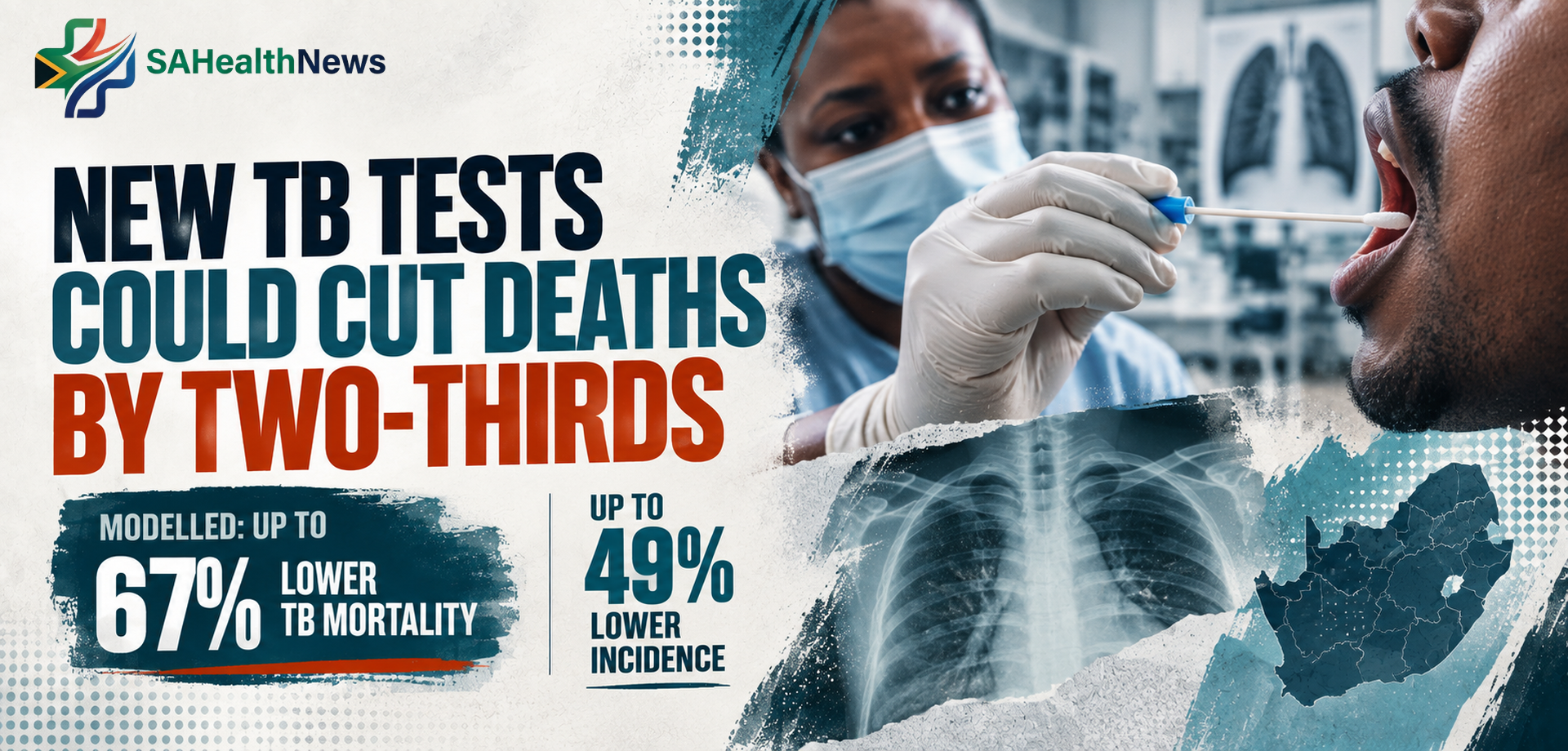
A UCT-led Thembisa model finds clinic-based TB tests using tongue swabs or sputum could cut incidence by up to 49% and deaths by up to 67% — if far more symptomatic patients are actually tested.
A new South African modelling study suggests that easier tuberculosis tests used routinely in clinics could substantially reduce the country’s TB burden — but the projected gains depend on the health system actually testing far more people who arrive with symptoms.
Researchers led by the University of Cape Town used Thembisa, a mathematical model developed for South Africa’s linked HIV and TB epidemics, to test how changes in diagnosis, prevention, HIV treatment and behaviour could affect TB over the next 15 years.
The model found that introducing newer clinic-based tests using tongue swabs or sputum could reduce TB incidence by as much as 49% and TB mortality by as much as 67%.
Those figures are projections, not results from a clinical trial. They describe what could happen under modelled assumptions if the diagnostic technology improves access to microbiological testing and is implemented effectively.
South Africa still has a large TB burden, and one of the persistent weaknesses in the care pathway is that many people who present to clinics with TB symptoms are not microbiologically tested.
Conventional testing commonly requires a patient to produce sputum, after which the specimen is sent to a laboratory. That creates practical barriers: some patients struggle to produce sputum, laboratory processing adds steps, and patients may need to return for results.
The newer tests examined in the modelling can be performed at clinics using either tongue-swab or sputum specimens. According to the UCT research team, their accuracy in people with TB symptoms is similar to current laboratory-based sputum tests, while the clinic-based approach can produce results faster and at lower cost.
The World Health Organization has endorsed the newer testing approach for people with TB symptoms. That distinction matters: the researchers caution that WHO has not endorsed the same tests for broad community screening of people without symptoms because accuracy is lower in asymptomatic populations.
The researchers separately modelled expanded testing outside clinics, including mobile services and door-to-door campaigns.
Under those scenarios, TB incidence could fall by as much as 38% and mortality by as much as 49%.
That does not automatically make mass community screening the best policy. Community testing is more expensive, and the study says further health-economic analysis is needed to determine whether the additional health benefit justifies the cost.
The more immediate opportunity may be fixing testing gaps inside clinics: making it easier to collect specimens, reducing laboratory dependence and ensuring that people who arrive with TB symptoms are actually tested.
The modelling also reinforces the close relationship between South Africa’s HIV and TB epidemics.
Future rates of antiretroviral therapy initiation were among the factors that influenced projected TB mortality. In a worst-case scenario modelled by the researchers, reductions in ART initiation could increase TB mortality by 17%.
That is particularly relevant after disruptions to United States-funded HIV programmes raised concern about continuity of prevention, testing and treatment services.
The study also identified TB preventive therapy as an important intervention, particularly for people recently diagnosed with HIV and household contacts of people with TB.
The World Health Organization’s End TB strategy set a target of reducing TB incidence by 80% between 2015 and 2030.
According to the UCT analysis, South Africa achieved a reduction of about 22% between 2015 and 2024 and is unlikely to reach the 2030 target on its current trajectory.
The model nevertheless suggests that a combination of better diagnosis, stronger HIV treatment, preventive therapy and other interventions could bring the country much closer to the target.
The important caveat is that modelling cannot guarantee a real-world reduction of 49% in incidence or 67% in deaths. Those estimates describe the potential effect of changing key programme conditions. Staffing, procurement, clinic workflow, patient follow-up, test performance and access will determine how much of that potential is realised.
For South Africa, the study’s practical message is less about a single breakthrough test than about closing the diagnostic gap: a better test has limited value if people with symptoms are still not offered one.
SA Health News is journalism, not medical advice. People with symptoms suggestive of TB should seek assessment from a healthcare professional.
Source: SA Health News Desk