Breaking
Latest health news from South Africa and around the world•Wellness, nutrition, and fitness updates daily•Medical breakthroughs and healthcare updates•Science-backed health explainers and guides•Health tech, reviews, and upcoming events•
 SA Health News Desk
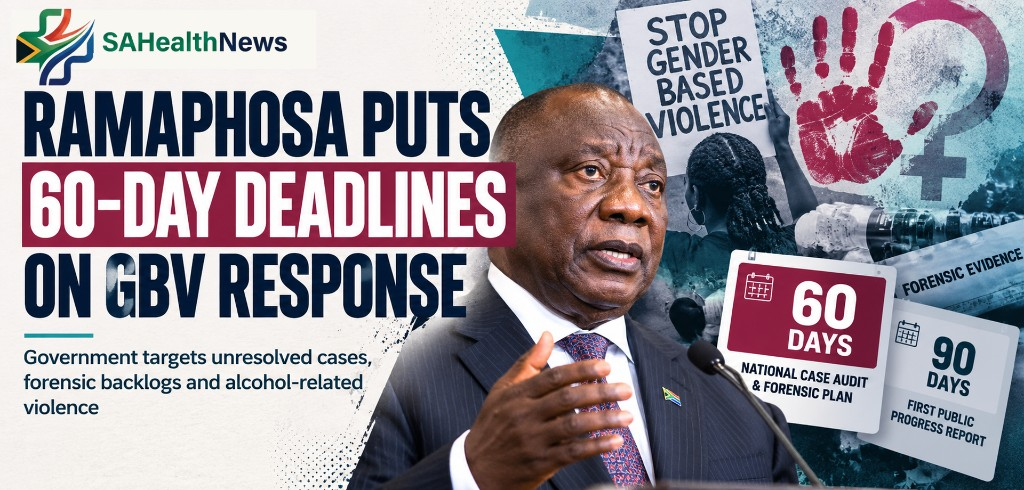
Ramaphosa has set 60-day deadlines for a national GBV case audit and forensic backlog plan, with a first public progress report due in 90 days.
President Cyril Ramaphosa has ordered a time-bound national response to gender-based violence and femicide, including a review of unresolved cases, action on forensic backlogs and a government package aimed at reducing alcohol-related violence.
The directives were announced on 29 September 2026 following renewed concern over killings of women in and around Ekurhuleni. They move several parts of the response from broad commitments to measurable deadlines, and they pull health squarely into the picture, from forensic turnaround times to alcohol-related harm.
Police and justice authorities have been instructed to conduct a national case-recovery operation covering unresolved murders, attempted murders, rapes and serious sexual offences involving women and children.
Within 60 days, the audit must identify how many cases remain unresolved, their age, cases awaiting forensic evidence, cases where suspects have been identified but not arrested, and investigations or prosecutions that have stalled.
Individual recovery plans are expected to specify the outstanding action, the responsible official and a deadline for progressing each priority case.
The government has also ordered a funded plan within the same 60-day period to tackle forensic backlogs. Priority forensic samples involving the rape or murder of women and children are to receive urgent processing. That matters for survivors and families waiting on results that can determine whether a case moves, stalls or collapses.
The first consolidated public progress report is due within 90 days, followed by quarterly reporting.
The health implications extend beyond policing.
The Minister of Trade, Industry and Competition has been directed to work with the ministers responsible for Health, Social Development, Police and Cooperative Governance on a coordinated legislative and enforcement package aimed at reducing alcohol-related violence.
Ramaphosa explicitly distinguished alcohol from the cause of GBV: responsibility remains with perpetrators. The policy rationale is instead that harmful alcohol use can aggravate interpersonal violence and should therefore form part of violence-prevention policy.
That distinction matters for clinics and communities. Alcohol-control measures cannot substitute for policing, survivor services, functioning courts or interventions addressing gender inequality and violent social norms. They can, however, sit alongside injury prevention, emergency care demand and the wider public-health cost of violence.
South African Medical Research Council research provides a longer-term measure of the problem.
Its national femicide research found that 60.1% of women murdered in 2020/21 were killed by an intimate partner. Fewer than one in five intimate-partner femicide cases resulted in a conviction, while the proportion of cases in which perpetrators could not be identified increased substantially.
A South African Medical Research Council national prevention strategy reports that approximately three women a day are killed by intimate partners in South Africa, with an intimate-partner femicide rate of about 5.6 per 100,000 women.
These figures reinforce why GBV is not solely a criminal-justice issue. Violence has direct consequences for physical injury, sexual and reproductive health, mental health, disability, substance use and the wellbeing of children exposed to violence in the home.
Whether these directives help will depend on measurable change rather than another layer of policy language.
The immediate indicators are now identifiable: unresolved cases progressed, forensic turnaround times reduced, priority samples processed, municipal safety hazards corrected and the promised alcohol-policy package delivered.
Government has committed itself to reporting those results publicly. The first 90-day report will therefore provide an early test of whether the new response is changing operational performance rather than simply restating the scale of South Africa's GBV crisis.
This article is for public information. It is not medical or legal advice. Anyone at immediate risk should contact local emergency services; survivors can also reach organisations such as the GBV Command Centre on 0800 428 428.
Source: SA Health News Desk