Breaking
Latest health news from South Africa and around the world•Wellness, nutrition, and fitness updates daily•Medical breakthroughs and healthcare updates•Science-backed health explainers and guides•Health tech, reviews, and upcoming events•
 SA Health News Desk
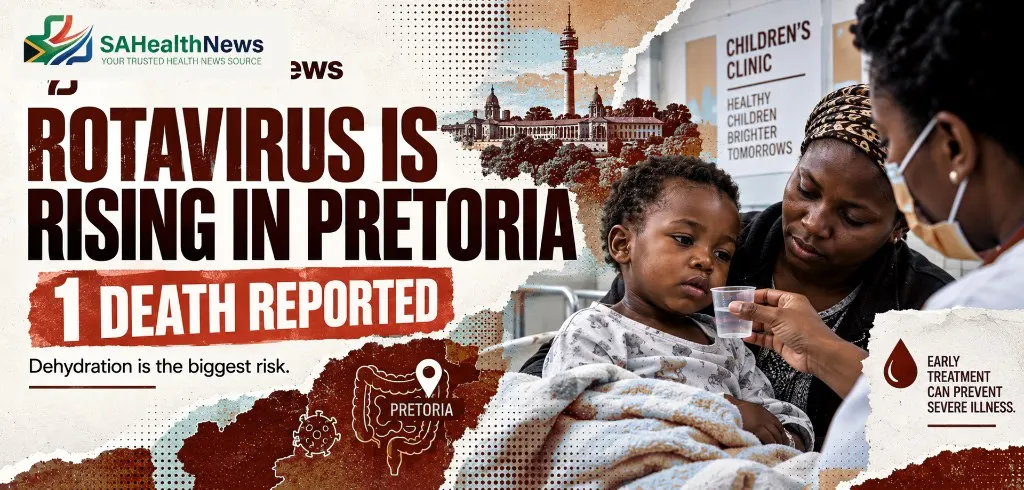
NICD reports a sharp Pretoria rotavirus rise and one death. Dehydration — not every loose stool — is the clinical emergency parents need to spot.
South Africa is still inside its 2026 rotavirus season, with the National Institute for Communicable Diseases reporting a sharp increase in infections in Pretoria and one death.
The warning matters because rotavirus is not simply another childhood stomach bug. The infection can cause repeated vomiting and profuse watery diarrhoea, and young children can lose dangerous amounts of fluid in a relatively short period.
The NICD says the current national season is ongoing and is urging parents to make sure children receive their scheduled rotavirus vaccination and to recognise dehydration early.
South Africa normally sees rotavirus activity rise during the cooler, drier months. Since the vaccine entered the Expanded Programme on Immunisation in August 2009, the typical season has run from July through August and can continue into September.
That makes the current increase seasonally plausible. The Pretoria spike and reported fatality are nevertheless important enough to warrant specific attention.
Rotavirus infects the digestive system and spreads mainly through the faecal-oral route.
Symptoms usually begin with vomiting followed by non-bloody, watery diarrhoea. Fever occurs in some patients, while appetite loss, lethargy and abdominal discomfort can also occur.
For parents, the critical issue is not trying to identify rotavirus from symptoms alone.
It is recognising when a child is losing more fluid than they are replacing.
The NICD lists dry mouth, absence of tears, sunken eyes or a sunken soft spot in babies, fewer wet nappies, unusual fussiness, lethargy and refusing food or fluids among signs of early or moderate dehydration.
Severe dehydration is an emergency.
A child may become unusually sleepy or limp, develop cold or discoloured skin, produce dark urine, breathe rapidly or have a fast heartbeat. Skin that remains tented for longer than normal after being gently pinched can also indicate significant fluid loss.
At that point, waiting to see whether the diarrhoea resolves is the wrong approach.
The child needs medical assessment.
The NICD recommends increasing fluids when diarrhoea begins and continuing breastfeeding for infants.
Where commercially prepared oral rehydration solution is unavailable, its current public guidance describes a home solution made with six teaspoons of sugar and half a teaspoon of salt dissolved in one litre of clean water.
The proportions matter.
Adding excessive salt can itself be dangerous, particularly for a small child.
Oral rehydration does not stop the infection. Its purpose is more important: replacing water and electrolytes while the illness runs its course.
A severely dehydrated child may require intravenous fluids in hospital.
That is why early recognition makes such a difference. A child who can still drink and retain fluids is in a very different clinical position from one who arrives at hospital after prolonged fluid loss.
Most children encounter rotavirus by the age of two, but vaccination substantially reduces the risk of severe disease.
South Africa incorporated rotavirus vaccination into its national childhood immunisation programme in 2009.
The vaccine is aimed primarily at preventing the serious diarrhoea, dehydration and hospitalisation that made rotavirus particularly dangerous before routine immunisation.
Vaccinated children can still become infected.
That does not mean the vaccine has failed.
Vaccines do not need to prevent every infection to have substantial public-health value. Preventing an infection from progressing to severe dehydration or hospitalisation is itself an important outcome.
The current warning also arrives against a broader concern about childhood vaccination coverage in South Africa.
That makes missed rotavirus doses part of a larger problem rather than an isolated vaccination issue.
The warning comes from active diarrhoeal-disease surveillance rather than anecdotal reports.
The NICD conducts syndromic surveillance through the GERMS-SA platform at five sites: Pelonomi Hospital in the Free State, Klerksdorp/Tshepong hospitals in North West, Red Cross War Memorial Children’s Hospital in the Western Cape, Kabokweni Clinic in Mpumalanga and Kalafong Hospital in Gauteng.
Patients presenting for treatment of diarrhoea at participating sites contribute to the surveillance picture.
That network does not represent a literal count of every rotavirus infection in South Africa.
Its value lies in detecting patterns: when infections rise, where unusual activity appears and whether the expected seasonal behaviour is changing.
The Pretoria increase is therefore a surveillance signal, not an estimate of the total number of infected children in the city.
The NICD has not published a Pretoria case total in its public warning.
That number should not be invented from the available data.
A rotavirus warning can easily produce the opposite problem: parents rushing every child with a loose stool to an emergency department.
The useful dividing line is the child’s condition.
A child who is alert, drinking and urinating normally can often be managed initially with careful hydration and monitoring, depending on their age and overall health.
Persistent vomiting, inability to drink, reduced urine output, increasing lethargy or other signs of dehydration change that calculation.
Babies and very young children can deteriorate particularly quickly because their fluid reserves are small.
The NICD’s message is therefore not that Pretoria parents should panic.
It is that the rotavirus season is not finished, transmission has increased sharply in the city’s surveillance data, and dehydration needs to be treated as the main warning sign.
One death has already been reported.
The preventable danger is allowing fluid loss to progress until a child reaches care critically dehydrated.
Source: SA Health News