Breaking
Latest health news from South Africa and around the world•Wellness, nutrition, and fitness updates daily•Medical breakthroughs and healthcare updates•Science-backed health explainers and guides•Health tech, reviews, and upcoming events•
 SA Health News Desk
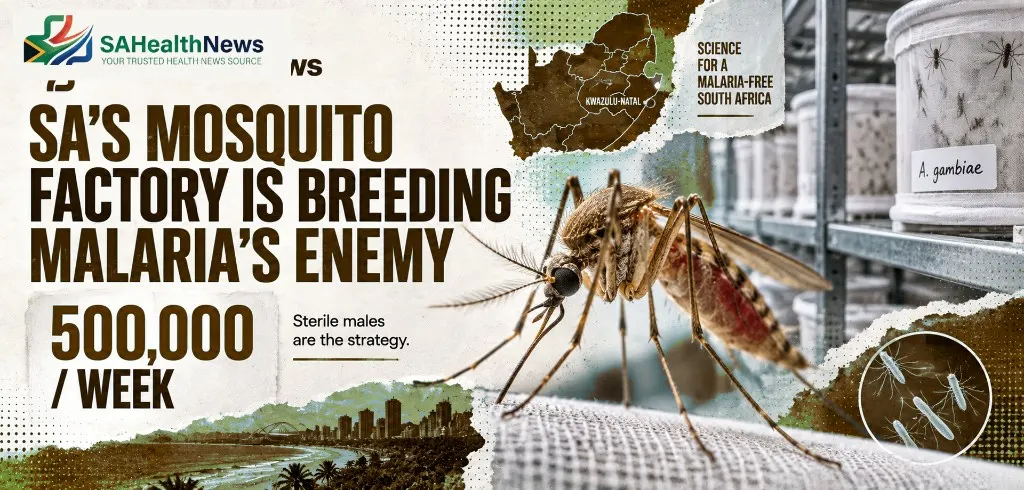
South Africa’s pilot mass-rearing facility can produce about 500,000 Anopheles arabiensis a week for sterile-insect technique — promising, still not peer-reviewed elimination.
South Africa has spent more than a decade developing an unusual weapon against malaria: breed enormous numbers of mosquitoes, sterilise the males and release them into areas where malaria still circulates.
The programme has now reached a significant technical milestone.
South Africa’s pilot mosquito mass-rearing facility can produce approximately 500,000 *Anopheles arabiensis* mosquitoes every week, according to new details released by Wits University.
The work is being developed jointly with the National Institute for Communicable Diseases.
The objective sounds counter-intuitive until the biology is understood.
Researchers do not want the laboratory males to spread malaria.
Male mosquitoes do not bite people.
Instead, scientists want them to compete with fertile wild males for mates.
The technique is known as the Sterile Insect Technique, or SIT.
Researchers rear male Anopheles arabiensis mosquitoes and sterilise them using X-rays.
They are then released into the wild.
A female Anopheles arabiensis generally mates once. If she mates with one of the sterilised laboratory males, her eggs are not viable.
Repeat that process across a sufficiently large mosquito population and the number of mosquitoes in the next generation should fall.
The strategy is therefore closer to biological population suppression than conventional insecticide spraying.
South Africa is interested in the technique because one particular malaria vector has proved difficult to control with existing tools.
Indoor residual spraying has played a major role in South Africa’s malaria-control programme.
Insecticide is applied to interior walls where mosquitoes rest, killing vectors that enter homes.
That approach works particularly well against mosquitoes that feed and rest indoors.
Anopheles arabiensis does not always cooperate.
It can bite and rest outdoors, allowing it to avoid both sprayed interior surfaces and, in some circumstances, insecticide-treated bed nets.
As South Africa drives malaria transmission towards increasingly low levels, these behavioural differences become more important.
Tools that were sufficient to dramatically reduce transmission may not necessarily eliminate the final pockets.
SIT is being developed as an additional tool rather than a replacement for existing malaria control.
This is not confined to a Johannesburg laboratory.
Researchers conducted a 12-week small-scale field trial in Mamfene in northern KwaZulu-Natal, releasing roughly 50,000 sterile male mosquitoes twice a week.
Wits reports that the target mosquito population declined while sterile males were being released and rebounded after the releases stopped.
That pattern is encouraging because it is consistent with the intervention suppressing the population.
It is not yet definitive proof that SIT can eliminate malaria transmission.
Wits explicitly notes that the findings from the trial have not yet been published or peer-reviewed.
That limitation matters.
A reduction in mosquito abundance is not automatically the same thing as a reduction in human malaria cases.
Researchers will ultimately need larger epidemiological trials capable of measuring whether the technique reduces disease transmission under real-world conditions.
A mosquito factory introduces an obvious safety problem.
Female mosquitoes bite.
Researchers therefore need a reliable way to prevent disease-transmitting females from being released with the sterile males.
The South African programme uses a specially developed genetic sexing strain.
The male mosquitoes carry a dieldrin-resistance marker linked to the Y chromosome.
During the larval stage, the mosquitoes are exposed to a controlled dieldrin treatment. Females without the resistance marker are eliminated, while the resistant males survive.
The resulting male cohorts are then placed in custom 3D-printed canisters and sterilised using a precisely controlled X-ray dose.
The aim is delicate: make the males infertile without making them so weak that wild females refuse to mate with them.
A sterile mosquito that cannot compete successfully in a natural swarm is of little use.
Producing the insects is only part of the challenge.
Adult mosquitoes are fragile.
If thousands are packed into containers and transported normally, they can damage their wings and legs before reaching the release site.
South African researchers have developed a chilled-transport process that temporarily immobilises the insects.
Using that approach, they have transported adult mosquitoes more than 500 kilometres from the Johannesburg rearing facility to release areas in northern KwaZulu-Natal.
Researchers are now considering whether drones could eventually distribute sterile males over difficult terrain.
That remains an operational concept rather than an established deployment method.
Community acceptance will also matter.
People living in malaria areas need to understand why health authorities are deliberately releasing mosquitoes into their neighbourhoods.
Before the Mamfene trial, researchers used school dramas, local radio and even Maskandi music to explain the project to communities.
The message had to overcome an obvious contradiction:
Public-health programmes have spent generations telling people to avoid mosquitoes.
Now scientists were arriving with thousands more.
The distinction is that the released insects are sterile males, which do not take blood meals and therefore do not transmit malaria by biting humans.
Public trust is not a minor part of the technology.
A technically effective mosquito-control system will fail if communities reject releases or believe scientists are exposing them to disease.
South Africa’s mass-rearing facility can now produce insects at substantial scale.
Researchers have demonstrated transport.
They have developed sex separation.
They have conducted small field releases.
The next steps include collecting regulatory evidence, conducting larger epidemiological studies and testing whether the approach can contribute to local elimination.
That is the correct point at which to judge the programme.
SIT has a biologically plausible mechanism and decades of precedent in controlling other insect populations.
South Africa’s Anopheles arabiensis programme also rests on years of local scientific work.
But the new Mamfene observations remain unpublished.
The programme therefore sits somewhere important between experiment and public-health intervention.
It is no longer merely an idea.
It is also not yet an established malaria-elimination tool.
If larger trials show that sterile releases reduce human transmission, South Africa may have developed something much more valuable than a local mosquito-control project.
It could have a scalable African tool for attacking the outdoor-biting mosquitoes that conventional indoor malaria interventions struggle to reach.
Source: SA Health News