Breaking
Latest health news from South Africa and around the world•Wellness, nutrition, and fitness updates daily•Medical breakthroughs and healthcare updates•Science-backed health explainers and guides•Health tech, reviews, and upcoming events•
 SA Health News Desk
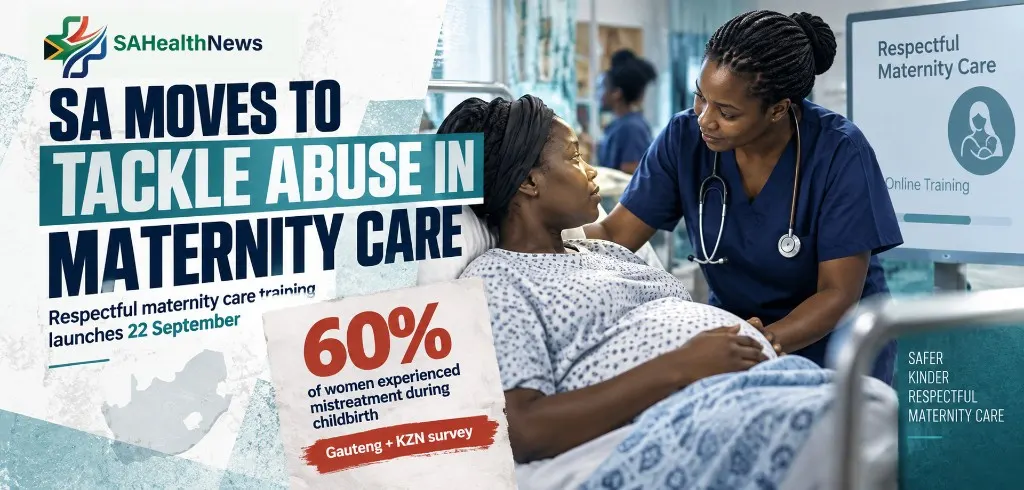
A new respectful maternity care course launches 22 September after a Gauteng–KZN survey estimated ~60% of women experienced mistreatment during childbirth.
South Africa’s National Department of Health is preparing to launch a new respectful maternity care training course aimed at reducing mistreatment of women during pregnancy and childbirth.
The online course is scheduled to launch on 22 September 2026 through the department’s Knowledge Hub and is being considered for mandatory use among staff working with pregnant women and maternity patients.
The programme follows renewed concern about verbal abuse, humiliation, non-consensual procedures, lack of privacy and other forms of mistreatment reported by women using maternity services.
Respectful maternity care is not limited to clinical technique.
A woman’s experience can be shaped by nurses, doctors, administrative staff, porters, security personnel and other workers she encounters while seeking care.
The department’s approach therefore considers a wider group of maternity-facing staff rather than treating respectful care as a narrow obstetric issue.
The course contains three lessons, embedded video material and approximately 3.5 hours of self-paced training.
Its purpose is to reinforce dignity, communication, consent, privacy and respectful interaction during maternity care.
A survey commissioned by the DG Murray Trust and Embrace and conducted by Social Surveys Africa interviewed 845 women in Gauteng and KwaZulu-Natal who had given birth during the previous decade.
The study estimated that around 60% had experienced some form of physical, verbal or emotional mistreatment during maternity care.
Researchers extrapolated the findings to estimate that approximately 1.79 million women across the two provinces may have experienced mistreatment over that period.
The survey should not be interpreted as a national prevalence study. It covered women in Gauteng and KwaZulu-Natal and relied on reported experiences over a long retrospective period.
But the findings provide a substantial signal about the scale of the problem in two of South Africa’s most populous provinces.
Only about 7% of respondents who experienced mistreatment said they had reported it.
Around a third recognised at the time that the treatment they received was wrong.
The study estimated that, on average, hundreds of women a day could be experiencing some form of mistreatment across the two provinces represented in the survey.
Low reporting matters because complaint systems cannot correct problems they never capture.
Women may not know where to complain, may fear retaliation or may believe poor treatment is simply part of using an overstretched public health service.
Around a quarter of women who reported mistreatment said procedures had been performed without adequate consent.
Approximately 75% said they did not have a support person present during childbirth, while roughly four in ten reported inadequate privacy.
These are not cosmetic issues.
Consent, privacy and communication are part of safe clinical care because they affect whether patients understand what is happening, disclose important information and feel able to participate in decisions.
An online course can standardise expectations and make respectful-care principles visible across the health system.
It cannot by itself resolve overcrowding, understaffing, burnout, poor supervision or facility cultures that tolerate abusive behaviour.
Those structural pressures do not excuse mistreatment, but they can make it harder to change if training is not accompanied by accountability and better working conditions.
The useful measure of the new programme will therefore be what happens after staff complete it.
That includes whether complaints are handled effectively, whether facilities monitor patient experience and whether women report measurable improvement in dignity, privacy and informed consent.
South Africa’s maternity system already measures deaths, complications and clinical outcomes.
Respectful care adds another necessary question: whether women are treated as people with rights while receiving that care.
Source: SA Health News