Breaking
Latest health news from South Africa and around the world•Wellness, nutrition, and fitness updates daily•Medical breakthroughs and healthcare updates•Science-backed health explainers and guides•Health tech, reviews, and upcoming events•
 SA Health News Desk
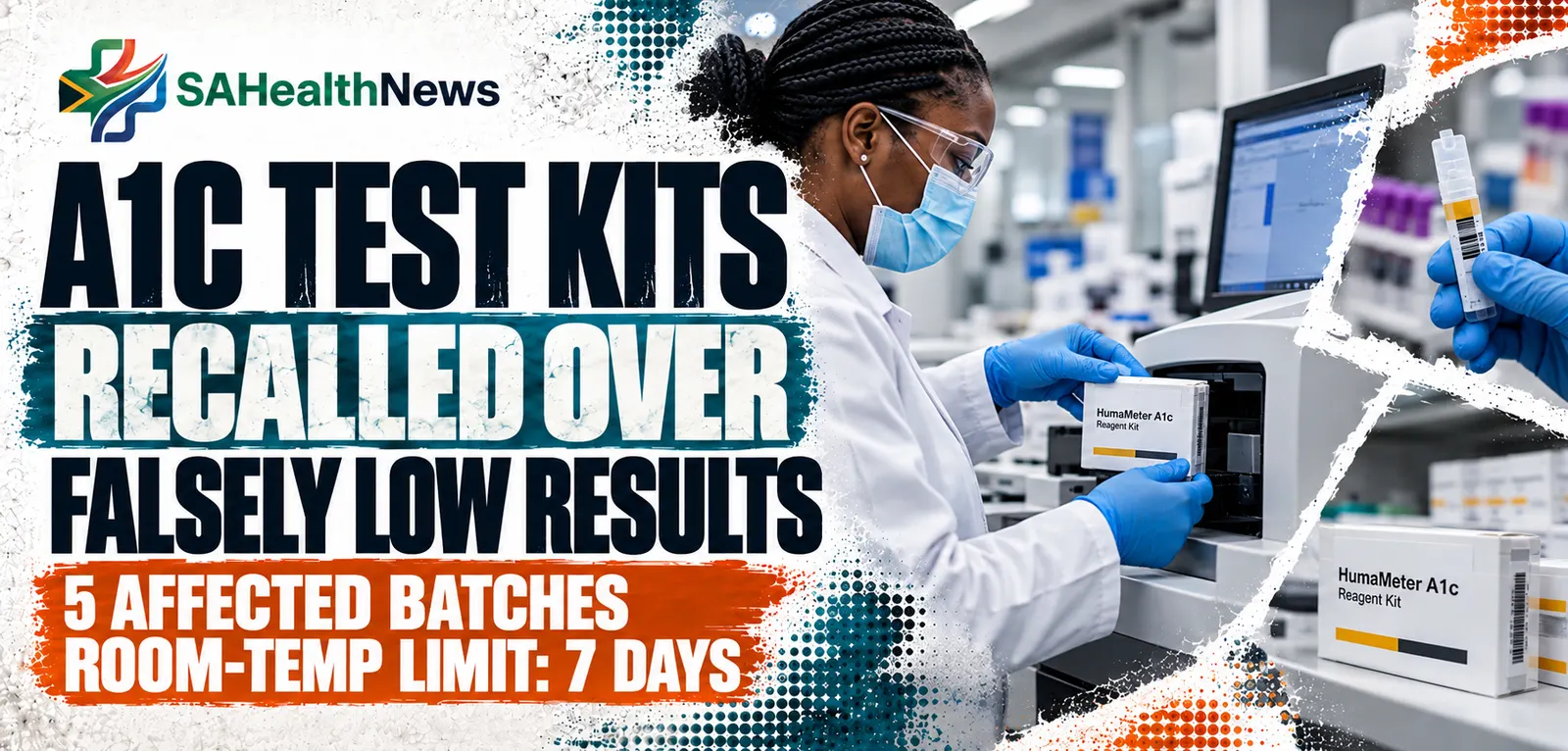
SAHPRA is recalling five HumaMeter A1c reagent batches after room-temperature storage beyond seven days was linked to falsely low HbA1c results.
South Africa’s medicines regulator has published a recall notice for selected HumaMeter A1c reagent kits after the manufacturer found that some cartridges stored at room temperature for longer than seven days may produce falsely low HbA1c results.
The South African Health Products Regulatory Authority lists the action as a Class II, Type C recall involving five batches distributed by Axim Nuclear and Oncology: 065005, 065012, 065022, 065025 and 065029.
HbA1c testing is used to monitor longer-term blood-glucose control in people with diabetes. A result that reads lower than the patient’s true value could make diabetes control appear better than it is and may delay a clinician’s decision to adjust treatment.
The recall notice says manufacturer HUMAN Gesellschaft für Biochemica und Diagnostica found during retained-sample testing that reagent cartridges did not consistently meet the stated 90-day in-use stability specification when stored at 18–25°C.
Further investigation found that cartridges kept at that temperature for more than seven days might not reliably distinguish between results around 50 and 60 mmol/mol. SAHPRA says the affected cartridges could produce falsely low patient results, with a mean deviation of up to 7.87% below European Reference Laboratory target values.
The room-temperature storage instruction has therefore changed. The previous instruction that cartridges could be stored at 18–25°C for up to three months is replaced by a maximum of seven days at that temperature.
Kits kept continuously refrigerated at 2–8°C did not show the same decrease in results and remained within specification over their stated shelf life.
HbA1c reflects blood-glucose exposure over roughly the previous two to three months and is commonly used to assess whether a diabetes treatment plan is working.
A falsely low result does not automatically mean a patient has been harmed, but it can affect a treatment decision. SAHPRA says the expected consequence is more likely to be a delay in therapy adjustment until the next clinical review than an immediate acute risk.
Patients should not change medicines, doses or treatment schedules on the basis of this recall alone. Anyone concerned about a recent HumaMeter A1c result should contact the clinic, laboratory or healthcare professional that performed the test.
That clinical caution matters in a country with a large diabetes burden. Clinics often use point-of-care or near-patient HbA1c tools to speed decisions when laboratory access is slow. When those tools drift low, the error is quiet: the patient feels no different, and the number looks “better”.
Clinicians reviewing recent trends should ask whether an unexpectedly improved HbA1c came from an affected batch and storage condition, not only from lifestyle or medicine changes.
SAHPRA advises healthcare professionals and distributors to read the field safety notice and return affected stock to Axim Nuclear and Oncology.
The recall is batch-specific. It does not mean every HbA1c result produced by every HumaMeter A1c system is unreliable.
Facilities should check fridge logs and room-temperature storage practice as carefully as they check batch numbers. A kit that was refrigerated correctly is not the same problem as a kit left on a bench for weeks under the old three-month room-temperature instruction.
Procurement and laboratory managers should also update local SOPs so the seven-day room-temperature limit is visible where cartridges are opened and stored.
A Class II, Type C recall is a regulatory action, not a public instruction to stop all diabetes monitoring. The practical response is narrower: identify affected lots, quarantine them, return them, and reassess borderline results if an affected cartridge may have been used.
People living with diabetes who feel unwell, have high home glucose readings, or have symptoms of poor control should seek clinical care regardless of any single lab printout. Symptoms and self-monitoring still matter when a laboratory method is under review.
Confirmed facts: five named batches, Class II Type C recall, falsely low risk linked to >7 days at 18–25°C, refrigerated kits within specification, return stock to Axim, do not self-alter treatment from the notice alone.
The Wire Room test for clinics is operational: batch check done, storage SOP updated, and any suspicious “too-good” HbA1c reviewed with the treating clinician.
Check primary NICD or SAHPRA notices before repeating secondary claims. Programme facts, batch numbers and case counts should be verified against the official source on the day of reading.
Distributors should treat the field safety notice as an operations document: identify stock locations, segregate the five listed batches, document returns, and confirm that replacement inventory carries the updated storage instruction. Quiet shelf stock in satellite clinics is where recalls fail.
Laboratories that use multiple HbA1c methods should also avoid mixing trend interpretation across platforms without noting method changes. A falsely low cartridge result followed by a laboratory HPLC result can look like sudden “worsening” when the patient has not changed at all.
A Care Room publish standard still applies: keep the checkable facts in the lead, name the source for every number, and do not upgrade preliminary reports into settled outcomes. Readers should confirm facility notices, batch lists and case counts against the primary authority on the day they act.
A Care Room publish standard still applies: keep the checkable facts in the lead, name the source for every number, and do not upgrade preliminary reports into settled outcomes. Readers should confirm facility notices, batch lists and case counts against the primary authority on the day they act.
Source: SA Health News