
Breaking
Latest health news from South Africa and around the world•Wellness, nutrition, and fitness updates daily•Medical breakthroughs and healthcare updates•Science-backed health explainers and guides•Health tech, reviews, and upcoming events•
 SA Health News Desk
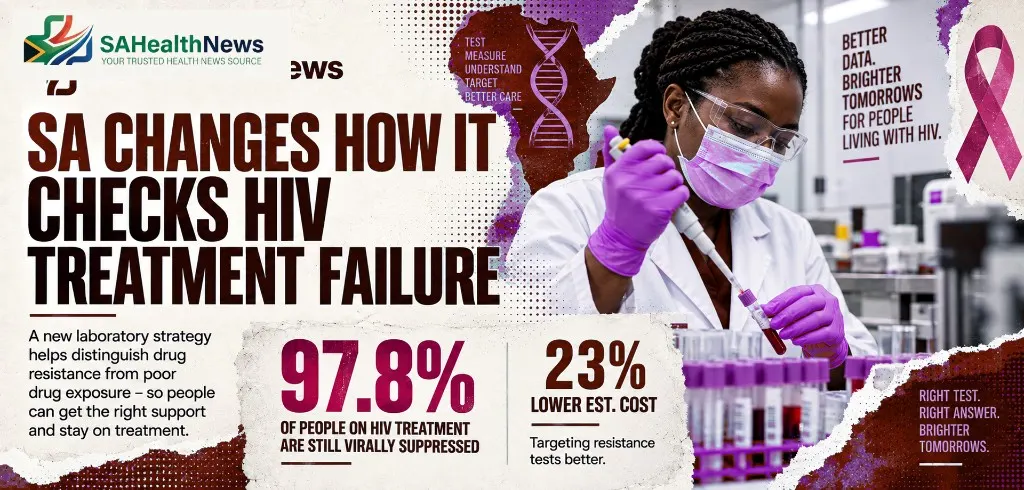
A Johannesburg study shows drug-exposure testing before resistance sequencing can cut monitoring costs ~23% and better separate adherence gaps from dolutegravir resistance.
South Africa has begun using a new laboratory strategy in public HIV care to distinguish between two very different reasons why treatment can stop suppressing the virus: drug resistance and inconsistent medication use.
The approach centres on dolutegravir, the integrase inhibitor that forms the backbone of South Africa’s standard first-line antiretroviral treatment.
When a patient’s viral load rebounds despite being on dolutegravir, clinicians face an important question. Has HIV developed resistance to the medicine, or has the patient not had enough drug exposure because doses were missed?
Those situations require different responses.
Research from two Johannesburg public-sector clinics now shows that measuring whether dolutegravir is actually present in the same blood sample can help identify which patients are most likely to benefit from expensive HIV resistance testing.
A modified version of that strategy has now been introduced into South Africa’s public HIV programme.
The ITREMA-2 study was a prospective implementation study conducted at two public-sector clinics in Johannesburg.
Researchers analysed 400 samples from 288 adults receiving dolutegravir-based antiretroviral therapy whose viral loads had rebounded to at least 400 HIV RNA copies per millilitre.
The samples were collected between May 2023 and January 2025.
Participants had a median age of 44. Women accounted for 56% of the study population, while 83% had previously received antiretroviral treatment that did not contain dolutegravir.
Instead of immediately performing resistance sequencing on every eligible patient, researchers first tested residual viral-load samples to determine whether dolutegravir was detectable in the blood.
If the drug was present, the laboratory automatically performed resistance testing on the same specimen.
The logic is important.
Someone whose blood contains dolutegravir but whose virus is still replicating despite treatment presents a different resistance risk from someone whose blood contains little or no evidence of recent drug exposure.
Dolutegravir was detectable in 108 of the 288 participants — 38%.
Among participants with successful sequencing, resistance to dolutegravir was found in 13% of those with detectable drug, compared with 2% among those without detectable dolutegravir.
Across the successfully assessed study population, the overall prevalence of dolutegravir resistance was 6.7%.
The drug-exposure test was particularly useful for identifying people unlikely to have dolutegravir resistance.
Its negative predictive value for the absence of resistance was 97.8%, with a 95% confidence interval of 93.5% to 99.5%.
That does not mean a negative drug-exposure result can absolutely rule out resistance.
Three participants without detectable dolutegravir still had resistance mutations.
It does mean the test can substantially improve how laboratories decide where expensive sequencing is most likely to be useful.
HIV treatment suppresses viral replication when an effective combination of antiretroviral medicines is maintained at sufficient concentrations.
When doses are repeatedly missed, drug concentrations fall.
The virus can then begin replicating again and the patient’s viral load rises.
But that does not necessarily mean the virus has genetically changed enough to resist the medicine.
Changing treatment unnecessarily can therefore create another problem.
A patient could lose access to an otherwise effective, well-tolerated regimen when what they actually need is support to take it consistently.
The opposite mistake is also dangerous.
Repeatedly treating a genuinely resistant infection as an adherence problem can allow the virus to continue replicating while ineffective treatment remains in place.
Resistance testing can resolve that question, but HIV genotyping is substantially more complex and expensive than routine viral-load testing.
South Africa already operates a national HIV drug-resistance laboratory network through the National Health Laboratory Service. The NHLS also provides HIV viral-load testing and treatment monitoring across the public sector.
The challenge is using that specialised capacity where it adds the most value.
The ITREMA researchers modelled the cost of adding dolutegravir exposure testing to the treatment-failure pathway.
When applied to patients with confirmed virological failure, the strategy was estimated to reduce monitoring costs by approximately 23% compared with the existing approach.
The saving comes largely from targeting resistance sequencing rather than treating it as the first laboratory answer for every patient.
There is another advantage.
Drug-exposure results give healthcare workers objective information that can support conversations about medication use.
Adherence is difficult to measure accurately from a consultation alone.
Patients may forget doses, misunderstand instructions, struggle to collect medication, experience side effects or face circumstances that make daily treatment difficult.
A laboratory result showing little or no recent drug exposure does not explain why someone missed treatment.
It does give the clinical team a clearer indication of where the investigation should start.
Dolutegravir became a preferred HIV medicine partly because it has a high genetic barrier to resistance.
That means HIV generally needs to accumulate more specific mutations before the drug stops working effectively than it does with several older antiretrovirals.
That strength should not be confused with immunity to resistance.
The ITREMA-2 study detected dolutegravir resistance in 6.7% of successfully sequenced participants with viral rebound, and resistance is increasingly being reported among treatment-experienced people in low- and middle-income countries.
Resistance was also associated with several existing antiretroviral-resistance mutations.
That is particularly relevant in South Africa because many people currently receiving dolutegravir spent years on older antiretroviral regimens before switching.
The study population reflects that history: 83% had previous exposure to non-dolutegravir ART.
The most important development is not simply publication of another HIV study.
A modified version of the reflex-testing strategy has now been implemented in South Africa’s public HIV-care pathway.
That moves the work from an experimental Johannesburg programme into health-service implementation.
The underlying study was published in The Lancet HIV.
The implementation will now provide a much larger real-world test.
Researchers will need to establish how the strategy performs across South Africa’s public health system, whether the predicted cost savings materialise, how quickly resistance results reach clinicians and whether the additional information improves patient outcomes.
The principle is straightforward.
A rising viral load tells clinicians that HIV treatment is no longer suppressing the virus properly.
It does not tell them why.
South Africa is now adding another piece of laboratory evidence before deciding whether the problem is resistance or inadequate drug exposure.
For a public HIV programme operating at enormous scale, making that distinction earlier and more cheaply could prevent unnecessary treatment changes while directing specialised resistance testing towards the patients who need it most.
Source: SA Health News