Breaking
Latest health news from South Africa and around the world•Wellness, nutrition, and fitness updates daily•Medical breakthroughs and healthcare updates•Science-backed health explainers and guides•Health tech, reviews, and upcoming events•
 SA Health News Desk
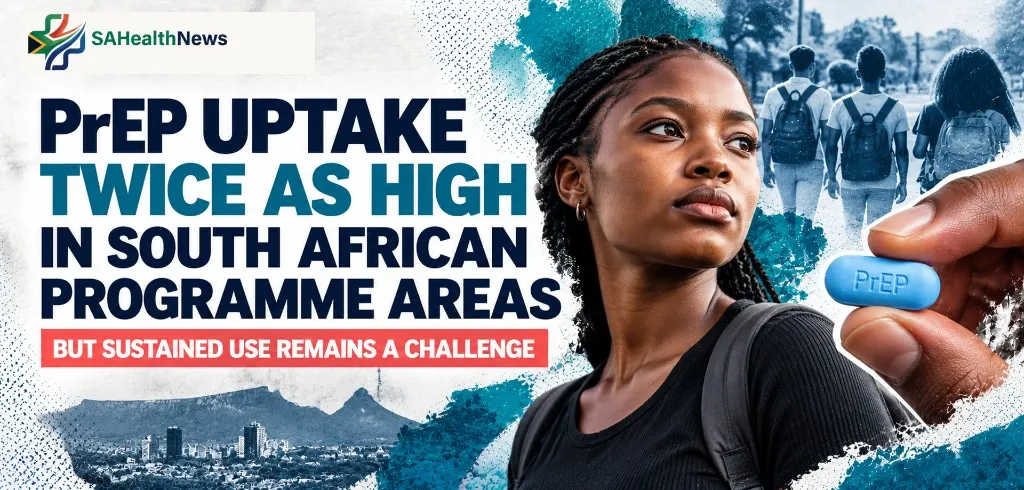
HERStory 3 found 26.4% of young women in My Journey areas had ever used PrEP vs 13.0% elsewhere — but current use among sexually active HIV-negative participants was only 7.1%.
A large South African evaluation has found substantially higher reported use of HIV-prevention medicine among young women living in communities served by the My Journey Programme. The less encouraging finding is how few were using it at the time researchers asked.
Among 5,025 adolescent girls and young women aged 15 to 24, 26.4% in programme areas said they had ever used pre-exposure prophylaxis (PrEP), compared with 13.0% in matched comparison areas. PrEP is medicine taken by people without HIV to reduce their risk of acquiring the virus.
The South African Medical Research Council (SAMRC) announced the peer-reviewed findings on 6 October 2026. The HERStory 3 survey was conducted between February and May 2024, so the results describe the programme at that time, not current national uptake in October 2026.
The study covered 24 subdistricts across eight provinces. Twelve had implemented My Journey, a combination prevention programme offering HIV testing, condoms, PrEP, prevention education and other support through schools and community services. Researchers matched them to 12 subdistricts without the programme.
The difference in reported lifetime PrEP use is substantial. It suggests that putting prevention services closer to young women may be associated with more people trying them.
But the programme's harder challenge is sustained protection.
Among sexually active participants living without HIV in programme areas, 22.2% had ever used PrEP, while 7.1% reported using it at the time of the survey. Current use in comparable communities was 6.1%.
Those percentages come from a narrower group than the headline comparison of all survey participants. They should not be treated as a direct measure of how many individual women stopped PrEP: this was a cross-sectional survey, not a study tracking each participant's medication use over time.
PrEP only protects against HIV when used as prescribed for the specific product. A person who tried an oral prevention medicine at some point but is no longer taking it may not be protected against future exposure. Decisions about starting, stopping or changing PrEP should be made with a healthcare professional.
Researchers also found that 84.7% of participants in programme areas knew their HIV status, compared with 80.5% in comparison areas.
Laboratory testing of dried blood spot samples found HIV prevalence of 9.5% in programme areas and 10.4% in comparison areas. That difference was not statistically significant.
Prevalence measures the proportion of people living with HIV at a particular time. It does not show how many new infections occurred during the programme, nor does it establish that the programme reduced transmission.
That distinction matters when evaluating HIV prevention. Higher awareness and reported PrEP uptake are useful service indicators, but the evaluation did not demonstrate a reduction in HIV prevalence, and it was not designed to measure new infections over time.
My Journey combines medical prevention with services intended to address barriers that make prevention difficult to access or maintain. These include education, life-skills support, school retention and efforts to strengthen economic opportunities.
The programme has been supported by the Global Fund to Fight AIDS, Tuberculosis and Malaria since 2016. Its services are delivered in high-HIV-burden communities through schools and community Safe Spaces, among other settings.
That broader design reflects the realities behind HIV vulnerability. Access to a clinic or medicine is only one part of the problem when young women also face financial insecurity, unequal relationships, stigma or interrupted education.
The results suggest an opportunity to improve how prevention is offered: make it easier to start, but also provide ongoing support that helps people continue with an option suited to their circumstances.
The evaluation was not randomised. Programme sites were selected before the study, and participants were surveyed at a single point after implementation.
Researchers used matched comparison areas and laboratory-confirmed HIV results, strengthening the evaluation compared with a programme report that simply counts visits. Nevertheless, differences between communities could still influence the findings.
The study identifies associations, not proof that My Journey itself caused the higher PrEP uptake. It also does not establish how many infections the programme prevented.
The findings arrive as South Africa expands HIV-prevention choices, including six-monthly injectable lenacapavir. Longer-acting options may help some people who find daily pills difficult, but availability, eligibility, follow-up and individual preference will determine whether they translate into sustained protection.
The clearest lesson from HERStory 3 is that access and continuity are different measures of success. Getting more young women through the door is meaningful; ensuring they can maintain effective prevention is the next test.
This article is health journalism, not individual medical advice.
Source: SA Health News