Breaking
Latest health news from South Africa and around the world•Wellness, nutrition, and fitness updates daily•Medical breakthroughs and healthcare updates•Science-backed health explainers and guides•Health tech, reviews, and upcoming events•
 SA Health News Desk
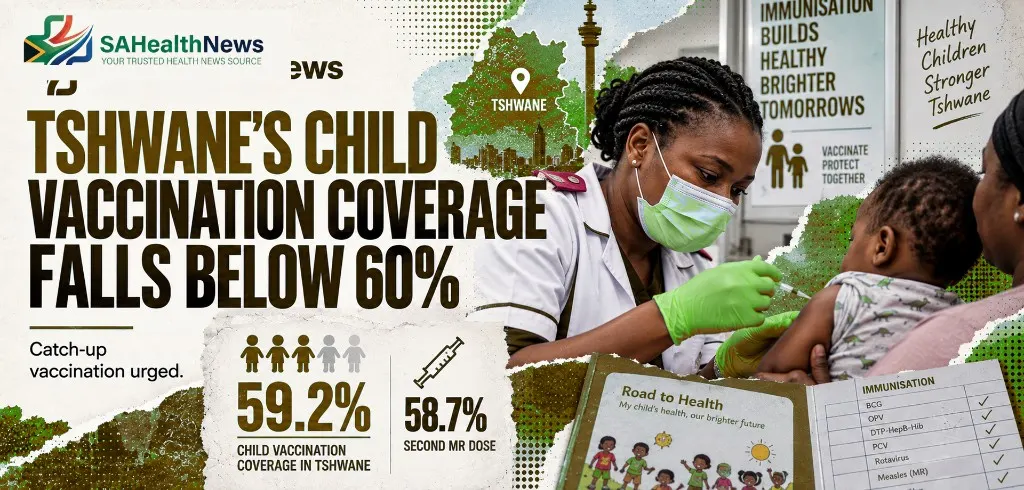
Only 59.2% of Tshwane children under one met Gauteng’s coverage measure in Q1 2026/27 — more than 30 points behind the West Rand.
Routine childhood vaccination coverage in Tshwane has fallen below 60% on two important provincial measures, leaving the district substantially behind the rest of Gauteng and increasing the number of children susceptible to preventable disease.
New figures released by the Gauteng Department of Health show that during the first quarter of the 2026/27 financial year, only 59.2% of children under one in Tshwane met the province’s immunisation coverage measure.
Coverage for the second measles-rubella dose administered at one year was even lower, at 58.7%.
Across Gauteng, the equivalent figures were 72% and 70.7%. Both provincial figures remain below target.
The gap between districts is considerable.
The West Rand recorded 90.6% coverage among children under one and 86.3% for the second measles-rubella dose. Sedibeng recorded 69.5% and 69.1% respectively.
That puts Tshwane more than 30 percentage points behind the West Rand on the under-one measure.
The numbers turn a general national concern about falling childhood immunisation into a much more specific local problem.
The latest warning followed community visits by Gauteng Health MEC Faith Mazibuko and provincial health teams.
According to the department, outreach teams encountered substantial numbers of children under five who had missed scheduled vaccinations.
That matters because vaccination programmes depend on children receiving doses at the ages specified in the national schedule.
South Africa provides routine childhood vaccines free through state clinics and community health centres. The programme protects children against diseases including measles, polio, tuberculosis, hepatitis B, diphtheria and meningitis.
Missing an appointment does not mean a child has permanently lost the opportunity to be protected.
Gauteng Health is specifically asking parents and caregivers to bring children who are behind schedule to their nearest healthcare facility for catch-up vaccination.
Vaccination protects the child receiving it, but high coverage also makes it harder for infectious diseases to find susceptible people.
When coverage falls, those gaps accumulate.
A neighbourhood can contain infants who are too young for particular vaccines, children who missed doses and people whose immune systems do not respond strongly enough to vaccination.
Highly contagious infections can exploit those clusters.
Measles is the clearest example.
South Africa has already spent considerable effort responding to measles outbreaks and closing vaccination gaps.
The newly reported 58.7% second-dose figure for Tshwane leaves a substantial immunity gap.
That does not mean a new measles outbreak is inevitable.
It means the population contains more susceptible children than health authorities want to see.
A parent may reasonably ask why a child needs another measles-containing vaccine after already receiving an earlier dose.
The second dose is not simply an unnecessary repeat.
No vaccine produces a protective immune response in every recipient after a single dose. A later dose gives children who did not respond adequately the first time another opportunity to develop protection.
High two-dose coverage is therefore considerably more useful for outbreak prevention than simply counting children who received at least one injection.
That is why Gauteng’s 70.7% provincial second-dose figure — and Tshwane’s 58.7% — deserves attention independently of overall under-one immunisation coverage.
Gauteng Health is encouraging parents to take the child’s Road to Health Booklet to healthcare appointments.
The booklet records vaccinations as well as growth, nutrition, developmental milestones and other aspects of childhood healthcare.
But the department has also made an important practical point: parents who have lost the booklet should still take the child to a healthcare facility.
Healthcare workers can help establish what catch-up vaccination is required.
A missing booklet should not become a reason for delaying care further.
The provincial outreach findings may also point to something broader.
A child missing several vaccination appointments may be missing other preventive healthcare at the same time.
Gauteng Health says children between six months and five years should attend a healthcare facility every six months for vitamin A supplementation and deworming.
Routine child-health visits also give healthcare workers opportunities to monitor growth and identify developmental, nutritional or medical problems earlier.
The vaccination statistic can therefore act as a warning about access to primary healthcare more generally.
The important next question for Gauteng is why Tshwane is performing so much worse than the West Rand.
Distance from clinics, migration, caregiver work schedules, vaccine availability, missed appointments, inaccurate records, healthcare staffing and vaccine hesitancy can all affect coverage.
The newly released figures establish the size of the gap.
They do not yet explain it.
That should be the next piece of reporting.
For parents, the immediate action is simpler.
If a child has missed a scheduled vaccine, the provincial health department says they should be taken for catch-up immunisation rather than waiting for the next routine appointment.
Source: SA Health News